

Table of Contents
- Are Bespoke Cycling Wheels Worth the Investment?
- Hand Built vs Factory Wheelsets: Where the Money Goes
- The Benefits of Custom Carbon Wheels on the Road and Gravel
- Wheelset Durability and Maintenance: What Ownership Really Looks Like
- Bespoke Builds Reviewed: Five Wheelsets and Who Each One Suits
- Cost-Benefit Analysis: What You Pay and What You Get Back
- Compatibility, Warranty and the Long-Term Cost of Ownership
- Conclusion: When Bespoke Cycling Wheels Earn Their Place
- Frequently Asked Questions
Last Updated: October 2, 2026
Are Bespoke Cycling Wheels Worth the Investment?
Bespoke cycling wheels are hand-built wheelsets assembled to a rider's specific weight, terrain and power output, rather than mass-produced on a factory line.
The honest answer is that bespoke cycling wheels are not worth it for every rider.
Below, we'll show you exactly how to judge the value for your own riding, including the questions most buyers never think to ask before spending thousands.
Hand Built vs Factory Wheelsets: Where the Money Goes
A factory wheelset is assembled by machine and checked by sample. A hand-built wheelset is laced, tensioned and trued by a person who then re-checks it over several days as the spokes settle.
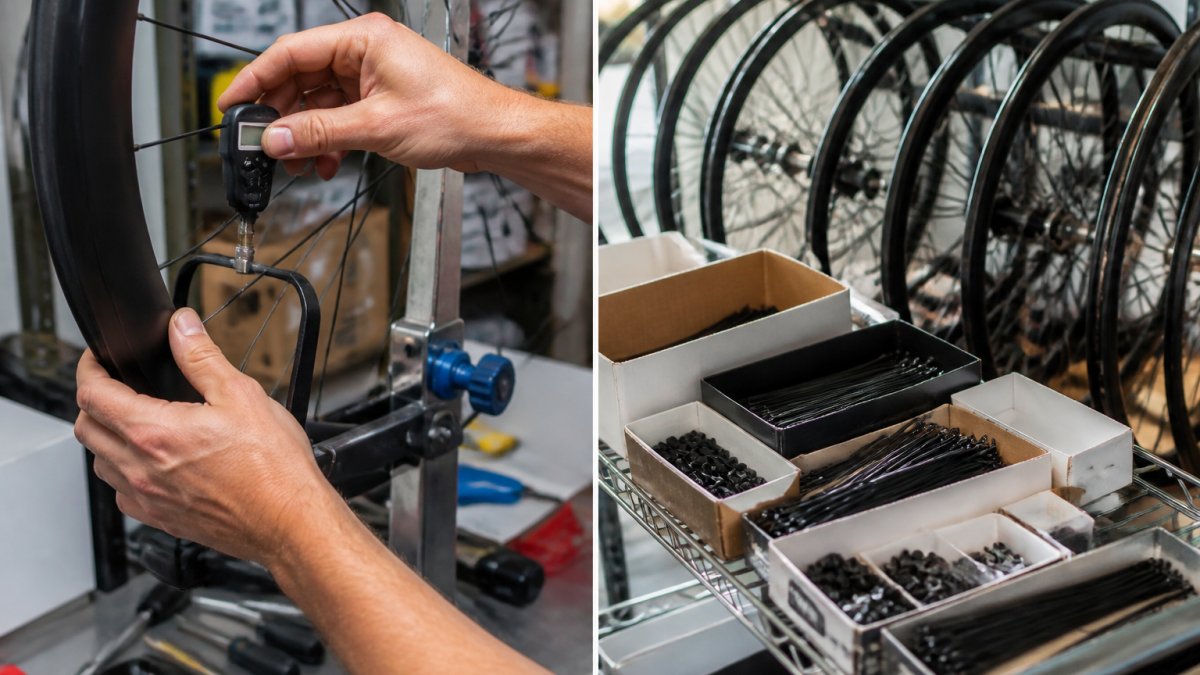
What a Hand Builder Actually Does Differently
The work is in the re-tensioning. A wheel is laced, trued and tensioned, then left. Each day it is re-tensioned and trued again until the pre-stretch has left the spokes. Factory wheels skip that cycle because it costs time.
The Benefits of Custom Carbon Wheels on the Road and Gravel
The benefits of custom carbon wheels come down to three things: aerodynamics, rotational mass and compliance. How much each one matters depends entirely on where and how you ride.
Aerodynamics, Rim Depth and Crosswind Stability
Deeper rims reduce drag, but depth alone is not the goal. Rim profile and the way pressure releases off the front wheel decide whether a deep rim feels planted or twitchy in a crosswind. A wave-shaped rim at 45/55mm depth, like the Carbon Spoked Wave 5031, is built specifically to release crosswind pressure faster than a flat-sided rim of the same depth.
Rotational Mass and Climbing Efficiency
Rotational mass matters because you accelerate the rim and tyre every pedal stroke, not just once. Stripping weight from the spokes and rim is worth more than stripping it from the frame. The TiFi Polymer Spoked Gravel 45 comes in at 1190g, and the 45 FWT Wide Carbon Spoked GWR at 1160g, both using polymer or carbon spokes to get there.

Wheelset Durability and Maintenance: What Ownership Really Looks Like
Wheelset durability and maintenance is where bespoke builds separate themselves, because the failure points are spoke fatigue and tension loss, not the rim itself. Polymer spokes resist both better than steel.
Why Spoke Material Matters
Berd spokes are made from Dyneema, an ultra high molecular weight polyethylene with an improved fatigue life over steel and no susceptibility to corrosion. TiFi spokes use 6Al-4V titanium ends with aramid fibre, giving 52% more elasticity than a steel spoke. That elasticity lets the rim move independently of the hub, which is what smooths rough gravel. In practice, this means fewer broken spokes and slower tension loss, the two things that send a wheel back to the builder.
Real Service Intervals
- Every 6 months: Check spoke tension with a tension meter and check lateral and radial trueness. On gravel, check every 3 months if you ride in the wet.
- Every 12 months: Inspect hub bearings for roughness or play. Ceramic bearings in the Wave 5031 and 45 FWT hubs typically last 15,000-25,000km, but inspection is cheap and failure mid-ride is not.
- Every 2-3 years: Full bearing service or replacement. This is the main wear item after tyres.
- As needed: Rim inspection for impact damage, especially on gravel. Carbon does not dent like alloy, but a hard hit can delaminate.
Failure Modes to Watch
Tension loss is the slow killer. A wheel that loses uniform tension will feel vague in corners before it visibly wobbles. Spoke fatigue shows as repeated breakages at the elbow or nipple, a sign the wheel was not stress-relieved properly. Rim wear on rim-brake wheels shows as a concave brake track; on disc wheels, it is impact damage that matters.
Maintenance Is Simpler Than Most Riders Expect
Check spoke tension and trueness twice a year, more often if you ride gravel in the wet. Bearings are the other wear item, and ceramic bearings in the Wave 5031 and 45 FWT hubs hold up well with occasional inspection. The payoff is that a hand-built wheel usually needs less intervention over its life, not more, which is the quiet part of the durability story.

Bespoke Builds Reviewed: Five Wheelsets and Who Each One Suits
Five builds cover the realistic spread of road, gravel and mixed use.
| Wheelset | Weight | Price | Best For |
|---|---|---|---|
| Berd Spoked Asymmetric 46 Gravel | 1290g | $2,950 | Rough gravel, heavy riders |
| TiFi Polymer Spoked Gravel 45 | 1190g | $2,990 | Fast gravel, comfort priority |
| TiFi Polymer Spoked Gravel Max | 1190g | $3,290 | Aero gravel racing |
| Carbon Spoked Wave 5031 | 1420g | $2,600 | Road racing, power transfer |
| 45 FWT Wide Carbon Spoked GWR | 1160g | $2,600 | Wide tyre road and gravel |
Berd Spoked Asymmetric 46 Gravel. The asymmetric rim profile is the point here.

TiFi Polymer Spoked Gravel Max. A 54mm deep, 44mm wide front rim paired with a 50mm deep, 37mm wide rear.
Carbon Spoked Wave 5031. The fastest road option.
Berd Spoked Asymmetric 46 Gravel Wheelset 1260g →
45 FWT Wide Carbon Spoked GWR. A filament-wound rim at 45mm deep and 36.5mm wide, designed for 34mm+ tyres.
Cost-Benefit Analysis: What You Pay and What You Get Back
Bespoke wheels cost more than factory wheels because you are paying for labour, not just materials. The question is whether that labour buys you something you can feel, and whether the total cost of ownership over five years favours the hand-built option.
The Purchase Price Is Only the Entry Fee
A hand-built wheel arrives properly stress-relieved and tensioned, so that first service is usually a check, not a rebuild. The bespoke wheel typically needs bearing service only, and often less frequently because the hub is loaded more evenly.
What You Get Back
What you get back falls into three categories. First, speed: less rotational mass and lower drag mean easier acceleration and less effort to hold speed. Second, comfort: polymer spokes and wider rims let you run lower pressures without pinch flats. Third, longevity: a properly tensioned wheel with fatigue-resistant spokes holds its trueness far longer than a machine-built one.
The Long-Term Cost of Ownership
The realistic view includes:
- Bearing replacement: Ceramic bearings in the Wave 5031 and 45 FWT hubs typically last 15,000-25,000km with occasional inspection. Steel bearings in cheaper factory hubs often need replacement at 8,000-12,000km.
- Rim wear: Carbon rims do not wear like alloy, but brake track wear on rim-brake wheels and impact damage on gravel are real. Crash replacement programs, like the 3-year manufacturing warranty and reduced-price crash replacement on the Wave 5031 and 45 FWT, materially change the five-year cost.
- Spoke fatigue: Polymer spokes resist fatigue better than steel, so fewer spoke replacements over the wheel's life. A single steel spoke replacement is cheap; a full re-lace is not.
What You Do Not Get
What you do not get is a free lunch. A 1420g aero wheelset like the Wave 5031 is not the lightest option here, because stiffness and crosswind stability cost weight. Riders chasing pure climbing numbers should look at the 1160g 45 FWT instead.
Compatibility, Warranty and the Long-Term Cost of Ownership
Compatibility is the question most buyers forget until the wheels arrive.
Thru-axle spacing and disc brake rotor mounting are the two that catch people out.
Long-term cost of ownership is where bespoke builds quietly win.
Warranty matters here. The Wave 5031 and 45 FWT both carry a 3-year warranty on manufacturing defects, with crash replacement at a reduced price.
Conclusion: When Bespoke Cycling Wheels Earn Their Place
The riders who get the most from bespoke cycling wheels are the ones whose factory wheels have already let them down, whether through flex, tension loss or a cracked rim.
STOXbyHand has spent over 12 years building hand-built carbon wheelsets for road, gravel and mountain bikes, with spoke options including carbon fibre, Berd and TiFi polymer. Every wheel is built to order and matched to your weight, terrain and riding style.
Frequently Asked Questions
What are the primary performance benefits of hand-built wheels?
Hand-built wheels are laced, trued and tensioned by a person, then re-tensioned over several days until the spokes stop stretching. That process produces even spoke tensions and runout held to 0.1mm, which matters most on rear disc wheels where drive-side and non-drive-side tensions can differ by up to 40% on a symmetric rim. The result is a wheel that holds its shape, transfers power without lateral flex and needs less truing over its life than a factory-tensioned equivalent.
How do bespoke carbon wheelsets differ from mass-produced alternatives?
The difference is in specification and assembly, not just the rim. A bespoke build lets you choose spoke type, hub, rim depth and internal width to suit your weight, terrain and tyre choice. STOXbyHand builds each wheelset to order, with options including Berd polymer, TiFi polymer and carbon spokes, and finishes every wheel to 0.1mm trueness. Factory wheelsets are built to a single average spec and a production tolerance, so you get what is on the shelf.
How much does it cost to have custom wheels made?
In the STOXbyHand range, hand-built carbon wheelsets start at $2,600 for the Carbon Spoked Wave 5031 and the 45 FWT Wide Carbon Spoked GWR, rise to $2,950 for the Berd Spoked Asymmetric 46 Gravel Wheelset, $2,990 for the TiFi Polymer Spoked Gravel 45, and top out at $3,290 for the TiFi Polymer Spoked Gravel Max. Each is a one-time purchase built to your specification, with a three-year warranty on manufacturing defects and crash replacement at 50% to 60% of RRP.
Does spoke choice significantly impact ride quality and durability?
It changes both. TiFi spokes have 52% more elasticity than steel and 110% more than carbon, and in back-to-back on-bike accelerometer testing they cut vibration by around 15% versus steel and around 29% versus carbon. Berd spokes use Dyneema, which has 15 times the strength-to-weight ratio of steel and better fatigue life. Both let you run a wider, lower-pressure tyre, or size down to a 40mm tyre while keeping the comfort of a 45.
Are bespoke wheels more cost-effective over the long term?
They can be, because the money goes into a wheel you can service rather than replace. Hand-built wheels hold tension longer, so you spend less on truing, and hubs and spokes can be replaced individually instead of scrapping a whole wheelset. Add a three-year warranty on manufacturing defects and crash replacement at 50% to 60% of RRP, and the cost per year of riding drops the longer you keep them.