

Table of Contents
- Carbon vs Alloy Wheels for Gravel: Key Differences
- Impact Resistance and Durability
- Ride Quality and Vibration Damping
- Stiffness and Power Transfer
- Best Gravel Wheelsets for Racing
- Carbon Fibre Wheelset Durability and Maintenance
- Cost-to-Performance Value and Resale
- Which Material Should You Choose?
- Frequently Asked Questions
Last Updated: September 2, 2026
Carbon vs Alloy Wheels for Gravel: Key Differences
The choice between carbon and alloy wheels for gravel riding shapes how your bike handles rough terrain, how much energy you expend, and whether you're working with your equipment or against it. Carbon offers aerodynamic efficiency and rotational mass advantages; alloy delivers durability and repairability that favour endurance riders tackling heavy loads on remote terrain.
At STOXbyHand, we've built hand-crafted wheelsets in both materials for over 12 years. The decision comes down to your riding discipline, budget, and tolerance for risk.
Material composition and manufacturing
Carbon fibre wheels are constructed from resin-infused carbon fabric wound around a mould. The layup process, how many plies, in which directions, at what angles, determines lateral stiffness, vertical compliance, and fatigue life. High-modulus carbon (like Toray T700 or T800) offers superior strength-to-weight ratios but costs significantly more. EPS internal moulding applies higher pressure during cure, reducing defects compared to pressure-bag moulding.
Alloy wheels are forged or cast from aluminium alloy (typically 6061 or 7075), then machined to shape. The process is faster and cheaper than carbon layup, with more predictable material properties. Alloy won't delaminate but will dent under impact and eventually crack if spoke tension isn't maintained.
Weight and rotational mass
Carbon wheels are typically 200-400 grams per set lighter than comparable alloy builds, reducing energy needed to spin up wheels on each pedal stroke. However, this advantage matters most on climbs and during initial acceleration. Beyond that, aerodynamic profile and rolling resistance dominate.
Impact Resistance and Durability
Gravel riding demands wheels that absorb punishment without failing. Carbon and alloy fail in opposite ways.
Carbon delamination and rim deformation
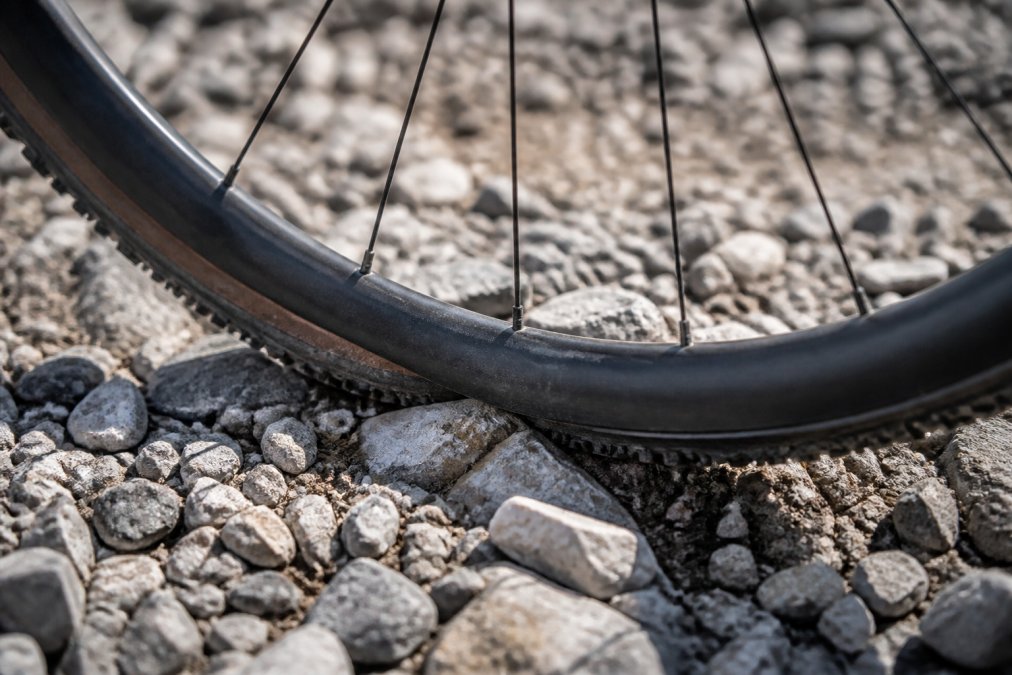
Carbon wheels can crack and delaminate when subjected to sudden impact loads. A hard sidewall strike can initiate a crack that spreads through the layup, sometimes progressing internally for weeks before sudden failure. However, carbon rims resist denting. The trade-off is that damage isn't always visible. Most manufacturers offer crash replacement at 40-50% of retail price.
Alloy dent resistance and structural integrity
Alloy rims dent easily, reducing lateral stiffness locally and creating spoke tension imbalances. But dents are repairable and visible, so you know what you're dealing with. Alloy doesn't delaminate, so impact damage is isolated to the strike zone.
Long-term fatigue life comparison
Carbon wheels can last indefinitely if never crashed. The material doesn't fatigue like metal. Alloy rims experience material fatigue from spoke tension cycles. A well-maintained alloy wheel lasts 5-10 years; a poorly maintained one might fail in 2-3 years.
Ride Quality and Vibration Damping
How a wheel absorbs trail chatter directly affects fatigue on long rides.
Vertical compliance and trail chatter
Carbon wheels offer vertical compliance, the rim flexes slightly under load, absorbing bumps. A well-designed carbon rim provides 15-25% more vertical give than a stiff alloy rim, reducing trail chatter (peer-reviewed research). Alloy rims are stiffer and transmit vibration more directly to the frame.
Advanced spoke materials amplify this difference. TiFi polymer spokes (titanium and aramid fibre composite) offer 52% more elasticity than steel and reduce vibrations by 29% compared to carbon spokes (peer-reviewed research). Berd polymer spokes damp vibrations 200% more effectively than steel spokes.

Advanced spoke materials and comfort
Spoke material matters more than most riders realise. Steel spokes transmit vibration directly. Polymer spokes flex more, allowing the rim to move independently of the hub, reducing vibration that reaches your hands.
The STOXbyHand TiFi Polymer Spoked Gravel 45 uses 2.2-gram spokes made from titanium and aramid fibres. The aramid component provides elasticity like a shock absorber, whilst the titanium ferrule handles spoke tension. For bikepacking and endurance events, this matters, wheels with better vibration damping keep you fresher over 50+ kilometres.
Stiffness and Power Transfer
Lateral stiffness determines how efficiently you convert leg power into forward motion.
Lateral stiffness and acceleration
Carbon wheels are stiffer than alloy wheels of equivalent weight because carbon's strength-to-weight ratio is superior. Asymmetric rim profiles improve lateral stiffness further by balancing spoke tension between drive and non-drive sides. Traditional symmetric rims create 30-40% higher spoke tension on the drive side, reducing stiffness on the non-drive side. An asymmetric profile evens tension distribution, resulting in more uniform stiffness.
For gravel racing, this matters during acceleration, cornering, and sprinting.
Spoke tension and hub engagement
Hub engagement affects acceleration responsiveness. A 54-tooth ratchet engages every 6.7 degrees versus a 36-tooth at every 10 degrees (peer-reviewed research). Spoke tension uniformity is equally important. Hand-built wheels trued to 0.1-millimetre accuracy maintain uniform tension, ensuring consistent power transfer throughout the pedal stroke.
Best Gravel Wheelsets for Racing
Racing demands lightweight, aerodynamic wheels that accelerate quickly and maintain speed. Carbon dominates this category.
Carbon wheelsets for competitive events
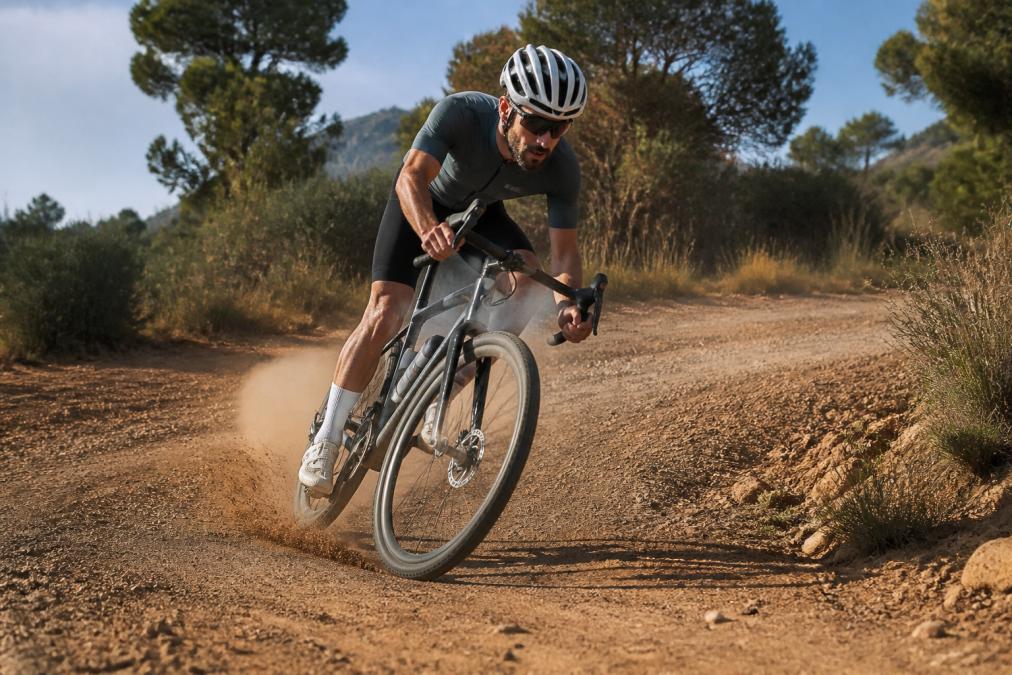
Carbon wheelsets excel in gravel racing because they're light, stiff, and aerodynamic. The STOXbyHand TiFi Polymer Spoked Gravel Max (https://stoxbyhand.com/products/tifi-polymer-spoked-gravel-max) combines a 54-millimetre deep front rim with a 50-millimetre rear rim, resulting in a wheelset that's fast on flats and climbs well. At 1,190 grams, it's light enough to feel responsive, and the TiFi spokes provide 29% better vibration damping than carbon spokes.


For UCI-compliant racing, carbon wheels are standard. The 80-millimetre rim depth limit and weight floor are set with carbon in mind.
Alloy wheelsets for endurance and reliability
Alloy wheelsets suit gravel events where durability matters more than absolute speed. The STOXbyHand Core Gravel 35 Wheelset (https://stoxbyhand.com/products/core-gravel-35-wheelset-650b-or-700c) uses a 35-millimetre deep carbon rim with alloy spokes and straight-pull Core hubs. At 1,440 grams, it's heavier than carbon alternatives but significantly cheaper. For multi-day bikepacking or remote events where catastrophic failure is unaffordable, alloy provides peace of mind.
Carbon Fibre Wheelset Durability and Maintenance
Carbon wheels demand different care than alloy.
Warranty coverage and crash replacement
Most carbon wheelset manufacturers, including STOXbyHand, offer 3-year warranties on manufacturing defects and crash replacement at 40-50% of retail price. A delaminated carbon rim cannot be reliably repaired. STOXbyHand's policy covers manufacturing defects for 3 years and offers 50% off retail for crash replacement on the SL 5031 model.
Maintenance requirements and care
Carbon wheels need protection from UV damage. Sunlight degrades the resin matrix over years. Store wheels indoors or cover them when not in use.
Spoke tension requires monitoring. Have your wheels checked and re-tensioned after the first 50 kilometres of riding, then annually. Avoid extreme temperature swings, which create stress at the carbon-resin interface.
Cost-to-Performance Value and Resale
Budget determines which material makes sense. Carbon is an investment; alloy is a purchase.
Price comparison and long-term investment
Carbon wheelsets range from $1,990 to $3,290+ for hand-built options. The STOXbyHand SL 5031 (https://stoxbyhand.com/products/sl-5031-1428-grams) at $1,990 offers a 50-millimetre deep, 31-millimetre wide rim with high-modulus carbon. The TiFi Polymer Spoked Gravel 45 (https://stoxbyhand.com/products/tifi-polymer-spoked-gravel-45) costs $2,990, adding advanced TiFi spokes for superior vibration damping. The Berd Spoked Asymmetric 46 (https://stoxbyhand.com/products/berd-berd-spokes-asymmetric-gravel-wheelset-1260g) at $2,950 uses Berd polymer spokes for extreme lightness.
Alloy wheelsets cost less upfront. The STOXbyHand Core Gravel 35 typically starts under $1,500 for comparable quality. The long-term cost calculation favours carbon if you keep wheels for 5+ years without crashing. A $2,500 carbon wheelset used for 10 years costs $250 per year. An $800 alloy wheelset lasting 5 years costs $160 per year, but replacing it twice in a decade approaches $1,600 total.
Resale value and market depreciation
Carbon wheels retain value better than alloy. A used carbon wheelset in good condition sells for 50-70% of retail. Alloy wheels depreciate faster, typically 30-50% of retail. Hand-built wheels from STOXbyHand hold value better than generic wheels. A damaged carbon wheel has near-zero resale value; a slightly dented alloy wheel still sells for 30-40% of retail.
| Wheelset Type | Entry Price | Typical Lifespan | Resale Value | Best For |
|---|---|---|---|---|
| Carbon (high-modulus) | $1,990-$3,290 | 5-10 years (crash-free) | 50-70% | Racing, climbing, speed |
| Alloy (round spokes) | $800-$1,500 | 5-7 years | 30-50% | Endurance, bikepacking, durability |
| Carbon (standard modulus) | $1,200-$1,800 | 4-8 years | 40-60% | Budget-conscious racers |
| Alloy (bladed spokes) | $1,200-$1,800 | 4-6 years | 25-40% | Budget gravel riders |
Which Material Should You Choose?
The decision hinges on three factors: your discipline, your budget, and your risk tolerance.
Racing and lightweight climbing
Choose carbon if you're racing gravel events, targeting podium finishes, or chasing personal records on climbs. Carbon's weight advantage translates to real performance gains when every kilogram matters. A 50+ millimetre deep rim adds 1-2 kilometres per hour on flats without extra effort.
The STOXbyHand TiFi Polymer Spoked Gravel Max at $3,290 is engineered for this purpose. The 54-millimetre front rim generates significant aero benefit, TiFi spokes reduce vibration fatigue, and the 1,190-gram weight keeps you responsive on climbs.
Bikepacking and heavy loads
Choose alloy if you're carrying 15+ kilograms of gear, riding remote terrain where mechanical support is hours away, or planning multi-day self-supported events. Alloy's dent resistance and repairability matter more than speed when you're far from help.
The STOXbyHand Core Gravel 35 prioritises durability. The 35-millimetre rim depth is conservative (less aero but more impact-resistant), and straight-pull hubs are strong. The 1,440-gram wheelset won't win races but will survive washboard roads and rocky descents without delaminating.
Budget-conscious riders
Alloy makes sense if you're starting out, upgrading from cheap stock wheels, or testing gravel before committing serious money. A $1,200 alloy wheelset is a meaningful upgrade from a $300 wheel without requiring a $2,500 investment.
Many experienced riders choose alloy deliberately for specific use cases. The question isn't "which is better", it's "which fits my riding style, terrain, and budget?"
Choosing between carbon and alloy wheels for gravel riding requires understanding what you're optimising for. Carbon offers speed, weight savings, and long-term durability if never crashed. Alloy provides repairability, predictable failure modes, and lower entry cost. The best wheelset matches your discipline, terrain, and budget.
STOXbyHand has spent 12 years hand-building both carbon and alloy wheelsets for gravel riders. Whether you're chasing race results or exploring remote backcountry, we can build a custom wheelset with advanced spoke options like Berd or TiFi polymer to match your specific riding style. Get started with STOXbyHand's custom wheel builder and choose a wheelset engineered for your terrain.
Frequently Asked Questions
Are carbon wheels worth it for gravel?
Carbon wheels offer significant weight savings and aerodynamic benefits for gravel racing, typically 200-300 grams lighter than alloy equivalents. However, they cost more and require careful handling to avoid delamination on extremely rough terrain. For competitive gravel events or climbs, the performance gain justifies the investment. For casual riding or heavy bikepacking loads, alloy wheels provide better durability at lower cost. Consider your riding intensity and terrain before committing to carbon.
What are the best gravel wheelsets for racing?
The best gravel wheelsets for racing combine low rotational mass with lateral stiffness for acceleration and power transfer. Carbon wheelsets with advanced spoke materials like TiFi polymer or Berd deliver superior vibration damping and comfort during 50+ mile events. STOXbyHand's TiFi Polymer Spoked Gravel Max ($3,290) features 54mm front and 50mm rear depth for aerodynamic efficiency, while the Berd Spoked Asymmetric 46 ($2,950) balances spoke tension for consistent performance. Both are hand-built to 0.1mm trueness for reliable handling in competitive conditions.
Is carbon or aluminium better for a gravel bike?
Carbon excels at weight and aerodynamic efficiency, making it superior for racing and climbing. Aluminium offers better impact resistance and dent recovery, making it more forgiving on rough terrain and heavy loads. Carbon wheels can delaminate under extreme impacts; alloy wheels dent but remain structurally sound. For gravel racing on moderate terrain, carbon wins. For bikepacking, endurance touring, or aggressive rocky riding, alloy provides peace of mind and lower replacement costs. Choose based on your primary use case.
How do carbon and alloy wheels differ in vibration damping?
Advanced spoke materials significantly impact vibration damping more than rim material alone. TiFi polymer spokes reduce vibrations by 15% compared to steel and 29% versus carbon spokes, allowing the rim to deform independently of the hub for a smoother ride. Carbon rims with traditional spokes transmit more trail chatter. Alloy rims with modern spoke technology (Berd or TiFi) can match or exceed carbon performance in comfort. The trend toward wider tyres and lower pressures means vibration damping now matters more than material stiffness for gravel performance.
What is the environmental impact of carbon versus alloy wheel manufacturing?
Carbon fibre production is energy-intensive and generates composite waste that is difficult to recycle. Alloy wheels use recycled aluminium and are fully recyclable at end of life. However, carbon wheels last longer under race conditions, reducing replacement frequency. Advanced polymer spokes like Berd (made from Dyneema) offer a lighter, more durable alternative that reduces overall environmental footprint by cutting rotational mass and extending wheel life. Consider total lifecycle impact rather than manufacturing alone when evaluating environmental cost.