

Table of Contents
- Quick Comparison: Custom Gravel Wheelsets for Racing
- What Makes a Custom Gravel Wheelset for Racing Worth It
- The Benefits of Carbon Spokes for Gravel Racing
- Gravel Racing Wheelset Weight Guide: What Actually Matters
- Best Rim Depth for Gravel Racing by Terrain and Race Distance
- Hub Engagement, Spoke Count and the Compatibility Matrix
- Maintenance, Tire Pressure and What to Ignore
- Conclusion
- Frequently Asked Questions
Last Updated: September 17, 2026
Quick Comparison: Custom Gravel Wheelsets for Racing
A custom gravel wheelset for racing is a hand-built carbon wheel set configured around your weight, terrain and race distance rather than pulled off a shelf. At STOXbyHand, every wheel is laced and tensioned by hand, and the range below spans 1160g to 1440g with carbon, Berd and TiFi polymer spoke options.
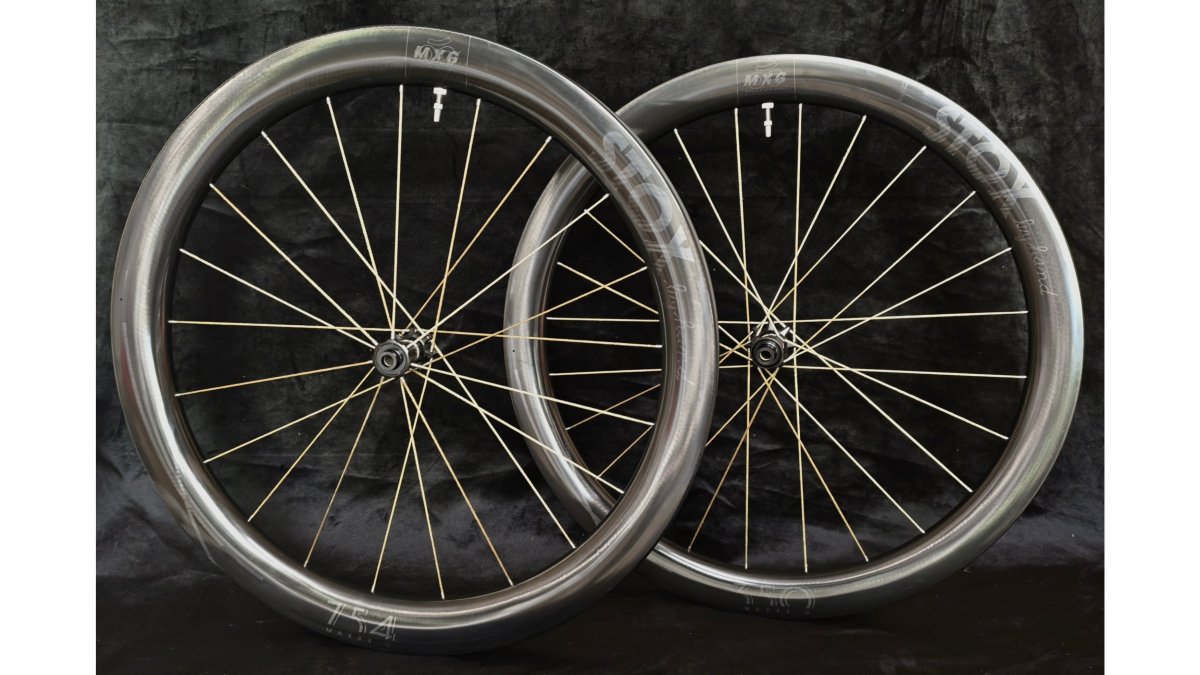
Here is how the current range lines up.

| Wheelset | Weight | Rim Depth | Spokes | Price | Best For |
|---|---|---|---|---|---|
| 45 FWT Wide Carbon Spoked GWR | 1160g | 45mm | Carbon | $2,600 | Wide tyre aero racing |
| TiFi Polymer Spoked Gravel 45 | 1190g | 45mm | TiFi polymer | $2,990 | Rough terrain comfort |
| Berd Spoked Asymmetric 46 | 1290g | 46mm | Berd polymer | $2,950 | Balanced spoke tension |
| TiFi Polymer Spoked Gravel Max | 1190g | 54/50mm | TiFi polymer | $3,290 | Fast, aero gravel racing |
| Wave CS 4565 | 1420g | 45/55mm | Carbon | $2,200 | Crosswind stability |
What Makes a Custom Gravel Wheelset for Racing Worth It
Off-the-shelf wheels are built to a price and a compromise. A custom gravel wheelset for racing is built to a rider.

The Benefits of Carbon Spokes for Gravel Racing
Carbon spokes change two things at once: weight and lateral stiffness. But the spoke is only half the story, the rim it laces into decides whether that stiffness becomes speed or fatigue.
Why carbon spokes accelerate faster
A carbon spoke wheel accelerates faster because rotational mass drops at the rim edge, where it costs the most energy to spin up. Carbon spokes also resist stretch better than steel, so spoke tension holds steadier over a season of racing. The trade-off is compliance. Carbon is stiff, and on washboard gravel that stiffness transmits straight to your hands. That is why the range also offers Berd and TiFi polymer options.
Carbon vs alloy rims: the decision that outranks the spoke
Most racers obsess over spokes and ignore the rim, yet the rim is where the majority of a wheelset's rotational mass sits. The two materials behave very differently under gravel racing loads.
For racing, the practical split is this:
- Carbon rim + carbon spoke: lightest and stiffest combination, best for climbing-heavy courses and lighter riders who can exploit the stiffness without being beaten up by it.
- Carbon rim + polymer spoke (Berd or TiFi): keeps the rim weight advantage while restoring vertical compliance, which is the combination most gravel racers land on for long, rough events.
- Alloy rim + steel spoke: the budget and durability option, best treated as a training or backup wheelset rather than a race-day choice.
Hooked vs hookless, briefly
Hookless rims are simpler to mould, slightly lighter, and pair with tubeless tyres designed for them. Hooked rims retain a wider range of tyre compatibility and give a more secure bead seat at very low pressures. If you race at low pressure on rough gravel, confirm your chosen tyre is approved for the rim type before ordering, this is a compatibility question, not a performance one.
Gravel Racing Wheelset Weight Guide: What Actually Matters
Weight matters less than rotational mass. A 200g saving at the hub is nearly worthless; the same saving at the rim edge is worth real time on a climb.
A practical guide:
- Under 1200g: climbing-focused, best for lighter riders
- 1200-1350g: all-round racing, the sweet spot for most
- 1350-1450g: aero and stiffness priority, best for strong riders
Best Rim Depth for Gravel Racing by Terrain and Race Distance
Rim depth is a terrain decision, not a fashion one.
45 FWT Wide Carbon Spoked GWR (1160 →
Hub Engagement, Spoke Count and the Compatibility Matrix
Hub engagement decides how quickly power reaches the ground. A 36-tooth star ratchet gives fast uptake without the drag and wear of an ultra-fine mechanism. Fewer teeth means a larger engagement arc but less friction and longer service life; more teeth means faster pickup but more drag and more frequent servicing. On gravel, where you are rarely sprinting from a standstill, a mid-range ratchet is usually the better trade than a maximum-tooth design.
The compatibility matrix most buyers get wrong
Compatibility is where most buyers trip up, and it is the part generic wheelset pages skip. Work through this before you order anything.
| Specification | What to confirm | Common gravel values |
|---|---|---|
| Front axle | Diameter and length | 12x100mm thru-axle (some 15x100mm) |
| Rear axle | Diameter and length | 12x142mm thru-axle |
| Brake mount | Disc interface | Flat mount or post mount (frame/fork dependent) |
| Rotor fitting | Rotor-to-hub interface | Center lock or six-bolt |
| Freehub body | Drivetrain match | HG, XDR, or Micro Spline |
| Tyre clearance | Frame and fork limit | Check stated max tyre width |
| Rim type | Bead interface | Hookless or hooked |
| Tyre standard | Tubeless or tube-type | Confirm tubeless compatibility |
Freehub body: the one that stops the build
The freehub body is the single most common ordering error. Match it to your groupset family, not to the wheel:
- HG (Hyperglide): the long-standing Shimano/SRAM road and gravel standard, widely available and easy to source.
- XDR: SRAM's road and gravel freehub, required for 12-speed SRAM road/gravel cassettes and for cassettes with a 10-tooth smallest cog.
- Micro Spline: Shimano's 12-speed MTB and gravel standard, needed for Shimano 12-speed cassettes.
Rotor and axle gotchas
Center lock and six-bolt rotors are not interchangeable without an adapter, and adapters add a small weight and a small stack-height change. Pick the rotor interface your existing rotors use, or commit to new rotors at the same time.
Maintenance, Tire Pressure and What to Ignore
Tyre pressure is the single biggest free speed gain on gravel, and it is the one thing most riders never test properly. Lower pressure increases grip and reduces rolling resistance on rough surfaces, up to the point where the tyre squirms or bottoms out on the rim.
Conclusion
Choosing a custom gravel wheelset for racing comes down to matching weight, rim depth and spoke type to your body and your race course, not chasing the lightest number on a spec sheet. STOXbyHand builds each wheel by hand to 0.1mm trueness, with carbon, Berd and TiFi polymer spoke options and a 3-year warranty on manufacturing defects. If you want a wheelset configured for how you actually ride, talk to STOXbyHand and get a build matched to your weight, terrain and race distance.
Frequently Asked Questions
Does spoke material like Berd or carbon fibre improve gravel racing performance?
It changes how the wheel behaves more than it changes raw speed. Carbon spokes raise lateral stiffness, so power transfer feels sharper out of corners. Berd polymer spokes, made from Dyneema, cut rotational mass by roughly 150-200 grams and damp vibration better than metal. TiFi polymer spokes reduce measured vibration by about 15% versus steel and 29% versus carbon. Pick carbon for punchy efforts, polymer for long rough days.
How do I choose the right rim depth for gravel racing?
Match depth to terrain and race length. Riders on flatter, faster courses benefit from a deeper front rim, such as the 54mm front on the TiFi Polymer Spoked Gravel Max, because it holds speed with less effort. Hilly or technical courses suit something around 45mm, like the 45 FWT Wide Carbon Spoked GWR. Windy exposed sections favour wave-profile rims that release crosswind pressure instead of catching it.
How does wheel weight affect gravel racing speed?
Weight matters most when you accelerate, not when you hold a steady pace. A wheelset dropping from 1,420 grams to 1,160 grams saves 260 grams of rotational mass, which helps on repeated climbs and out-of-saddle surges. On flat, steady courses the gain is smaller. Extremely light wheels can also lose momentum on descents, so the goal is balance rather than the lowest possible number.
Are carbon fibre gravel wheels durable enough for rough terrain?
Construction decides durability more than the material. The wheelsets listed here are hand-built to 0.1mm trueness with uniform spoke tensions, which reduces the fatigue that causes cracks and going out of true. The 45 FWT carries a 110kg rider limit and a 3-year warranty on manufacturing defects, with crash replacement at a reduced price. Wider internal widths also improve impact resistance by supporting a larger tyre volume.
What is the advantage of a custom wheel build for endurance gravel events?
A custom build matches the wheel to your weight, power and race type instead of forcing you into a stock spec. Heavier riders pushing strong power can step up to a 21/24 spoke count for extra lateral stiffness, while lighter riders can run a 20/20 build for less weight. You also choose spoke material, rim depth and hub engagement, so the wheelset suits the terrain you actually race on.