

Table of Contents
- Why Go Custom? The Real Difference from Factory Wheelsets
- Hand Built vs Factory Wheelsets: What Changes on the Trail
- Choosing the Right Spoke Count for MTB Riding Styles
- Rim Profile and Width: Matching Tyres to Terrain
- The Benefits of Carbon Fibre Spokes for Mountain Biking
- Hub Engagement and Brake Interface Standards
- Our Recommendation: MTB XC / AM 29er 30/36 Asymetrical
- Conclusion
- Frequently Asked Questions
Last Updated: September 9, 2026
Why Go Custom? The Real Difference from Factory Wheelsets
The best custom mountain bike wheel options are built around your specific weight, riding style, and terrain, rather than engineered to a price point for mass production. Factory wheelsets compromise on spoke tension, rim profile, and hub quality. When you choose custom, every component is selected to work as a cohesive system.
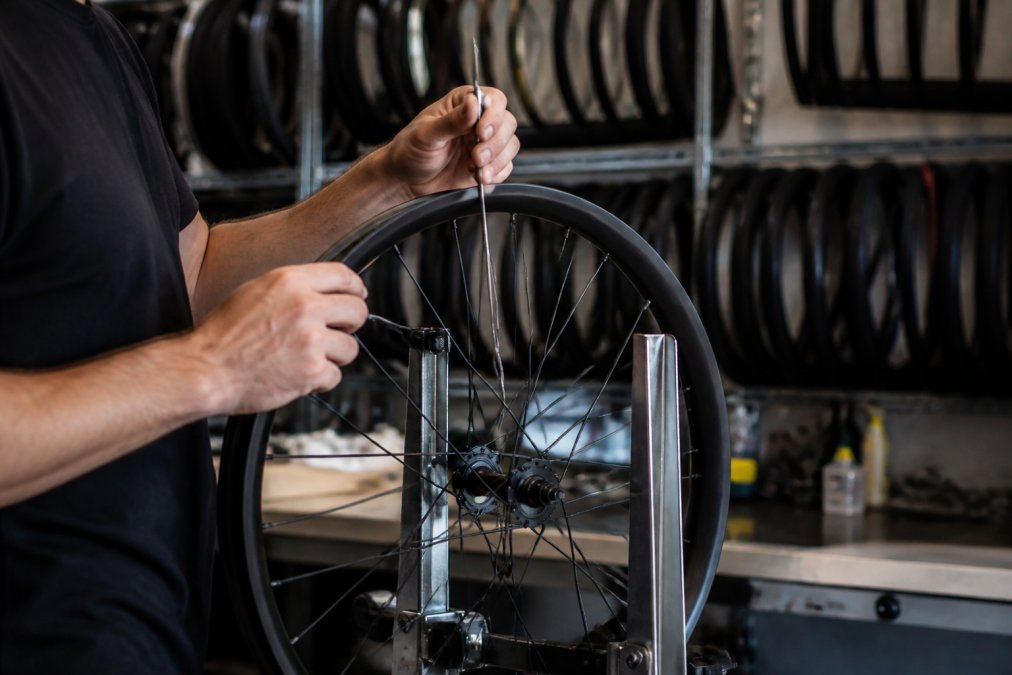
At STOXbyHand, we have spent over 12 years hand-building wheels. Each wheel is tensioned and trued by hand to a tolerance that machine assembly cannot replicate. This precision translates directly to durability, because uniform spoke tension distributes impact forces evenly across the rim.
Hit a square-edged rock at speed: a factory wheel with uneven tension often buckles or cracks at the point of lowest tension, while a hand-built wheel with balanced tension flexes and recovers.
Hand Built vs Factory Wheelsets: What Changes on the Trail
The hand built vs factory wheelsets debate comes down to consistency. Factory machines apply the same torque to every spoke regardless of the rim's shape. A skilled builder compensates for these irregularities, adjusting tension spoke by spoke to create a wheel that holds true season after season.
On the trail, this means a wheel that stays true after hard landings. A heavier spoke count alone does not provide durability; a properly tensioned 28-spoke hand-built wheel outperforms a loosely tensioned 32-spoke factory wheel.
Serviceability also matters. When a factory wheel fails, you often face a full replacement. With a hand-built wheel, a broken spoke is a simple repair any competent shop can handle, because the components are standard and accessible.
Choosing the Right Spoke Count for MTB Riding Styles
Spoke count is the most misunderstood specification in mountain biking. More spokes does not always mean a stronger wheel; the count must match your riding style, weight, and forces. Cross-country riders may run 28 spokes, while enduro and gravity riders typically need 32.
The relationship between spoke count and durability is not linear. Too few spokes for your weight causes flex and fatigue; an unnecessarily high count adds rotating mass without strength gains. Match the wheel's structural capacity to the forces you produce.
Rider Weight and Impact Force Analysis
Rider weight is the single most important factor in spoke selection, because impact forces scale with mass. Heavier riders generate significantly more force through the wheel. This is why the best custom mountain bike wheel options for heavier riders use higher spoke counts and reinforced rims.
A rider weighing 85 kg or more who rides aggressively should consider a 32-spoke rear wheel with a reinforced rim profile. A lighter rider, under 75 kg, can run 28 spokes and save weight without sacrificing reliability.
The Engineering Logic Behind Spoke Count
When a wheel hits an obstacle, the rim compresses locally and the opposite spokes go slack. The fewer spokes you have, the more load each must carry during that slack phase. This is why a 28-spoke wheel requires a stiffer rim profile than a 32-spoke wheel.
Wheel builders use the "spoke load index": divide total system weight (rider plus bike plus gear) by the number of rear spokes, aiming for under 4.5 kg per spoke. A 90 kg rider on a 14 kg bike with 3 kg of gear totals 107 kg, 3.34 kg per spoke on a 32-spoke wheel, a safe margin, versus 3.82 kg on a 28-spoke wheel.
Spoke Count by Riding Discipline
| Discipline | Typical Rider Weight | Recommended Spoke Count (Rear) | Rationale |
|---|---|---|---|
| Cross-country / Marathon | Under 75 kg | 28 | Weight saving matters more than absolute strength; smooth power delivery |
| Trail / All-mountain | 75-90 kg | 28-32 | Balance of weight and durability; 28 works with a stiff rim, 32 for heavier riders |
| Enduro | 80-100 kg | 32 | Repeated hard impacts require more load-sharing spokes |
| Gravity / Downhill | 85 kg+ | 32-36 | Maximum durability; weight penalty is irrelevant at these speeds |
When 28 Spokes Is the Right Call
A 28-spoke rear wheel is not automatically weak. With a modern asymmetric rim and butted spokes (2.0/1.8/2.0 mm), it delivers excellent performance for riders under 80 kg on trail or cross-country. The rim must be stiff enough for the wider spacing; look for a reinforced spoke bed and at least 30 mm internal width. The weight saving versus 32 spokes is 60-80 grams per wheel. Prowheelbuilder standards
When 32 Spokes Is Non-Negotiable
If you weigh over 85 kg, ride enduro or gravity terrain, or want a wheelset that survives multiple seasons without needing a true, 32 spokes is the sensible default. The extra four spokes reduce peak load per spoke by roughly 12-14 per cent compared to 28 spokes, preventing fatigue failures at the J-bend or nipple interface.
Spoke Count and Wheel Building Precision
Spoke count also affects tensioning precision. A 32-spoke wheel has more adjustment points, allowing finer tuning of roundness and trueness. A 28-spoke wheel requires a more geometrically perfect rim, because there is less opportunity to compensate for irregularities.
The Bottom Line on Spoke Count
Start with your system weight, then factor in riding style and terrain. If you are on the boundary between counts, err towards the higher count unless racing. A 32-spoke rear wheel with quality butted spokes serves most riders better than a 28-spoke build requiring more maintenance. The weight penalty is roughly 40-50 grams.
Rim Profile and Width: Matching Tyres to Terrain
Rim width determines how your tyre behaves, and it is the specification most riders get wrong. A rim too narrow creates a light-bulb profile prone to pinch flats; a rim too wide makes the sidewall unstable. The internal width should match the tyre's intended volume.
Modern rims range from roughly 25 mm to 35 mm internal width. For tyres between 55 mm and 61 mm (2.2 to 2.4 inches), 30 mm is the sweet spot. For tyres between 63 mm and 66 mm (2.5 to 2.6 inches), 33 to 35 mm provides better support and traction. Tubeless compatibility is essential at these widths.
The rim profile also affects impact handling. A hookless design is stronger and lighter but requires specific tyre compatibility. WTB TCS 2.0 Technology A hooked rim, like the 24 mm internal profile on many STOXbyHand wheels, offers broader tyre compatibility and easier tubeless setup.
The Benefits of Carbon Fibre Spokes for Mountain Biking
Carbon fibre spokes represent the most significant advancement in wheel technology for riders seeking maximum stiffness and acceleration. Unlike steel spokes that flex under load, carbon spokes transmit power more directly, with the difference most noticeable when sprinting or climbing out of the saddle.
Carbon spokes are also lighter than steel, reducing rotational mass, and they dampen high-frequency vibration better than metal, reducing fatigue on rough terrain. For riders demanding the fastest wheelset, carbon spokes are the defining feature.
STOXbyHand offers carbon spoke wheelsets hand-built to 0.1 mm trueness, both laterally and radially, with uniform tensions. A taper-lock interface between the carbon spoke and alloy nipple prevents the bonding failures that plague cheaper designs.
The Trade-Offs You Need to Know Before Buying
Carbon spokes are not a universal upgrade. Their stiffness transmits more impact energy directly to the rim, so they require rims designed for higher localised stresses. Pairing them with an unrated rim can lead to rim bed cracking over time.
Impact resistance is another concern. A carbon spoke hit by a rock or hard crash can suffer internal delamination invisible from the outside, whereas steel spokes bend and show obvious damage. Most manufacturers recommend replacing carbon spokes after any significant impact.
Serviceability: The Hidden Difference from Steel
A broken steel spoke is fixable anywhere; any shop with a spoke wrench can have you rolling in 20 minutes. A broken carbon spoke requires specific tools and replacement spokes that are not universally stocked, so you will likely need to send the wheel back to the builder.
For riders in remote terrain or travelling internationally, this serviceability gap matters. If the nearest wheel builder is 300 km away, a steel-spoked wheel is the more practical choice.
Tension Maintenance and Long-Term Care
Carbon spokes hold tension differently from steel. Steel stretches slightly under load and returns, holding tension for years. Carbon does not stretch, so tension is set entirely at build time, and any settling in the rim or hub shows up as a loss of tension that cannot be corrected by stretching.
In practice, carbon-spoked wheels may need their first tension check sooner than steel, typically after the first 500-1000 km, once the rim and hub have bedded in. After that, tension stability is excellent.
Rider Weight and Carbon Spoke Selection
Carbon spokes are not recommended for heavier riders or aggressive rocky-terrain riding. The lack of flex means the rim absorbs more impact energy, and most carbon spoke systems are designed for riders under 90 kg system weight. Over that threshold, a high-quality steel build serves you better.
Cost-Benefit Analysis
The performance gains from carbon spokes are real but incremental for most riders. The stiffness is most noticeable to racers and strong riders. For recreational riders, the difference between a well-built steel wheel and a carbon wheel is often less noticeable than the difference between a mediocre and an excellent build. The premium typically ranges from 30 to 50 per cent over steel.
The Verdict on Carbon Spokes
Carbon spokes are a legitimate upgrade for riders wanting maximum stiffness and reduced rotational weight who accept the serviceability trade-offs. They suit cross-country and marathon racers, or trail riders prioritising acceleration on predictable terrain. For enduro and gravity riders, or those in remote areas, a high-quality steel build remains more practical.
Hub Engagement and Brake Interface Standards
Hub engagement is the time it takes for the hub to catch when you start pedalling, measured in degrees of freewheel rotation. Lower degrees mean quicker power delivery, which matters on technical climbs. A 36-tooth star ratchet system, providing approximately 10 degrees of engagement, is the standard for performance mountain biking.
Modern mountain bikes use thru-axles and one of two brake interface standards: centre-lock or six-bolt. Centre-lock rotors are easier to install, while six-bolt offers more rotor options. Your hub choice must match your frame's axle standard, including boost spacing. These decisions determine whether your wheelset will fit.
Our Recommendation: MTB XC / AM 29er 30/36 Asymetrical
For most cross-country and all-mountain riders, the STOXbyHand MTB XC / AM 29er 30/36 Asymetrical wheelset is the best custom mountain bike wheel option available. Priced at $1,890.00, it features asymmetric rims laced to 54-ratchet light straight-pull hubs with either XD or Shimano freehub bodies, and Pillar Wing spokes.
The defining feature is the 2.8 mm offset, which increases average spoke tension and overall rigidity. By increasing tension on the non-drive side of the rear and the rotor side of the front, the wheel achieves better balance, less stress, and greater durability. These rims have been used by one of New South Wales' leading mountain bike teams.
Recommended for tyres from 55 mm to 79 mm (2.2 to 3.1 inches), it is versatile across trail, all-mountain, and light enduro riding.
| Wheelset | Price | Spoke Count | Best For | Key Feature |
|---|---|---|---|---|
| MTB XC / AM 29er 30/36 | $1,890.00 | 30/36 | XC and all-mountain | 2.8 mm offset for durability |
| Carbon Spoked Wave 5031 | $2,600.00 | 24 carbon | Aggressive trail and enduro | Carbon spokes for stiffness |
| Wave CS 4565 | $2,200.00 | 24 carbon | All-mountain racing | Wave profile for stability |
| SL 5031 | $1,990.00 | Pillar Wing | All-round performance | 50 mm depth, aero benefits |
Conclusion
Choosing custom mountain bike wheel options requires matching every component to your weight, riding style, and terrain. Factory wheels compromise on tension and durability, while a hand-built wheel distributes stress evenly and can be serviced for years. The MTB XC / AM 29er 30/36 Asymetrical from STOXbyHand delivers the durability and precision that aggressive trail riding demands.
Get started with STOXbyHand and ride a wheelset built to your exact specifications, with hand-built precision and the confidence that comes from a two-year warranty.
Frequently Asked Questions
What are the benefits of hand-built mountain bike wheels over factory sets?
Hand-built wheels receive individual attention to tension and trueness. Each spoke is tensioned to a uniform spec, and the rim is trued to 0.1mm both laterally and radially. This precision reduces stress points, which means the wheel stays true longer and is less likely to crack or break spokes. Factory wheelsets are often machine-built, which can leave inconsistent tension across the wheel, leading to premature fatigue and the need for frequent truing.
How does spoke count affect the durability of a custom wheelset?
Spoke count directly influences lateral stiffness and load capacity. A higher spoke count, like 32, distributes rider weight and impact forces across more points, making the wheel more durable for heavier riders or aggressive terrain. A lower count reduces weight but requires stiffer rims and spokes to maintain strength. For enduro or gravity riding, a higher spoke count is safer. For cross-country racing, a lower count saves weight without sacrificing performance for lighter riders.
How do carbon fibre, Berd, and TiFi polymer spokes differ in performance?
Carbon fibre spokes offer high lateral stiffness for precise power transfer, making the wheel feel more responsive during acceleration and cornering. Berd spokes are made from a polymer that provides vertical compliance, which can improve comfort and traction by allowing the wheel to absorb small impacts. TiFi polymer spokes offer similar compliance with a focus on impact resistance. Choosing between them depends on whether you prioritise stiffness and speed or comfort and vibration damping.
Can I make my own custom wheels?
Yes, you can build your own wheels, but it requires specific tools like a truing stand, spoke tension meter, and nipple driver, along with the knowledge of lacing patterns and tensioning sequences. The process is time-consuming and has a learning curve; an incorrectly built wheel can fail. A professional hand-built wheel ensures that the tension is uniform and the wheel is perfectly true, which maximises durability and performance, and is often backed by a warranty.
Are custom mountain bike wheels worth the investment for trail riding?
For trail riding, custom wheels are a significant upgrade if you want durability and performance tailored to your weight and terrain. A wheelset built with an asymmetrical rim and higher spoke count, like our MTB XC / AM 29er, can handle rougher trails with less risk of damage. You also get to choose the hub engagement and rim width to match your tyres. For casual riders, a factory set may be fine, but for regular trail riders, the resilience is worth it.