

Table of Contents
- Why Hand-Built Wheels Stay True: The Physics Behind It
- Spoke Tension and Wheel Durability: How Precise Tension Prevents Loosening
- Stress Relieving Bicycle Wheels: Why This Step Prevents Spoke Wind-Up
- Hand-Built vs Factory Wheelsets: Why Precision Matters
- Component Selection: Rim Profile, Hub Flange, and Lacing Pattern
- The Break-In Period: What Happens in the First 100 Kilometres
- Maintenance and Truing: Keeping Hand-Built Wheels True Over Time
- Key Maintenance and Truing Summary
- Frequently Asked Questions
Last Updated: August 30, 2026
Why Hand-Built Wheels Stay True: The Physics Behind It
Hand-built wheels stay true because of precise spoke tension control, stress relieving techniques, and meticulous quality oversight. When a wheel builder manually adjusts each spoke with a tensiometer and applies stress-relieving methods, the resulting wheelset maintains its geometry far longer than factory-assembled alternatives. A wheel is a tensioned structure, not a rigid one. When forces aren't balanced uniformly, the wheel moves out of true. Factory automation prioritises speed; hand-building prioritises precision.
At STOXbyHand, we've spent over 12 years perfecting hand-built wheel construction. Our approach to spoke tension uniformity and stress relieving keeps our wheelsets true through thousands of kilometres of hard riding.
Spoke Tension and Wheel Durability: How Precise Tension Prevents Loosening
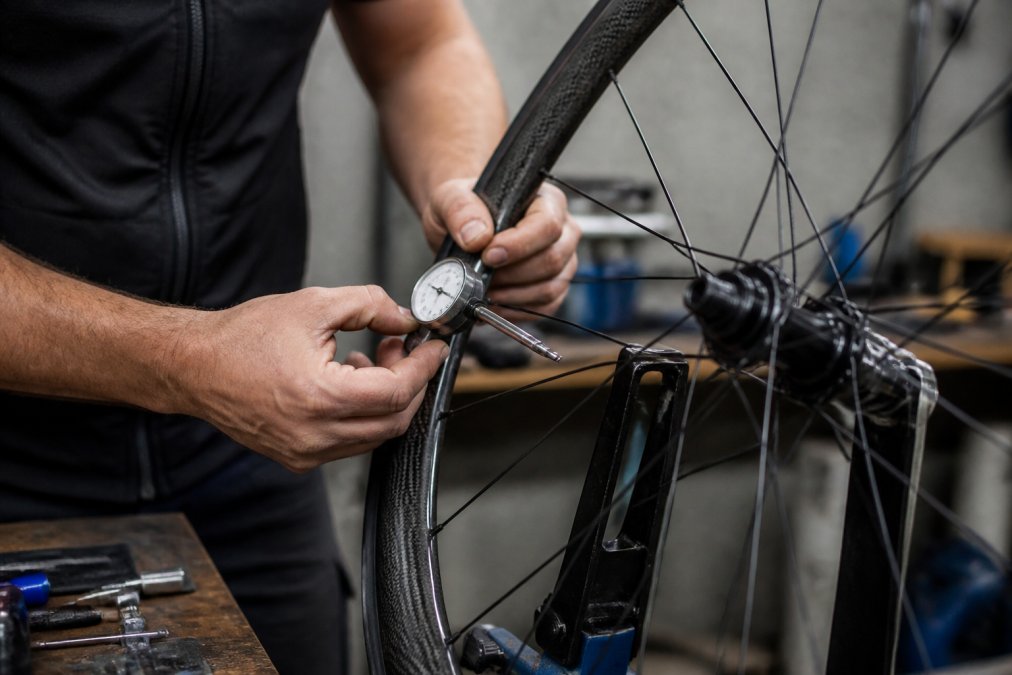
Spoke tension is the foundation of wheel stability. When spokes are tensioned uniformly, load distributes evenly. When tension varies, some spokes carry more load and fatigue faster. Hand-built wheels typically achieve variation of 5-10% or better. That difference compounds over time, every ride loads the wheel, and spokes starting at inconsistent tension lose true progressively.
A tensiometer measures spoke tension by the frequency of vibration when plucked; higher frequency means higher tension. A builder uses this feedback to adjust each spoke to a target value, ensuring uniform tension before stress-relieving begins.
Why Tension Uniformity Matters
Tension uniformity prevents uneven fatigue life. When all spokes start at the same tension, they fatigue at the same rate. Loose spokes fail first, and when they do, load transfers to neighbouring spokes, causing cascading failure. Uniform tension also distributes radial runout (vertical wobble) and lateral runout (side-to-side wobble) more evenly, maintaining tighter tolerances longer.
The Role of Tensiometer Calibration
A tensiometer is only useful if calibrated correctly. Professional wheel builders recalibrate regularly, often before each build, to ensure accuracy. Calibration involves checking against a known standard.
Stress Relieving Bicycle Wheels: Why This Step Prevents Spoke Wind-Up
Stress relieving forces residual stress in spokes, nipples, and rim to release in a controlled way before you ride. The builder applies controlled loads to compress the wheel radially, flex it laterally, and sometimes spin it under load. The wheel settles slightly, may lose small amounts of tension, and the builder re-tensions any loosened spokes and repeats until stable.
A hand-built wheel might go through 3-5 stress-relieving cycles. A thoroughly stress-relieved wheel maintains true for thousands of kilometres; one without proper stress relief loses true within the first few hundred kilometres as internal stress continues releasing under riding loads.
Mechanical Stress and Fatigue Life
Every spoke experiences cyclic mechanical stress as the wheel rotates and load on each spoke changes continuously. Fatigue life is how many cycles a spoke can endure before failure. A spoke starting with high residual stress has lower fatigue life because residual stress adds to cyclic riding stress. A stress-relieved spoke has higher fatigue life because only cyclic riding stress counts. Over millions of spoke cycles, this difference determines whether a wheel stays true.
Spoke wind-up, a slight twist along the spoke's length, changes effective spoke length and tension. Proper stress relieving reduces wind-up tendency by eliminating residual stress that contributes to twisting.
Nipple Seating and Long-Term Stability
The nipple is the threaded component holding the spoke to the rim. When first built, nipples aren't fully seated. A builder can accelerate seating by gently tapping each nipple during stress-relieving. This ensures nipples won't move later, preventing spoke loosening.
Hand-built wheels with proper stress relief and fully seated nipples maintain spoke tension stability for years.
Hand-Built vs Factory Wheelsets: Why Precision Matters
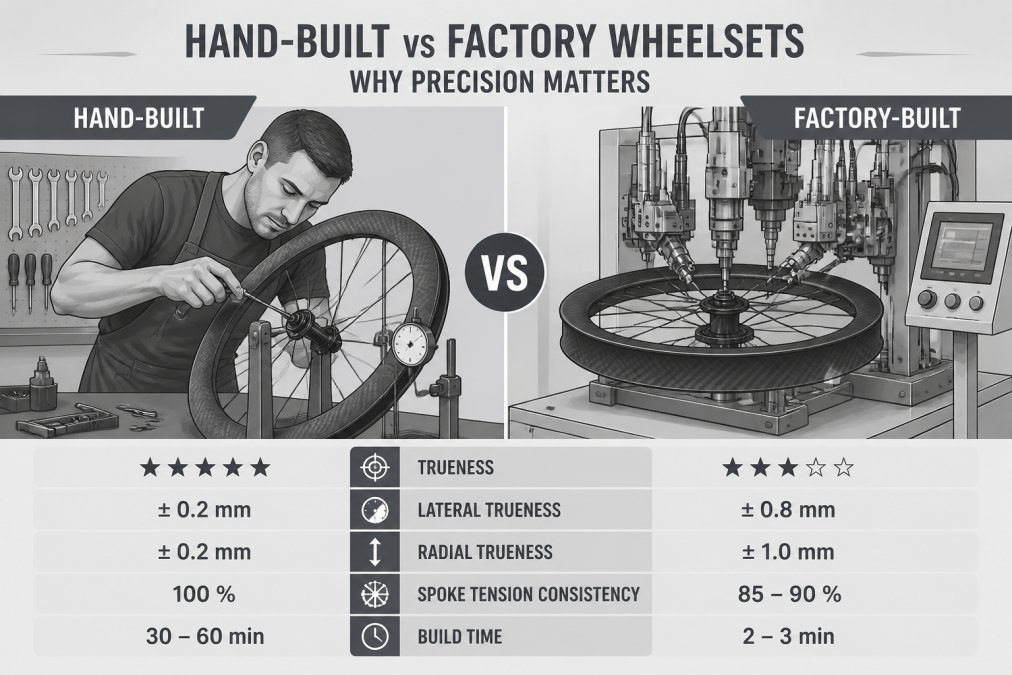
The fundamental difference is control. A hand-builder controls spoke tension, stress relieving, and quality verification at every step. A factory uses automation to control speed and cost. A factory wheel might be built in 20-30 minutes; a hand-built wheel takes 2-4 hours including stress relieving and quality verification.
STOXbyHand wheelsets receive manual spoke tensioning and multi-cycle stress relieving. Our Berd Spoked Asymmetric 46 Gravel Wheelset and TiFi Polymer Spoked Gravel models maintain true over thousands of kilometres and handle aggressive terrain without the runout issues plaguing factory alternatives.

Automated Assembly vs Manual Control
Factory automation excels at consistency within tight tolerances but cannot adapt to material variation. Real spokes, rims, and hubs vary slightly. A hand-builder assesses these variations and adjusts target tension accordingly. A machine applies the same tension regardless of material variation.
This matters with premium materials. Carbon fibre spokes, Berd polymer spokes, and TiFi polymer spokes have different stiffness profiles. A hand-builder adjusts the tension strategy for each spoke type.
Quality Control and Truing Standards
Factory quality control typically spot-checks finished wheels. Hand-built quality control checks every wheel at multiple stages: after initial tensioning, after stress relieving, and before leaving the workshop. A meticulous hand-built wheel might be trued to under 0.5mm, maintaining accuracy longer as spokes settle during break-in.
Component Selection: Rim Profile, Hub Flange, and Lacing Pattern
Three components matter most: rim profile, hub flange diameter, and spoke lacing pattern.
Rim profile affects spoke tension balance. Symmetric rims mean drive-side and non-drive-side spokes experience different tensions, sometimes 40% difference. Asymmetric rims offset the rim to even out tensions. STOXbyHand uses asymmetric rims on gravel and mountain bike wheelsets, increasing average spoke tension on the low-tension side and reducing tension differences.
Hub flange diameter affects spoke angle. Larger flanges mean shallower spoke angles, increasing lateral stiffness. Smaller flanges mean steeper angles, reducing stiffness. For gravel and mountain bikes, larger flanges provide the lateral stiffness needed for rough terrain.
Lacing pattern affects load distribution. Radial lacing is lighter but less stiff. Crossed lacing is heavier but stiffer. Most gravel and mountain bike wheels use 2-cross or 3-cross lacing for weight and stiffness balance.
Asymmetric Rim Design and Tension Balance
Asymmetric rims solve the rear wheel problem where disc rotors increase drive-side load. An asymmetric rim offsets toward the non-drive side, making drive-side spokes shorter and non-drive-side spokes longer. Longer spokes can be tensioned higher without overloading shorter spokes, resulting in more uniform spoke tension across the entire wheel and more even fatigue life.
Spoke Gauge and Butted Spoke Benefits
Spoke gauge is thickness. Thicker spokes are stiffer and stronger but heavier; thinner spokes are lighter but more prone to fatigue. Most hand-built wheels use 2.0mm to 2.4mm spokes.
Butted spokes are thicker at ends and thinner in the middle, concentrating strength where needed while reducing weight. Premium hand-built wheels often use butted spokes. Specialty materials like carbon fibre, Berd, and TiFi polymer are stiffer than steel, allowing thinner spokes to match steel strength. Our TiFi Polymer Spoked Gravel 45 and TiFi Polymer Spoked Gravel Max wheelsets use spokes as light as 2.2 grams each while maintaining strength for gravel and mountain riding.

The Break-In Period: What Happens in the First 100 Kilometres
A hand-built wheel isn't at full stability when new. The first 100 kilometres are a break-in period during which residual stress continues releasing, nipples settle, and true may shift slightly.
During the first 50 kilometres, expect the wheel to lose 5-10% spoke tension. This is normal. Stress-relieving during manufacturing triggers most release, but some residual stress remains. Riding loads accelerate that release. After 50 kilometres, tension stabilises.
Lateral and radial runout may also shift slightly. A wheel true to 0.3mm when new might show 0.5mm runout after 30 kilometres as nipples settle and the rim adjusts to riding loads. After 100 kilometres, runout typically stabilises.
To manage break-in, avoid extreme loads during the first 50 kilometres. Don't sprint hard, don't ride rough terrain, and don't carry heavy loads. Gentle riding allows gradual settling without shock loads. After 100 kilometres, the wheel handles normal riding.
Maintenance and Truing: Keeping Hand-Built Wheels True Over Time
Hand-built wheels stay true longer than factory wheels but still require maintenance. Regular inspection and minor truing before problems develop keeps them true long-term.
A wheel goes out of true when spokes loosen or the rim is damaged. Spoke loosening is gradual, a few spokes lose 5-10% tension over time, shifting geometry slightly. Regular inspection catches this before visible runout develops. A spoke losing tension has slightly lower pitch when plucked. Tightening by a quarter turn restores balance before the wheel goes visibly out of true.
Truing corrects runout by adjusting spoke tension. A wheel with 1mm lateral runout can be trued by tightening spokes on one side and loosening on the other. A skilled builder trues a wheel to within 0.3mm in 15-30 minutes. Severely out-of-balance wheels risk spoke breakage during truing.
Inspect wheels every 500 kilometres. Look for broken spokes, rim dents or cracks, and measure a few spokes with a tensiometer to verify they haven't loosened significantly. Address issues immediately. A loose spoke can be tightened before breaking; a broken spoke should be replaced promptly to prevent load transfer to neighbouring spokes.
Hand-built wheels from reputable builders like STOXbyHand are designed for maintenance. Our MTB XC / AM 29er 30/36 Asymmetrical wheelset uses durable Pillar Wing spokes and quality hubs built to last and serviceable in the field. If a spoke breaks, it can be replaced without rebuilding the entire wheel, an advantage over factory alternatives where component integration makes repair difficult.
Hand-built wheels stay true because they're built with precision, stress-relieved to eliminate residual tension, and inspected for quality at every stage. The extra time and skill costs more upfront but pays dividends in durability and true retention. STOXbyHand's 12 years of experience means every wheelset receives the precision and care that keeps wheels true through thousands of kilometres. Explore our range of custom-built options, from our Berd Spoked Asymmetric 46 Gravel Wheelset to our TiFi Polymer models, and experience the difference meticulous hand-building makes.

Key Maintenance and Truing Summary
| Maintenance Task | Frequency | What to Check | Action if Issue Found |
|---|---|---|---|
| Visual inspection | Every 500 km | Broken spokes, rim dents, visible runout | Replace spoke or assess rim damage |
| Spoke tension check | Every 1000 km | Tension uniformity with tensiometer | Tighten loose spokes by 1/4 turn |
| Truing assessment | Every 2000 km | Lateral and radial runout | True wheel if runout exceeds 1mm |
| Hub bearing check | Every 2000 km | Bearing play and smoothness | Adjust or service hub if needed |
According to research from cycling material science publications, spoke fatigue is accelerated by residual stress in the spoke material, which is why stress-relieving techniques are critical to durability. The International Organisation for Standardization's bicycle wheel standards define precision tolerances for spoke tension and runout that hand-builders often exceed. Additionally, material engineering studies on composite spokes show that specialty materials like TiFi polymer require different tensioning strategies than traditional steel, which is why experienced hand-builders adjust their approach for each material type.
Frequently Asked Questions
Q: What causes a wheel to go out of true?
A: Wheels lose true alignment when spoke tension becomes uneven. Hand-built wheels stay true longer because builders use tensiometer calibration to achieve uniform tension across all spokes, with variations under 5%. Stress relieving during the build process also prevents spoke wind-up, which is a major cause of trueness loss in the first 100 kilometres of riding.
Q: How does spoke tension and wheel durability work together?
A: Spoke tension is the primary factor determining wheel durability. Spokes under insufficient tension fatigue faster and fail prematurely; spokes under excessive tension crack. Hand-built wheels maintain optimal tension uniformity, distributing load evenly across all spokes and extending fatigue life significantly. Asymmetric rim designs further improve durability by balancing tension between drive and non-drive sides, reducing the mechanical stress that causes premature failure.
Q: Why is stress relieving important in hand-built wheels?
A: Stress relieving removes residual mechanical stress trapped in spokes and rims during manufacturing. Without this step, spoke wind-up occurs when tension is first applied, causing spokes to loosen and wheels to lose true within weeks. Hand-built wheels undergo deliberate stress-relieving cycles where tension is gradually applied, released, and reapplied. This process allows nipple seating to stabilise and prevents the sudden tension loss that makes wheels unreliable in the critical break-in period.
Q: Do hand-built wheels really stay true longer than factory wheels?
A: Yes. Hand builders use tensiometer calibration to verify every spoke, apply stress-relieving protocols, and perform final truing with radial and lateral runout tolerances under 0.5mm. This precision translates directly to longer-lasting trueness: hand-built wheels often require truing only once per season.