

Table of Contents
- How Aerodynamic Carbon Wheelset Benefits Translate to Real Speed
- Rim Depth, Internal Width and Tyre Synergy
- Carbon vs Alloy Wheels Performance: What the Data Shows
- Choosing a Carbon Fiber Wheelset for Cyclocross Racing
- Stiffness, Power Transfer and Climbing Efficiency
- Durability, Maintenance Costs and Long-Term Ownership
- Crosswind Stability and Wet-Weather Braking
- Conclusion
- Frequently Asked Questions
Last Updated: September 12, 2026
How Aerodynamic Carbon Wheelset Benefits Translate to Real Speed
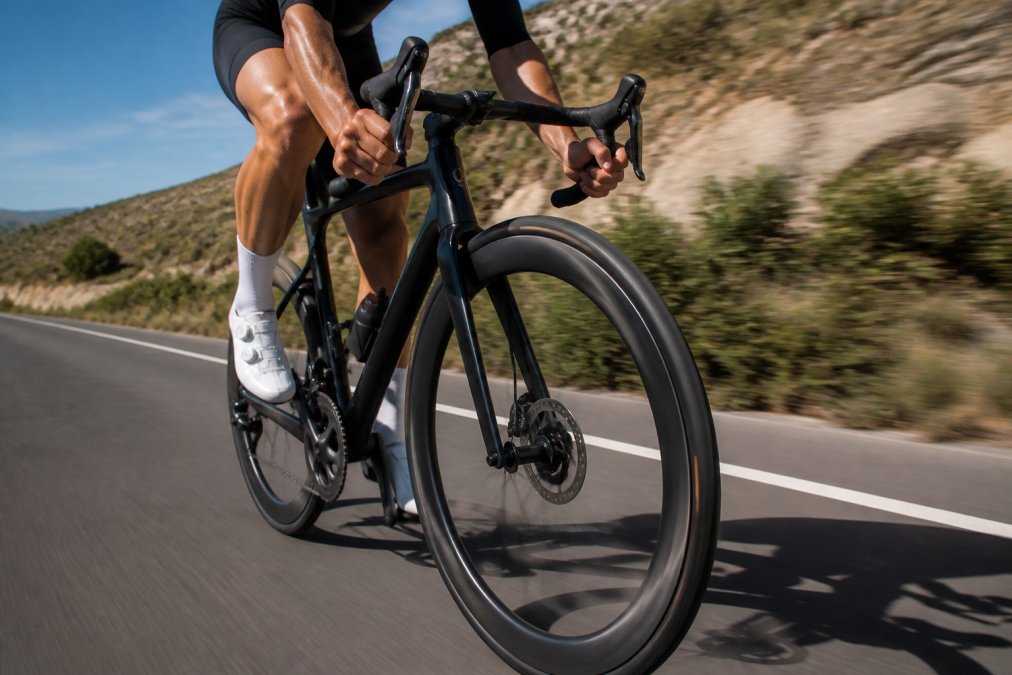
The benefits of an aerodynamic carbon wheelset come down to two measurable forces: lower aerodynamic drag at speed, and less rotational mass to accelerate. At STOXbyHand, we've spent over 12 years hand-building wheels for road, gravel and mountain bike riders, and the pattern is consistent. Riders who move from a shallow alloy wheel to a properly matched deep-section carbon wheelset report the same thing first: the bike holds speed on flat roads with less effort, then feels sharper out of corners.
That is not marketing. It is physics you can feel through the pedals.
The real-world gains break into two categories.
Aerodynamic Drag and the 105% Rule
Aerodynamic drag is the resistance air places on a moving wheel, and it rises sharply with speed. The 105% rule states that a rim should be about 105% as wide as the tyre it carries, so airflow leaves the tyre and meets the rim without a turbulent step (slowtwitch.com). Get that ratio right and the wheel cuts cleanly through air at yaw angles you actually ride in, not just in a wind tunnel.
Most riders overlook this. A deep rim paired with a tyre that bulges wider than the rim creates drag the rim depth was meant to remove.
Rotational Mass and Acceleration
Rotational mass is the weight at the outer edge of the wheel, and it costs more to accelerate than weight on the frame. Reducing mass near the rim lowers moment of inertia, so the wheel spins up faster under hard efforts. A lighter carbon wheelset does not make you faster on its own. It makes every acceleration cheaper, which matters in criteriums, cyclocross starts and repeated climbs.
Rim Depth, Internal Width and Tyre Synergy
Rim depth and internal rim width must be chosen together, because the tyre and rim behave as one aerodynamic unit. A 45mm rim suits all-round road and gravel use; deeper rims (50mm and above) favour flat, fast courses where velocity maintenance matters more than weight.

Internal width decides the tyre's real shape. A wider internal width supports a wider tyre without lightbulb deformation, which improves rolling resistance and cornering grip (bicyclerollingresistance.com). This is the synergy most buyers miss: a fast rim with the wrong tyre width is slower than a modest rim matched correctly.
Matching Tyre Width to Rim Profile
Match tyre width to rim profile using the 105% guideline and the rim's stated clearance.
| Rim Depth | Best Tyre Width | Best For | Trade-off |
|---|---|---|---|
| 30-35mm | 28-30mm | Climbing, gusty days | Less aero benefit |
| 45mm | 30-34mm | Road and gravel all-round | Slight crosswind catch |
| 50mm+ | 32-38mm | Flat, fast racing | Heavier, more wind-sensitive |
Check the manufacturer's stated tire clearance before buying. A rim that runs a tyre too wide loses the aero profile you paid for.
Carbon vs Alloy Wheels Performance: What the Data Shows
Carbon versus alloy wheels performance is usually framed as a simple weight argument. That framing hides the two mechanisms that actually separate the materials: specific stiffness (stiffness per gram) and the freedom to mould complex aerodynamic shapes.
Alloy rims are typically extruded as a straight profile and then bent into a hoop. That process limits how deep and how curved the rim can be before the material fatigues at the bend. Carbon fibre is laid up in a mould, so a rim can carry a blunt, rounded trailing edge, a wider internal width and a deeper section without the same manufacturing penalty. This is why a 50mm carbon rim can weigh less than a 32mm alloy rim while also being more aerodynamic.
The honest trade-offs, beyond weight:
- Stiffness-to-weight ratio: Carbon can be tuned by layup, stiffer vertically for power transfer, compliant laterally for comfort. Alloy stiffness is largely fixed by the extrusion.
- Impact behaviour: Alloy dents and bends; carbon tends to crack or delaminate on a hard hit. A dented alloy rim can often be trued and ridden home. A cracked carbon rim usually cannot.
- Repairability: Alloy rims can be re-rolled by a wheelbuilder. Carbon repair exists but is specialist work, and a repaired rim is rarely trusted for racing.
- Vibration damping: Carbon's layup absorbs more road buzz at the same depth, which is why deep carbon rims feel less harsh than deep alloy rims over rough tarmac.
- Braking surface: Alloy rims brake consistently in the wet with standard pads. Carbon rim-brake surfaces need specific compound pads and still lose bite when wet, a genuine safety consideration, not a marketing one (sheldonbrown.com).
For competitive riders chasing watt savings, carbon is the clear path. For a commuter, a loaded bikepacker or a rider on rough trails who wants a wheel that survives a rock strike and can be trued locally, alloy still has a strong case. Neither material is universally 'better', they optimise for different failure modes.
Choosing a Carbon Fiber Wheelset for Cyclocross Racing
A carbon fiber wheelset for cyclocross racing has different priorities to a road wheel. Cyclocross punishes wheels with mud, repeated remounts and hard landings, so impact resistance and tubeless compatibility matter more than outright depth.
Look for:
- Moderate depth (35-45mm) for mud clearance and control
- Wide internal width for grip in soft conditions
- Strong spoke tension retention and serviceable hubs
- Tubeless-ready rims to run lower pressure without pinch flats
At STOXbyHand, our hand-built approach lets us tune spoke count and lacing for the abuse a cross race delivers, rather than shipping one generic build.
Stiffness, Power Transfer and Climbing Efficiency
Lateral stiffness decides how much of your power output reaches the road instead of flexing the wheel sideways. But stiffness is not a single number, it is the sum of the rim, the spokes, the hub flange geometry and the spoke tension. A stiff rim laced with too few spokes or uneven tension will still feel vague under a hard sprint.
Power transfer depends on three things working together:
- Spoke count and lacing: More spokes and a two-cross or three-cross pattern resist lateral flex better than a radial low-count build. The trade-off is weight and aerodynamic drag from the spokes themselves.
- Hub flange geometry: Wide flanges increase the bracing angle, which stiffens the wheel without adding rim weight. A narrow-flange hub on a deep rim is a common cause of a flexy-feeling rear wheel.
- Spoke tension balance: Even tension across the wheel matters more than raw tension. A wheel with one over-tensioned spoke and several slack ones will flex and lose tension over time.
Hub engagement is a separate factor that riders often confuse with stiffness. A hub with more points of engagement (finer ratchet or pawl spacing) feels more immediate when you stamp on the pedals, because there is less rotation before drive engages. This is most noticeable in criteriums, cyclocross remounts and technical climbs where you are constantly accelerating from low speed. It does not make you faster in a steady effort, but it makes the bike feel sharper.
Climbing efficiency depends on both stiffness and low rotational mass. A wheel that is stiff but heavy climbs poorly because you pay to accelerate the mass every time the gradient changes. A light wheel that flexes wastes watts through lateral deformation. The best climbing wheels balance the two for your weight and power.
Watt savings from aerodynamics and stiffness compound over a long ride. On a climb, low weight and high stiffness dominate. On the flat, aero dominates. The best wheelset balances both for the terrain you ride most, and for most riders, that means a moderate-depth rim with a stiff, well-tensioned build rather than the deepest or lightest option available.
Durability, Maintenance Costs and Long-Term Ownership
Long-term ownership is where cheap carbon wheels fall apart, and it is the question most buyers should ask first. Fatigue resistance and impact tolerance separate a wheel that lasts seasons from one that cracks in a season.
What drives maintenance costs:
- Proprietary spokes and hubs that only the maker supplies
- Bearing quality and how easily they are replaced
- Whether the rim can be trued without special tooling
Standard, serviceable parts keep running costs low. Proprietary designs can leave you waiting weeks for a single component. Ask about warranty coverage and support before you buy, because a wheel is a long-term purchase, not a one-off.
Crosswind Stability and Wet-Weather Braking
Crosswind stability is how predictably a wheel handles gusty side winds, and it is the main reason deep rims get a bad reputation. Modern aerodynamic profiles with a rounded, blunt trailing edge shed side force more gradually than old V-shaped rims, so a 50mm wheel today is far calmer than a 50mm wheel from a decade ago.
Wet-weather braking is the other concern, and it depends on your brake system. Rim brakes on carbon braking surfaces need specific pads and lose more bite in the wet. Disc brake integration removes that problem entirely, delivering consistent stopping power in rain and mud. If you ride in wet conditions often, disc brakes are the safer choice, full stop.
Conclusion
The gains from an aerodynamic carbon wheelset are real, but only when depth, internal width and tyre width are matched to how you actually ride. Get that wrong and you pay for speed you never feel.
At STOXbyHand, every wheelset is hand-built and tuned to your weight, terrain and discipline, with spoke options including carbon fibre, Berd and TiFi polymer. Our 45 FWT Wide Carbon Spoked GWR ($2,600.00) suits riders wanting a wide aero rim and tyre combination, while the TiFi Polymer Spoked Gravel Max ($3,290.00) is built for rough gravel abuse.

Get started with STOXbyHand and ride a wheelset matched to your riding, not a generic build.
Frequently Asked Questions
Do carbon wheelsets make a noticeable difference in speed?
Yes, particularly above 30 km/h where aerodynamic drag dominates. A deep-section carbon wheelset can save 10-20 watts compared to a shallow alloy wheel at racing speeds, which translates to roughly 30-60 seconds over a 40 km effort. The gains come from reduced aerodynamic drag and lower rotational mass, though the exact benefit depends on rim depth and your average speed.
What is the disadvantage of a carbon wheelset?
The main drawbacks are cost, which starts around $2,200 for a hand-built set, and vulnerability to impact damage on rough terrain. Carbon can crack under sharp point loads where alloy would dent. Wet-weather braking on rim-brake carbon is also weaker until the braking surface is treated. Disc-brake wheelsets avoid that issue entirely, which is why most modern carbon wheels are disc-only.
How do hand-built carbon wheels compare to factory-built options?
Hand-built wheels are tensioned and trued by a person who can adjust spoke tension for your weight and riding style. Factory wheels are machine-built to a single spec. Hand-built sets typically hold tension longer and are easier to service because standard spokes and bearings are used. That matters if you ride aggressively or cover high mileage each year.
Does rim depth or weight matter more for climbing?
Weight matters most on steep gradients above 8%, where rotational mass and overall system weight decide your speed. Rim depth matters more on rolling terrain and flat courses where aerodynamic drag is the dominant force. A 45 mm deep wheelset at 1,160 grams gives you most of the aero benefit without a meaningful weight penalty, which is why it suits mixed terrain well.