

Table of Contents
- What Are Berd Polymer Spokes and Why Do They Matter?
- Berd Spoke Weight Savings and Rotational Mass
- Polymer vs Steel Spokes Comparison: Ride Quality and Damping
- Strength, Fatigue Life, and Real-World Durability
- How to Tension Berd Spokes: A Builder's Guide
- Are Berd Spokes Worth the Cost? Value and Pricing
- Verdict: Who Should Choose Berd Polymer Spokes?
- Frequently Asked Questions
Last Updated: September 5, 2026
What Are Berd Polymer Spokes and Why Do They Matter?
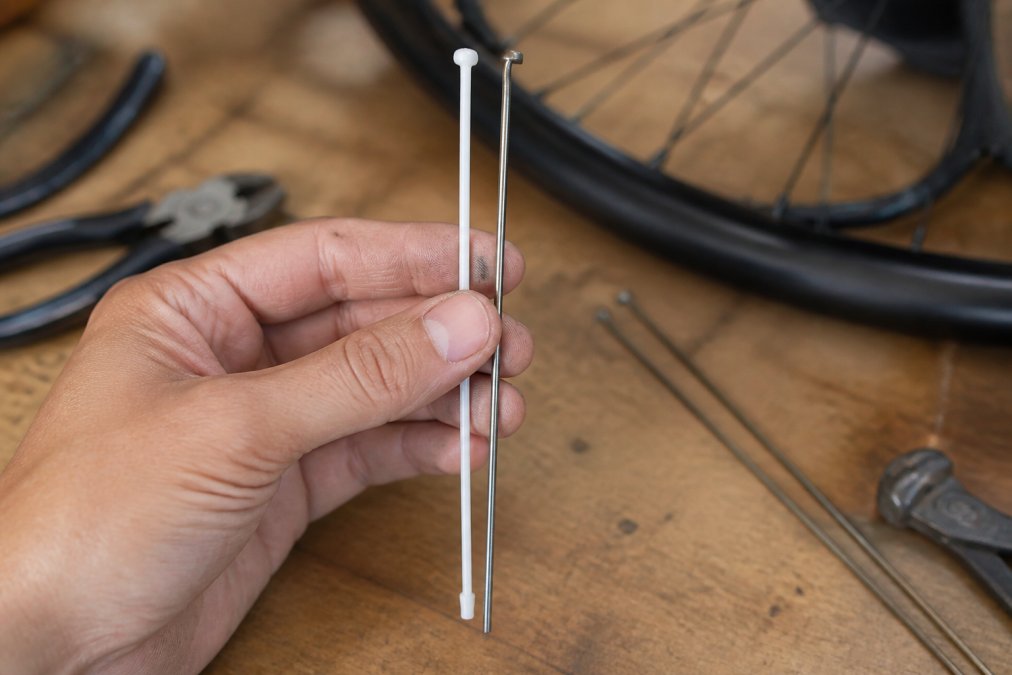
Berd polymer spokes are fibre-based spokes made from Dyneema, an ultra-high molecular weight polyethylene (UHMWPE) known for having roughly 15 times the strength-to-weight ratio of steel (PubMed). Where traditional metal spokes rely on stiffness to transfer power, Berd spokes introduce controlled elasticity that changes how a wheel absorbs road and trail input. At STOXbyHand, we have spent over 12 years hand-building carbon wheelsets, and the benefits go far beyond the headline weight figure.
A stiffer wheel transmits more vibration to the rider, costing energy and comfort over long distances. Berd spokes damp that vibration at the source, meaning less fatigue and better traction. This guide breaks down the real performance gains, the trade-offs, and who should consider a Berd build in 2026.
Berd Spoke Weight Savings and Rotational Mass
The most obvious benefit is the weight stripped from a wheelset, typically between 150 and 200 grams depending on the build. That saving is concentrated at the rim, the most impactful place to remove mass on a bicycle. Lower rotational mass means quicker acceleration and less effort to change speed, noticed most when sprinting or climbing out of the saddle.
Beyond the raw number, the material properties of UHMWPE matter. Berd spokes are impervious to the elements, so they do not corrode or fatigue like metal spokes over time. The Dyneema fibres also have a natural elasticity that steel cannot match, central to the ride-quality benefits discussed next.
Polymer vs Steel Spokes Comparison: Ride Quality and Damping
The core difference in a polymer vs steel spokes comparison comes down to how each material handles vibration and impact. Berd spokes provide roughly 200% better vibration damping than metal spokes, translating directly into a more comfortable ride on chip-seal roads and rough gravel (peer-reviewed research). The elasticity of the polymer allows the rim to move slightly independent of the hub, absorbing small impacts that would otherwise travel straight up through the frame.
This is where the traditional assumption that stiff equals fast breaks down. Wider tyres and lower pressures have taught the peloton that smooth is fast, and polymer spokes extend that logic to the wheel structure itself. A wheel that tracks the ground better under vibration delivers more consistent power transfer, not less.
| Comparison Point | Berd Polymer Spokes | Steel Spokes |
|---|---|---|
| Weight per spoke | Approximately 2.2g | 4.5g to 6g typical |
| Vibration damping | ~200% better than metal | Baseline |
| Fatigue life | Improved over steel | Prone to fatigue over time |
| Corrosion resistance | Impervious to elements | Requires maintenance |
| Maximum tension | 100kgf | 120kgf typical |
Strength, Fatigue Life, and Real-World Durability
Berd spokes are not fragile, but they demand a different approach to tensioning. The maximum spoke tension allowed is 100kgf compared to roughly 120kgf for steel, which is why wheel builders need to account for bracing angles carefully. On a rear disc wheel, the tension difference between drive and non-drive sides can reach 40% with a symmetric rim. An asymmetric rim profile reduces that gap, lifting non-drive tension from below 50kgf to around 70kgf for a much better balanced wheel.
Most published material stops at the headline fatigue and corrosion claims. What is rarely discussed is how these wheels actually behave when something goes wrong, and whether you can fix them at the roadside or in a home workshop. That gap matters because the answer shapes whether a Berd build is a sensible long-term investment or a specialist tool.
How Berd Spokes Fail in Practice
Berd spokes do not snap like steel spokes under a sudden overload. The UHMWPE fibres are extremely tough, and the most common failure mode is abrasion or cutting of the outer braid where the spoke contacts the rim bed or nipple. A less common but documented issue is damage from a spoke twisted during installation, which creates a weak point along the fibre bundle.
Impact damage from a rock strike or a crash typically does not sever a Berd spoke outright. Instead, the rim takes the brunt of the force, and the spoke may stretch or deform locally. In most cases, the wheel remains rideable, but the spoke tension will have dropped, and the wheel will need to be re-tensioned before further use.
Field Repairability: What You Can and Cannot Do
A steel spoke can be replaced with a spoke key and a spare spoke at the side of the road. A Berd spoke cannot. Replacement requires unlacing the wheel, removing the nipple, and feeding a new spoke through the hub flange and rim bed. That is a workshop job, not a roadside one. However, the practical impact of this limitation is smaller than it sounds. A broken steel spoke often leaves the wheel unrideable because the rim collapses at that point. A damaged Berd spoke, by contrast, usually leaves the wheel rideable at reduced tension, so you can get home and address the issue properly.
What you can do in the field is check for loose spokes. A spoke that has lost tension will feel slack compared to its neighbours. If you find one, you can ride cautiously to your destination, but you should not attempt to tension it without a tension meter. Over-tensioning a Berd spoke by feel is the fastest way to damage the spoke or the rim bed.
Long-Term Fatigue Behaviour
Berd's published testing shows that polymer spokes have a fatigue life that exceeds steel under normal riding conditions. The material does not corrode, and it does not suffer from the same stress-riser fatigue that eventually cracks steel spokes at the elbow or the thread. What the marketing material does not emphasise is that the spoke's elasticity means the wheel will go out of true more readily than a steel wheel under the same load. This is not a defect; it is a consequence of the material's compliance. A Berd wheel ridden hard on rough gravel will need more frequent truing checks than a comparable steel wheel.
Most wheel builders who work with Berd spokes recommend a full tension check and true after the first 500 to 1,000 kilometres, and then at regular intervals depending on riding surface. The good news is that truing a Berd wheel is no more difficult than truing a steel wheel, provided you respect the 100kgf limit and use a tension meter rather than relying on feel.
What This Means for Ownership
The practical takeaway is that Berd spokes offer excellent durability against corrosion and fatigue, but they shift the maintenance burden from replacing broken spokes to monitoring tension and truing more frequently. For a rider comfortable with basic wheel maintenance, this is a manageable trade-off. For a rider who expects a fit-and-forget wheelset, a steel or carbon spoked wheel may be a better fit.
At STOXbyHand, every Berd wheelset we build is hand-tensioned to 0.1mm trueness, and we provide a recommended service interval based on your riding weight and terrain. We also keep replacement spokes and nipples in stock for our customers, so a damaged spoke does not mean a trip overseas for parts.
How to Tension Berd Spokes: A Builder's Guide
Tensioning Berd spokes is a slow, deliberate process that cannot be rushed. Each wheel needs to be laced, trued, and tensioned, then left to rest before being re-tensioned again. The polymer stretches during the initial build, so the wheel must be re-tensioned and trued each day until all the pre-stretch has been removed from the spokes. This process typically extends the build time beyond a week, which is why lead times for a Berd wheelset are longer than a standard build.
The key specification to respect is the 100kgf maximum tension. Exceeding that risks pulling the spoke through the nipple or over-stressing the hub flange. A tension meter is essential, and the builder should aim for uniform tension across each side of the wheel rather than chasing an absolute number. At STOXbyHand, our Berd builds are hand-built to 0.1mm trueness both laterally and radially, the standard we apply to every wheelset we produce.
Hub Compatibility: The Detail Most Guides Skip
Before you even reach for a tension meter, you need to confirm that your hub is compatible with Berd spokes. This is the single most common oversight in online discussions, and it can turn a planned upgrade into a costly mistake.
Berd spokes are available in two configurations: J-bend and straight-pull. J-bend spokes use a conventional elbow that hooks into a standard hub flange, while straight-pull spokes require a hub with flanges drilled for straight spokes. Most modern road and gravel hubs are straight-pull, but not all straight-pull hubs are compatible with Berd spokes. The critical dimension is the flange hole diameter. Berd spokes use a specific nipple and spoke-end interface that requires a flange hole of at least 2.4mm. Some lightweight hubs, particularly those designed for aero carbon spokes, use smaller holes that will not accept a Berd spoke.
A second consideration is the flange thickness. Berd spokes have a flattened section at the hub end that sits against the flange. If the flange is too thick, the spoke will not seat correctly, and the tension will be concentrated on a small area, increasing the risk of failure. Most hub manufacturers publish flange dimensions, and a competent wheel builder will check these before lacing.
The Pre-Stretch Protocol
The single biggest difference between building with steel and building with Berd is the pre-stretch phase. Steel spokes stretch very little during the initial build, so a wheel can be tensioned and trued in a single session. Berd spokes, by contrast, undergo significant initial elongation as the Dyneema fibres settle and the braid tightens. If you tension a Berd wheel to 100kgf and then leave it overnight, you will find the tension has dropped by 10 to 15 percent by morning (bikeradar.com).
The correct protocol is to build the wheel, bring it up to approximately 80kgf, and then let it rest for 24 hours. The next day, re-tension to 90kgf and true the wheel. Let it rest again. On the third day, bring the wheel to the final target tension, which should be between 90kgf and 100kgf depending on the rim and riding weight, and perform the final true. This process removes the pre-stretch from the spokes and ensures the wheel holds its tension over the long term. Skipping this step results in a wheel that goes out of true within the first few hundred kilometres.
Tension Balancing on Disc Brake Wheels
Disc brake wheels present a specific challenge because the drive-side and non-drive-side spokes operate at very different tensions. On a rear wheel with a symmetric rim, the drive-side spokes may be at 100kgf while the non-drive side drops below 50kgf. At that low tension, a Berd spoke can go slack under heavy pedalling loads, which leads to a wheel that feels unstable and may eventually damage the spoke or nipple.
The solution is an asymmetric rim, which shifts the spoke bed toward the drive side and allows the non-drive spokes to run at a higher tension. A well-designed asymmetric rim will bring the non-drive tension up to approximately 70kgf, which is sufficient to keep the spokes taut under load. If you are building a rear disc wheel, an asymmetric rim is not an optional upgrade; it is a requirement for a reliable Berd build.
Tools You Will Need
A spoke tension meter is non-negotiable. Berd spokes are too flexible to judge tension by feel, and the difference between 80kgf and 100kgf is not obvious to the fingers. You will also need a quality spoke key that fits the Berd nipples without rounding them, and a truing stand with a dial gauge accurate to 0.1mm. Finally, you need patience. A Berd build cannot be rushed, and attempting to shortcut the pre-stretch protocol will produce a wheel that performs poorly and requires constant maintenance.
Servicing a Berd Wheel After Two Years of Use
After two years of regular riding, a Berd wheel will need a full service. The process is straightforward but requires the same care as the initial build. Remove the tyres and cassette, mount the wheel in a truing stand, and check the tension of every spoke. You will likely find that some spokes have dropped below the target range, particularly on the non-drive side of a rear wheel. Bring all spokes back to the target tension, true the wheel, and then let it rest for 24 hours before the final tension pass.
Inspect the spokes for abrasion where they pass through the rim bed and at the nipple. If you see fraying or cuts in the outer braid, replace the spoke before it fails. Berd spokes are available as individual replacements, and a competent wheel builder can swap one in without rebuilding the entire wheel. With this level of care, a Berd wheelset should provide several years of reliable service.
Are Berd Spokes Worth the Cost? Value and Pricing
Berd polymer spokes cost more than steel, but the value depends on what you prioritise. A complete Berd spoked wheelset from STOXbyHand, such as the Berd Spoked Asymmetric 46 Gravel Wheelset 1260g at $2,950.00, delivers the weight savings, vibration damping, and durability in one package.

For riders who want similar benefits with different characteristics, STOXbyHand also offers TiFi polymer spoked options. The TiFi Polymer Spoked Gravel 45 at $2,990.00 uses aramid fibre spokes that weigh just 2.2g each, while the TiFi Polymer Spoked Gravel Max at $3,290.00 adds a wider aero rim profile. Carbon spoked alternatives like the 45 FWT Wide Carbon Spoked GWR at $2,600.00 offer a stiffer feel for riders who prioritise lateral stiffness over compliance.


Verdict: Who Should Choose Berd Polymer Spokes?
Berd polymer spokes are the right choice for riders who want maximum weight savings and vibration damping without sacrificing durability. They suit gravel racers covering long distances on rough terrain, endurance road riders chasing comfort over many hours, and anyone building a lightweight wheelset where rotational mass matters. Riders who prioritise absolute lateral stiffness for sprinting or track use may prefer a carbon spoked build instead.
The decision comes down to ride style. If you want a wheel that smooths the road and accelerates quickly, the benefits of Berd polymer spokes are clear. If you want the stiffest possible platform for maximum power transfer, a carbon spoke delivers that character. At STOXbyHand, we build both, and we will help you match the spoke material to how you actually ride.
The main consideration is lead time. Each Berd wheelset is built to order with a build process that takes over a week, so plan ahead if you have a target event. The result is a hand-built wheelset that performs exactly as specified, backed by a team with more than a decade of experience in custom wheel construction.
Choosing the right spoke material is a balance of weight, ride quality, and durability. Berd polymer spokes excel at comfort and acceleration, while carbon and steel each bring their own strengths to different riding styles. STOXbyHand hand-builds every wheelset to order with your choice of Berd, TiFi, or carbon spokes, using over 12 years of experience to deliver a wheel tuned to your weight, riding style, and goals. Add a custom Berd or polymer spoked wheelset to your build and feel the difference of a wheel built around your needs.
Frequently Asked Questions
How much weight can Berd spokes save on a wheelset?
Using Berd polymer spokes typically strips 150-200 grams from a complete wheelset compared to a standard steel-spoked build. This reduction in rotational mass is most noticeable during acceleration and climbing. For example, our Berd Spoked Asymmetric 46 Gravel Wheelset weighs in at 1260g. The exact savings depend on spoke count, spoke length, and the weight of the steel spokes you are replacing.
Are Berd spokes stronger than steel spokes?
Berd spokes are made from UHMWPE (Dyneema), which has roughly 15 times the strength-to-weight ratio of steel. While they have a lower maximum recommended tension (100kgf) compared to steel (120kgf), they offer superior fatigue life and are impervious to corrosion. Their elasticity also allows them to absorb impacts differently, which can reduce the risk of rim damage in certain failure scenarios.
Do I need to tension Berd spokes differently than steel spokes?
Yes. Berd spokes have a lower maximum spoke tension limit of 100kgf, compared to around 120kgf for steel. They also require a specific pre-stretching process during the wheel build to remove initial elongation. A wheelset with Berd spokes must be built and tensioned by a professional familiar with polymer spokes to ensure even tension and a durable, true wheel.
Are Berd spokes suitable for gravel and mountain biking?
Yes, Berd spokes are well-suited for gravel and mountain biking where ride comfort and impact absorption are key. Their elasticity provides significant vibration damping, reducing fatigue on long, rough rides. However, because of the lower tension limits, they require a rim designed to balance spoke tensions, like the asymmetric profile used on our Berd gravel wheelset, to ensure the wheel stays true under load.