

Table of Contents
- Why carbon wheel maintenance matters
- Regular cleaning routines for carbon wheels
- Inspecting for cracks and structural damage
- Carbon rim fatigue signs and when to act
- Carbon spoke tension maintenance and truing
- How to choose carbon fiber spokes for mountain bikes
- Storage, transport and environmental protection
- Frequently Asked Questions
Last Updated: September 28, 2026
Why carbon wheel maintenance matters
Carbon fibre wheels represent a significant investment for serious cyclists. Unlike aluminium rims, carbon structures are susceptible to specific types of degradation that, if left unaddressed, can compromise both performance and safety. The stakes are higher because carbon failures often occur suddenly rather than gradually, leaving no margin for error during a critical race or ride.
At STOXbyHand, we've spent over 12 years building hand-crafted carbon wheelsets that demand proper care to deliver their full potential. Carbon wheel maintenance isn't just about cleaning, it's about understanding resin degradation, spoke tension loss, and structural fatigue, then catching problems before they become dangerous.
The difference between a wheelset that lasts five seasons and one that fails in two comes down to preventative maintenance: checking spoke tension, inspecting the brake track, and monitoring for micro-cracks.
Regular cleaning routines for carbon wheels
Cleaning carbon wheels requires a different approach than aluminium. Harsh solvents and abrasive scrubbing degrade the resin matrix, particularly around the brake track where heat cycles stress the material.
Use mild detergent and warm water with a soft brush. Pay attention to the brake track, where brake pad residue and heat accelerate resin degradation. Avoid pressure washers, concentrated water forces moisture into microfractures and accelerates delamination. Dry thoroughly to prevent water in spoke holes or hub interfaces.
For spokes (carbon, Berd, or TiFi polymer), wipe with mild detergent to remove grit and salt. Accumulated debris traps moisture and creates stress points. After cleaning, inspect the spoke-to-rim interface and nipple connections for gaps or separation, early signs of structural issues.
Clean wheels every 300-500 kilometres or after wet, salty, or muddy conditions. This 15-minute routine prevents buildup that leads to deeper problems.
Inspecting for cracks and structural damage
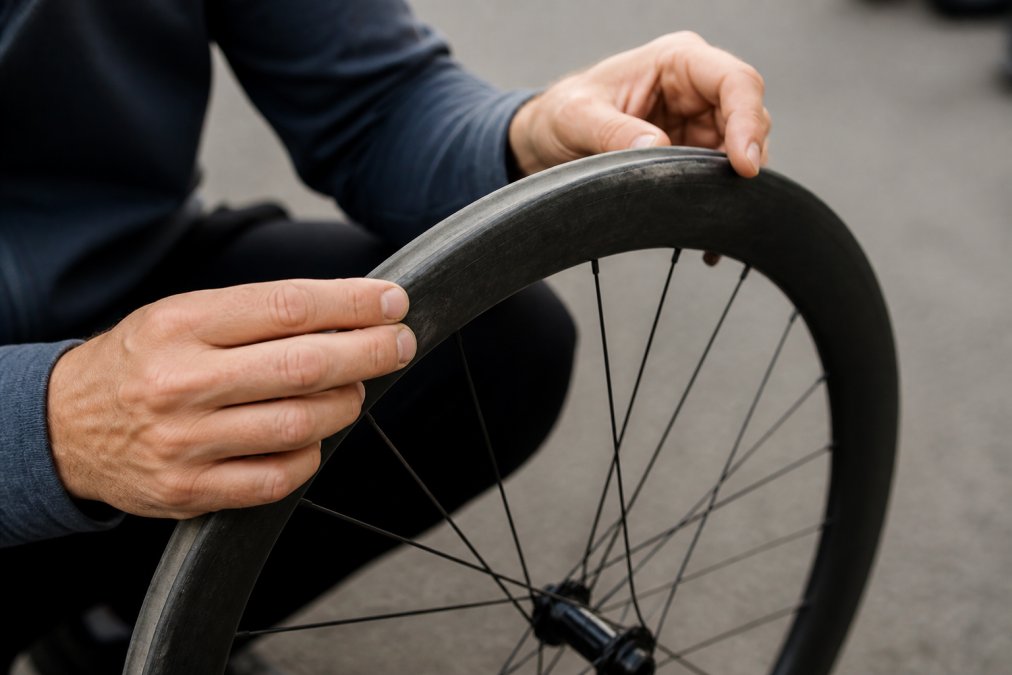
Visual inspection is your first line of defence. Carbon wheels develop stress fractures invisibly at first, but catching them early prevents full delamination.
Run your fingers along the brake track, feeling for raised edges or rough spots. Micro-cracks feel like slight roughness before becoming visible. Look for white or light-coloured marks indicating resin crazing. Check sidewalls under bright light for hairline cracks or dull, chalky finishes.
Pay special attention to the spoke bed, a high-stress zone where cracks often initiate. Retire wheels with cracks wider than hairline or visible delamination immediately. Impact damage from potholes can create internal damage, so inspect carefully after hard impacts.
Inspect monthly under bright LED light, or before important events.
Carbon rim fatigue signs and when to act
Carbon rim fatigue develops gradually. Early signs include slight loss of lateral stiffness, increased flex, or new vibrations, warnings that structural integrity is declining.
Listen for creaking under hard lateral pressure or sprinting. Creaking indicates micro-movement at the spoke-nipple interface or rim-hub connection, accelerating fatigue. Inspect and adjust spoke tension immediately.
Colour changes signal fatigue. Yellowing, darkening, or dull areas indicate heat damage and resin degradation. Discolouration on the brake track suggests the wheel is nearing end of life.
If you notice creaking, stiffness loss, colour changes, or stress marks, reduce riding intensity and schedule professional inspection. Riding fatigued wheels risks sudden failure.
Carbon spoke tension maintenance and truing
Spoke tension keeps wheels round and strong, but cannot compensate for worn bearings. Carbon spokes require the same tension maintenance as steel spokes but are sensitive to over-tensioning.
Spoke Tension Checking and Adjustment
Check spoke tension monthly by plucking each spoke and listening to pitch. All spokes on the same side should sound similar. Uneven tension accelerates fatigue and creates stress concentrations.
Use a spoke tension meter for consistency. Carbon wheels typically range 90-120 kilogram-force depending on spoke count and rim design. Over-tensioning causes sudden failure, so favour slightly lower tension if uncertain. Record baseline readings for reference.
Hub Bearing Inspection and Maintenance
Before adjusting spoke tension, inspect hub bearings. Worn bearings create lateral wobble that spoke truing cannot fix. Spin the wheel freely; healthy bearings coast 10-15 seconds. If it stops in 3-5 seconds, bearings need cleaning or replacement.
Check bearing play by grasping the rim and applying gentle lateral pressure, there should be no movement. Loose cones indicate play. Cartridge bearing hubs require replacement; cup-and-cone hubs can be adjusted with a cone wrench.
Tighten the cone until you feel resistance, then back off a quarter-turn. The wheel should spin freely with no play. Over-tightening crushes bearings; under-tightening stresses spokes and rim. Have a professional adjust if unfamiliar.
Cassette and Freehub Maintenance
On rear wheels, ensure the cassette lockring is tight. A loose lockring shifts the cassette under load, creating uneven spoke tension. Tighten to 40 newton-metres (standard for Shimano and SRAM; check your hub manual).
Inspect the freehub body for play. If the cassette rocks side-to-side, freehub bearings are worn and require professional repair or hub replacement.
Truing and Lateral Stiffness
Truing, adjusting spoke tension to bring the wheel back into perfect alignment, should be done by someone with experience. Lateral truing (side-to-side straightness) and radial truing (roundness) both require careful, incremental adjustments. A wheel that's out of true by more than 2 millimetres should be re-trued to prevent uneven brake pad wear and accelerated rim fatigue.
When truing, work in small increments: adjust one spoke by a quarter-turn, spin the wheel, and assess. Large adjustments often overcorrect and create new problems. If a wheel repeatedly goes out of true despite correct spoke tension and no visible rim damage, the issue is often bearing play or a bent hub flange, not spoke tension. Address the underlying bearing issue before continuing to chase spoke adjustments.
How to choose carbon fiber spokes for mountain bikes
Carbon fibre spokes offer significant advantages for mountain bikers: they're lighter than steel, stiffer than aluminium, and reduce overall wheel mass without sacrificing strength. However, not all carbon spokes are equal, and choosing the right spoke type depends on your weight, riding style, and the specific wheel design.
For riders under 85 kilograms, a 20-spoke configuration with carbon spokes provides excellent stiffness-to-weight ratio. The lighter overall wheel mass helps with acceleration and climbing. For riders over 85 kilograms or those who regularly ride out of the saddle with high power output, a 24-spoke configuration (typically 16 spokes on the drive side, 8 on the non-drive side for rear wheels) provides the lateral stiffness needed to prevent flex under load.
STOXbyHand offers carbon spoke options in configurations like the Carbon Spoked 5031, which uses tapered carbon spokes with an alloy nipple interface. This design provides the stiffness of full carbon with the durability of a proven spoke-to-rim connection. The taper lock interface prevents spoke slippage while avoiding the brittleness of fully bonded carbon-to-alloy connections.

Consider Berd or TiFi polymer spokes if you want an alternative to full carbon. These materials offer similar weight savings with slightly different stiffness characteristics. Berd spokes, for example, provide excellent impact resistance, making them ideal for aggressive terrain where traditional carbon spokes might be at risk of shattering from a hard impact.
The choice ultimately depends on your specific riding conditions, weight, and budget. Lighter isn't always better if it sacrifices reliability, a slightly heavier wheelset that stays true and doesn't crack is far more valuable than a featherweight set that requires constant maintenance.
Storage, transport and environmental protection
How you store and transport your carbon wheels dramatically affects their longevity. Carbon is sensitive to UV exposure, temperature extremes, humidity fluctuations, and chemical exposure, all of which accelerate resin degradation.
Storage Environment
Store wheels indoors in a cool, dry location away from direct sunlight. UV radiation breaks down the resin matrix over time, causing the surface to become chalky and brittle. If you must store wheels outdoors, use a UV-protective cover. Avoid storing wheels in unheated garages or sheds where temperature swings are extreme; these cycles cause the resin and carbon to expand and contract at different rates, creating internal stress. Ideal storage temperature is 15-25 degrees Celsius with relative humidity between 40-60 per cent.
Tubeless Sealant Chemistry and Carbon Compatibility
If you run tubeless tyres, be aware that sealant chemistry can interact with carbon resin over extended periods. Most tubeless sealants are latex-based or synthetic polymer suspensions designed to seal punctures by drying and forming a plug. However, some sealants contain solvents or surfactants that, over months of contact with the carbon rim interior, can soften or degrade the resin matrix, particularly if the sealant dries out and becomes acidic.
To minimise this risk, inspect the interior of tubeless rims every 6-12 months. If sealant has dried and crusted on the rim interior, clean it out with warm water and a soft brush; do not use acetone or harsh solvents, which will damage the resin.
Air Travel and Aeroplane Transport
Rack Transport and Vehicle Storage
Chemical Exposure
Pre-Ride and Pre-Event Inspection
Frequently Asked Questions
How long should carbon wheels last under normal riding conditions?
Carbon wheels typically last 5-10 years with proper maintenance, depending on riding intensity and environmental exposure. Hand-built carbon wheels like those from STOXbyHand are engineered for durability with uniform spoke tension and precision truing to 0.1mm, which extends longevity. Factors such as regular inspection, correct storage, and appropriate rider weight limits directly influence how long your wheelset performs at its peak.
What are the main signs of carbon rim fatigue I should watch for?
Watch for micro-cracks around the brake track, visible delamination where layers separate, stress fractures near spoke holes, and changes in wheel trueness. Resin degradation appears as discolouration or a chalky surface. If you notice the wheel losing lateral stiffness during sprints or the rim becoming difficult to keep true, these are strong indicators of carbon fatigue. Regular visual inspection every 2-3 weeks catches these issues early.
What's the difference between carbon fiber spokes and other spoke materials for mountain bikes?
Carbon fiber spokes offer superior lateral stiffness and acceleration compared to steel or aluminium alternatives, translating to more responsive handling and better power transfer. For mountain bikes tackling aggressive terrain, carbon spokes reduce radial flex while maintaining impact resistance. Advanced options like Berd and TiFi polymer spokes provide additional damping and durability. The taper lock interface used in STOXbyHand wheelsets ensures secure spoke-to-nipple connection without bonding, improving repairability.
How do I safely clean my carbon wheels without damaging the resin?
Use warm water and mild detergent with a soft brush to gently clean the rim and spokes. Avoid high-pressure washers and harsh solvents that degrade resin. Dry thoroughly with a microfibre cloth to prevent water pooling in spoke holes. For brake track residue, use a dedicated rim cleaner applied sparingly. Never use abrasive pads or acetone-based products. This routine protects the carbon layup and prevents chemical damage that compromises structural integrity.