

Table of Contents
- Why Riders Move Beyond Standard Carbon Wheelsets
- Carbon Fibre vs Alloy Wheelsets for Cyclocross and Gravel
- Custom Wheelset Spoke Options: Berd, TiFi Polymer, and Carbon
- Hand-Built Carbon Wheelsets Benefits for Precision and Longevity
- Rim Depth, Internal Width, and Aerodynamic Performance
- Choosing Your Alternative: Gravel, Road, and High-Load Applications
- Frequently Asked Questions
Last Updated: September 23, 2026
Why Riders Move Beyond Standard Carbon Wheelsets
Standard carbon wheelsets dominate the market, but they're not the universal answer riders often assume. When STOXbyHand began hand-building custom wheels over 12 years ago, we noticed a pattern: many cyclists were locked into conventional builds that didn't match their actual riding style, terrain, or comfort priorities. The assumption that stiffer and lighter always equals better has shifted. Recent developments in spoke technology and rim design have opened entirely new possibilities for carbon wheelset alternatives that deliver better real-world performance for specific applications.
The move beyond standard builds isn't about rejecting carbon fibre entirely. It's about recognising that the traditional approach, a symmetric rim with steel or basic carbon spokes, sacrifices comfort, durability, and rideability for marginal weight savings and stiffness metrics that matter less on rough terrain than they do on a velodrome. Gravel racers, endurance cyclists, and riders tackling mixed surfaces are discovering that alternative spoke materials and asymmetric rim designs solve problems that standard wheelsets simply don't address.
Carbon Fibre vs Alloy Wheelsets for Cyclocross and Gravel
Carbon fibre rims remain superior for performance-focused riders, but alloy wheelsets are experiencing a genuine renaissance for gravel and cyclocross applications. The traditional argument, carbon is lighter and stiffer, still holds true on paper. However, alloy rims offer impact resistance and durability that carbon cannot match when you're regularly hitting roots, rocks, and rough terrain at speed.
For cyclocross racing specifically, alloy wheelsets tolerate repeated hard landings and lateral impacts without the risk of hidden delamination that can plague carbon rims. A carbon rim that looks fine after a crash might have internal damage that only reveals itself after weeks of riding. Alloy rims dent, but they stay functional and repairable. The weight penalty, typically 200-300 grams per wheelset, matters far less in cyclocross than the reliability factor.
Carbon fibre excels in road racing and on smooth gravel surfaces where you're not expecting impacts. The aerodynamic benefits of deeper rims and the weight savings genuinely translate to faster times when the surface is predictable. For general gravel riding, mixed-terrain events, and any situation where durability matters more than saving 100 grams, alloy becomes the smarter choice. Many riders find they're faster on a slightly heavier alloy wheelset they trust completely than on a carbon set they're constantly monitoring for damage.
Cycling research on rim material performance shows that real-world speed differences between carbon and alloy diminish significantly once you account for rider confidence and the ability to push harder on terrain where you trust your equipment.
Custom Wheelset Spoke Options: Berd, TiFi Polymer, and Carbon
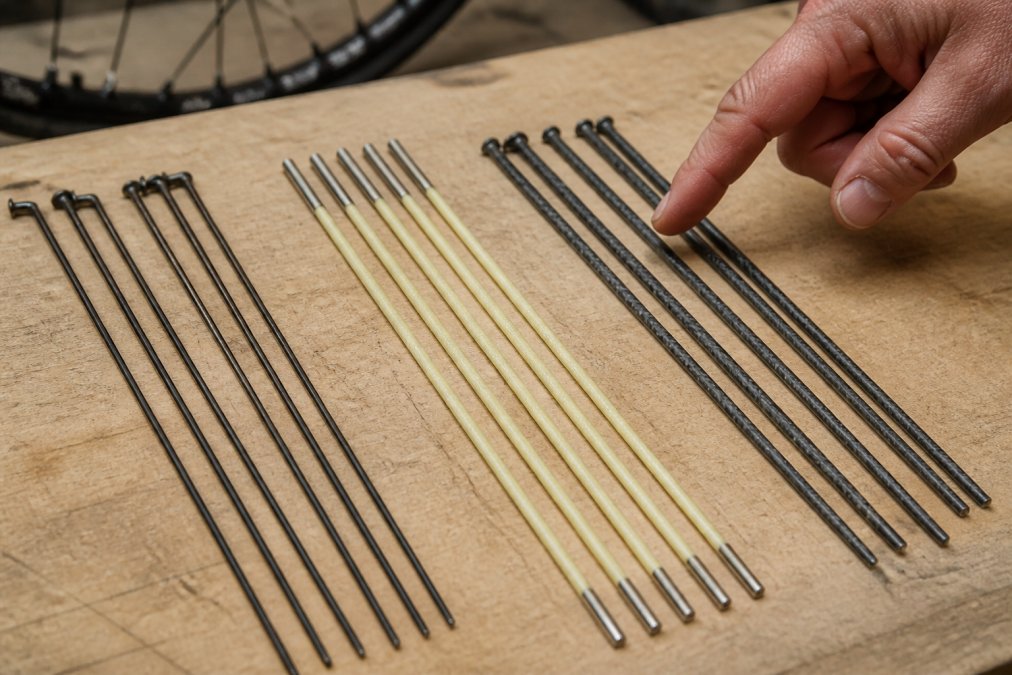
The spoke is where modern alternatives to standard wheelsets truly diverge. Traditional steel spokes remain the baseline, but three emerging technologies, Berd polymer, TiFi polymer-titanium hybrid, and carbon, each solve different problems and appeal to different rider priorities.
Berd Polymer Spokes: Lightweight Durability
Berd spokes are manufactured from Dyneema, an ultra-high-molecular-weight polyethylene with 15 times the strength-to-weight ratio of steel (The World's Strongest Fiber). At STOXbyHand, our Berd Spoked Asymmetric 46 Gravel Wheelset (1260g) represents the cutting edge of lightweight construction without sacrificing real-world durability.

The key advantage of Berd isn't just weight, it's vibration damping. Berd spokes absorb road vibration far more effectively than steel, which translates to a noticeably smoother ride, especially on rough surfaces. They're also impervious to corrosion and weather damage, meaning they'll maintain their performance characteristics indefinitely without the maintenance steel requires.
The trade-off is spoke tension management. Berd spokes have a lower maximum tension rating (100 kgf) compared to steel (120 kgf), which requires careful wheel design. Our asymmetric rim profile addresses this by evening out spoke tensions between the drive and non-drive sides, allowing us to build wheels that are both light and properly balanced.
TiFi Polymer Spokes: Maximum Comfort and Vibration Damping
TiFi spokes represent the newest alternative to standard carbon wheelsets. They combine 6AL-4V titanium at the spoke ends with aromatic polyamide fibres (the same material used in ballistic body armour) along the shaft. At just 2.2 grams each, they're the lightest spokes in the world, yet they deliver 52% more elasticity than steel spokes and 110% more than carbon.
The vibration reduction is measurable and noticeable. On-bike testing with 3D accelerometers shows TiFi spokes reduce vibrations by approximately 15% compared to steel-spoked wheels and 29% compared to carbon. For endurance riders and gravel racers covering 50+ kilometre events, this difference accumulates into genuine fatigue reduction.
Berd Spoked Asymmetric 46 Gravel →
Our TiFi Polymer Spoked Gravel 45 (1190g) and TiFi Polymer Spoked Gravel Max (1290g) wheelsets are built for riders who prioritise comfort without sacrificing speed. The wider rims (32mm internal, 44mm external on the Max) allow you to run larger tyres at lower pressures, which further enhances comfort and traction.
Traditional Carbon Spokes: Speed and Stiffness
Carbon spokes remain the standard for performance-focused builds because they deliver the stiffness and weight savings that matter in competitive road racing and smooth-surface gravel events. Our 45 FWT Wide Carbon Spoked GWR (1160 grams) features carbon spokes with a taper-lock interface that ensures consistent spoke tension and lateral stiffness.
Hand-Built Carbon Wheelsets Benefits for Precision and Longevity
Hand-built wheels from STOXbyHand offer precision that factory-assembled alternatives cannot match. Every wheelset is built to 0.1 millimetre trueness, both lateral and radial runout, with uniform spoke tensions verified across multiple days to ensure all pre-stretch is removed. This level of precision directly impacts longevity and real-world performance.
The precision also affects how the wheel responds to impacts and rough terrain. A properly tensioned wheel distributes load more evenly, which reduces the stress on individual spokes and the rim.
Rim Depth, Internal Width, and Aerodynamic Performance
Rim depth and internal width are the hidden variables that determine whether a wheelset will actually suit your riding. Standard carbon wheelsets often use conservative depths (35-40mm) and narrow internal widths (20-25mm) designed for 25-28mm tyres. Modern gravel and mixed-terrain riding demands different proportions.
Choosing Your Alternative: Gravel, Road, and High-Load Applications
The decision tree for choosing a carbon wheelset alternative depends on three factors: your terrain, your weight, and your priorities.
| Wheelset | Weight | Best For | Key Feature |
|---|---|---|---|
| TiFi Gravel 45 | 1190g | Gravel racing, mixed terrain | 52% more elasticity than steel |
| TiFi Gravel Max | 1290g | Fast gravel with wide tyres | 54mm front rim, aerodynamic |
| Berd Asymmetric 46 | 1260g | Rough terrain, endurance | 200% better vibration damping |
| Carbon 45 FWT | 1160g | Road, smooth gravel | Lightest option, maximum stiffness |
| Core Gravel 35 | 1440g | High-load, durability priority | Triple-butted spokes, proven reliability |
Frequently Asked Questions
Are hand-built carbon wheelsets better than standard factory wheels?
Hand-built carbon wheelsets offer superior precision and longevity compared to factory production. Each wheel is individually trued to 0.1mm lateral and radial runout, with uniform spoke tension and careful pre-stress removal over several days. This meticulous process eliminates the stress concentrations and inconsistencies that develop in mass-produced wheels, resulting in wheels that stay true longer and handle aggressive terrain without failure. Factory wheels prioritise speed over craftsmanship, whereas hand-built alternatives prioritise durability and consistent performance across thousands of kilometres.
What are the benefits of using polymer spokes like Berd or TiFi?
Polymer spokes dramatically reduce rotational mass and vibration compared to steel or carbon. Berd spokes, made from ultra-high molecular weight polyethylene, offer 15 times the strength-to-weight ratio of steel and damp vibrations much more effectively than steel spokes. TiFi polymer spokes (titanium and aramid fibre) weigh just 2.2g each and provide 52% more elasticity than steel and 110% more than carbon spokes. On-bike testing shows TiFi spokes reduce vibrations by 29% versus carbon spoked wheels. This translates to a smoother, more comfortable ride without sacrificing stiffness or durability.
Is it worth upgrading from standard carbon wheels to custom builds?
Custom builds justify the premium through durability, ride quality, and long-term value. Custom carbon wheelsets with premium spoke options (Berd, TiFi) cost more upfront but deliver measurable improvements in comfort and handling. For gravel racers, aggressive mountain bikers, or riders over 100kg, the durability premium alone justifies the investment over cheaper factory alternatives.
What makes TiFi polymer spokes worth the extra cost compared to standard carbon?
TiFi spokes combine aerospace-grade materials (6Al-4V titanium and aromatic polyamide fibre) to deliver performance impossible with carbon alone. At 2.2g per spoke, they are the world's lightest spokes. Their 52% greater elasticity than steel allows the rim to deform independently of the hub, absorbing impacts and vibrations that would crack stiffer carbon wheels. On-bike testing demonstrates 15% vibration reduction versus steel and 29% reduction versus carbon spoked wheels. For endurance gravel events or mountain biking, this elasticity prevents fatigue failures and provides the comfort needed for 50+ kilometre efforts on rough terrain.
How do I know a hand-built wheelset will stay true and not crack like my previous carbon wheels?
Hand-built wheelsets stay true because they are individually trued and re-tensioned daily until all pre-stress is removed from the spokes, a process that takes over a week per wheel. STOXbyHand backs every wheel with a 3-year warranty on manufacturing defects and offers crash replacement at 40-60% of retail price depending on the model. Each wheel is hand-built to 0.1mm precision with uniform spoke tensions, ensuring balanced load distribution that prevents the stress concentrations responsible for failures in standard carbon wheels.