

Last Updated: November 6, 2026
Quick Summary
Choosing gravel wheels for SRAM XDR compatibility starts with the freehub body, since XDR is about 1mm longer than XD and is designed for 12-speed road and gravel cassettes including XPLR. Confirm your hub's freehub standard, axle spacing and rotor mount before ordering, because a cassette that slides on is not proof of compatibility.
- SRAM XD and XDR share a spline pattern, but the XDR body is approximately 1mm longer.
- SRAM XPLR cassettes are designed for XDR freehubs and 1x gravel drivetrains.
- Rear axle spacing is 12x142mm thru-axle for gravel, or 135mm quick-release.
- Hookless gravel rims require tyres explicitly rated for hookless use and the stated maximum pressure.
- Ordering a wheelset before measuring axle spacing is the most common cause of a return.
Table of Contents
- Start With the Freehub: Why XDR Decides Your Gravel Wheels
- SRAM XD vs XDR Freehub: The 1mm Difference That Matters
- SRAM XPLR Cassette Compatibility and Gear Range Checks
- Gravel Wheel Axle Standards and Rotor Mounts to Confirm
- Hookless Gravel Rim Tyre Compatibility and Rim Width
- A Step-by-Step Gravel Wheels Compatibility Check
- Ordering a Custom XDR Gravel Wheelset From STOXbyHand
- Frequently Asked Questions
Start With the Freehub: Why XDR Decides Your Gravel Wheels
Choosing gravel wheels for SRAM XDR compatibility starts with one component most riders overlook: the freehub body. The freehub is the ratcheting mechanism inside the hub that the cassette slides onto, and its spline pattern determines which cassettes will physically fit.
SRAM's XDR standard is the modern 12-speed road and gravel interface, and it is not interchangeable with the older XD body without checking dimensions.
SRAM XD vs XDR Freehub: The 1mm Difference That Matters
SRAM XD and XDR freehubs share the same spline pattern, so a cassette will physically slide onto either body. What separates them is length: the XDR body is approximately 1mm longer than XD. That 1mm is not cosmetic.
The reason for the extra length is the cassette architecture. XD was introduced for mountain bike cassettes with a 10-tooth smallest cog, where the cassette threads onto the freehub body and the smallest cog overhangs the body's end.
In practical terms:
- XD: shorter body, designed around MTB cassettes with a 10-tooth minimum cog.
- XDR: approximately 1mm longer, designed around 12-speed road and gravel cassettes, including XPLR.
- HG (Hyperglide): a completely different spline pattern used by Shimano and older SRAM 11-speed and below; not interchangeable with XD or XDR.
A common mistake is assuming that "SRAM 12-speed" automatically means XDR. Many gravel groupsets now ship with XDR, but older stock, some MTB-derived setups and certain aftermarket hubs still use XD. Always confirm against the hub manufacturer's spec sheet rather than the groupset name.
Can you convert between them? Conversion depends on the specific hub model, so confirm with the hub manufacturer or a dealer whether an XDR body exists for your exact hub, whether the end cap also changes, and whether the axle configuration is supported.
Is a spacer ever needed? A spacer is not a universal fix for XD/XDR mismatch.
How to tell which body you have. Measuring the body length from the hub flange to the end cap is possible but difficult to do accurately, because the difference is only about 1mm.
Watch out: a cassette that slides onto the body is not proof of compatibility, the lockring engagement and cassette position are what actually matter.
SRAM XPLR Cassette Compatibility and Gear Range Checks
SRAM XPLR cassettes are designed for XDR freehubs and 1x gravel drivetrains. The freehub body is the same XDR unit across the range; what changes is the derailleur, the chain and sometimes the frame clearance.
Confirm every line against the manufacturer's current specification before buying, because revisions do occur.
| Cassette family | Speeds | Freehub standard | Typical largest cog | Drivetrain notes |
|---|---|---|---|---|
| SRAM XPLR (gravel) | 12 | XDR | 44T or 46T | 1x gravel derailleurs rated for the range |
| SRAM road 12-speed (wider range) | 12 | XDR | 36T | Faster, flatter terrain; tighter steps |
| SRAM MTB 12-speed | 12 | XD | 50T-52T | MTB derailleurs; not a direct gravel swap |
| Shimano/SRAM 11-speed and below | 11 or fewer | HG | Varies | Different spline; not XD/XDR |
Before committing, check four things:
- Derailleur maximum cog capacity. A derailleur rated for a 42-tooth maximum will struggle with a 46-tooth cassette, causing poor shifting or chain slap. Match the largest cog to the derailleur's stated maximum, not to what looks like it will fit.
- Chain length. Set chain length after fitting the cassette, not before. A longer cage or a larger cassette changes the required length.
- Frame clearance. Check the chainstay near the largest cog. Some frames are tight around a 46-tooth sprocket even when the derailleur is rated for it.
- Chainline. A 1x setup is more forgiving, but a cassette that sits too far inboard or outboard will shift poorly. This is where an incorrect freehub body or a misplaced spacer shows up.
Cassette-specific fit examples. A 10-44 XPLR cassette pairs cleanly with a wide-range gravel derailleur and a 1x crank, and suits mixed terrain where climbing matters. A 10-36 cassette suits faster, flatter racing where tighter gear steps are more useful than a very low climbing gear. In both cases the freehub is the same XDR body; the derailleur and chain are what change. An MTB 12-speed cassette with a 50-tooth or 52-tooth largest cog belongs on an XD body and an MTB derailleur, it is not a drop-in gravel solution.
Troubleshooting common fit symptoms.
- Cassette wobble. Check that the cassette is seated fully on the splines and that the lockring is tightened to specification. Wobble can also indicate a missing or incorrect spacer, or a freehub body that is not the standard you assumed.
- Poor lockring engagement. If the lockring bottoms out before the cassette is secure, the body may be the wrong length for the cassette. Verify XD versus XDR before applying force.
- Shifting problems after fitting a new cassette. Recheck chain length, derailleur capacity and the B-gap adjustment. A cassette that is correct for the freehub can still shift poorly if the derailleur is set up for a different range.
- Incorrect spacing or chainline. Confirm any spacer is the one specified by the manufacturer for that hub and cassette combination, and that the cassette sits at the intended position relative to the frame.
Watch out: if the lockring does not engage fully, do not ride the wheel, a partially engaged lockring can damage the freehub body and the cassette.
Core Gravel 35 Wheelset 650b or 700c SRAM XDR / 650B →
Gravel Wheel Axle Standards and Rotor Mounts to Confirm
Axle type and rotor mount are the two fitment details riders most often forget until the wheel arrives. Gravel frames use either thru-axle or quick-release, and the spacing differs between the two.
Measure your current setup before ordering:
- Front axle: 12x100mm thru-axle is common; some use 15x100mm
- Rear axle: 12x142mm thru-axle is the gravel standard; quick-release is 135mm
- Rotor mount: Center Lock or 6-bolt, and they are not interchangeable without an adapter
A quick-release frame cannot take a thru-axle hub without different end caps, and many hubs support both through swappable caps. Ask before you buy. For rotor mounts, Center Lock hubs need a lockring tool, while 6-bolt uses Torx bolts. If your frame runs 6-bolt rotors and the wheel is Center Lock, you'll need an adapter, which adds a small weight penalty and another failure point.
If you're weighing hub fitment options, our guide on thru-axle vs quick-release gravel wheelsets walks through the hub compatibility details frame by frame.
Hookless Gravel Rim Tyre Compatibility and Rim Width
Hookless rims have no bead hook, so the tyre's bead relies on a precise internal width and tight manufacturing tolerance to stay seated. This changes which tyres and pressures are safe. Hookless gravel rims typically pair with tubeless-ready tyres rated for hookless use, and running a non-approved tyre is a genuine safety risk, not a minor spec quibble.
Internal rim width drives the ideal tyre width. A wider internal width, around 24-25mm, supports a broader tyre and a flatter contact patch, which improves grip and comfort on rough gravel. Narrower rims suit tighter, faster tyres.
- Check the rim's stated maximum tyre pressure before inflating
- Confirm the tyre is explicitly hookless-compatible
- Match tyre width to internal rim width, not external
- Use a reliable pressure gauge; hookless tolerances are tight
Rim width also changes how tyre pressure behaves. A wider rim lets you run lower pressure without pinch flats, which is why gravel riders chasing comfort move toward wider internals. Our guide on how rim width changes tyre pressure explains the relationship in practical terms.
If you haven't settled on wheel size yet, our comparison of 650b vs 700c gravel wheelsets helps you decide before locking in rim and tyre compatibility.
A Step-by-Step Gravel Wheels Compatibility Check
Here is the sequence to work through before buying any gravel wheelset.
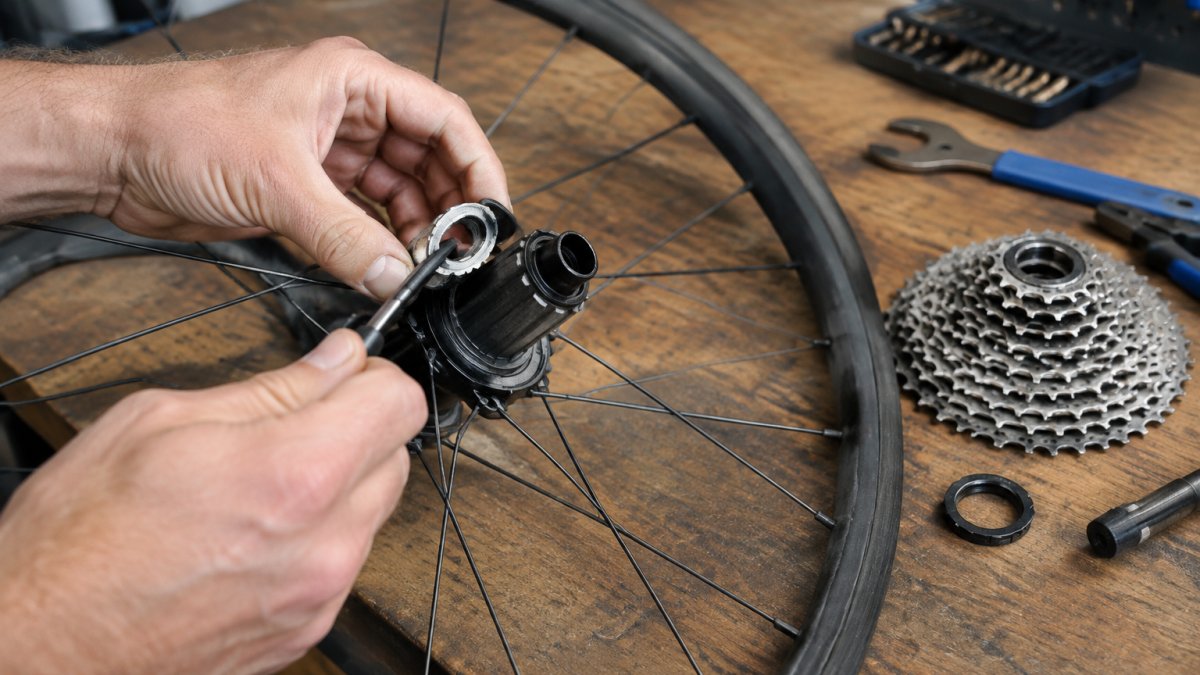
- Identify your freehub standard. Check your current cassette and hub spec. XD, XDR or HG.
- Confirm cassette fit. Match your cassette's speed and largest cog to the freehub and derailleur.
- Measure axle type and spacing. Front and rear, thru-axle or quick-release, and the exact millimetre spacing.
- Check rotor mount. Center Lock or 6-bolt, and whether an adapter is needed.
- Verify frame clearance. Measure chainstay and fork clearance for your intended tyre width.
- Confirm rim and tyre compatibility. Hookless or hooked, and the tyre's approved pressure range.
- Check wheel size. 700c or 650b, and whether your frame clears the larger tyre a smaller wheel allows.
| Check | What to Confirm | Common Mistake |
|---|---|---|
| Freehub | XD, XDR or HG | Assuming all SRAM 12-speed is XDR |
| Cassette | Speed and largest cog | Exceeding derailleur max cog |
| Axle | Type and spacing | Ordering thru-axle for a QR frame |
| Rotor | Center Lock or 6-bolt | Forgetting the adapter |
| Rim/tyre | Hookless approval, pressure | Running a non-approved tyre |
| Wheel size | 700c or 650b clearance | Tyre rubbing the chainstay |
Watch out: ordering a wheelset before measuring axle spacing is the single most common cause of a return. Measure twice.
Ordering a Custom XDR Gravel Wheelset From STOXbyHand
Once your compatibility checks are done, the build itself should match your riding. Our Core Gravel 35 Wheelset comes in 650b or 700c with a 24mm internal hookless rim, a 35mm depth, and a weight of 1440 grams when laced to our Core hubs.
We've spent over 12 years hand-building carbon wheels. Spoke options include carbon fibre, Berd and TiFi polymer. The rim is asymmetric with a 2.8mm spoke offset.
You can see the full spec and options on the Core Gravel 35 Wheelset 650b or 700c SRAM XDR product page. If you want to understand why hand-built matters before committing, our guide on the benefits of hand-built gravel wheelsets covers the build detail.
Frequently Asked Questions
What is the difference between SRAM XDR and XD freehub bodies?
The two freehubs share the same spline pattern and fit the same cassettes, but XDR is 1mm wider. That extra millimetre lets SRAM fit a 10-tooth smallest cog on its road and gravel cassettes. XD is designed around mountain bike cassettes. In practice, an XD cassette will mount on an XDR freehub with a 1mm spacer, but an XDR cassette will not fit an XD body because there is not enough width. When choosing gravel wheels, confirm which body the hub ships with before ordering.
Do gravel wheels need an XDR freehub for SRAM XPLR?
Yes. SRAM XPLR cassettes are built to the XDR standard, so the rear wheel needs an XDR freehub body to mount them correctly. If you are buying a new gravel wheelset, specify XDR at the point of order rather than planning to convert later.
How do I check whether a gravel wheel is compatible with my SRAM cassette?
Work through four checks. First, identify your cassette standard: XD or XDR. Second, confirm the hub's freehub body matches, allowing a 1mm spacer only when fitting an XD cassette to an XDR body. Third, check axle spacing and type, usually 12mm thru-axle at 142mm rear and 100mm front on gravel bikes. Fourth, confirm the rotor mount, Centre Lock or six-bolt. Ask the wheel builder to confirm all four in writing before you pay.
Are hookless gravel rims compatible with all tubeless tyres?
No. Hookless rims require tubeless tyres specifically approved by the tyre maker for hookless use, and you must stay within the rim's stated maximum pressure, which is often lower than riders expect. Check the tyre sidewall for hookless approval and cross-reference the rim's pressure rating. The STOXbyHand Core Gravel 35 uses a 24mm internal hookless rim, so confirm your chosen tyre is listed as hookless compatible and inflate to the rim's limit, not the tyre's.
Getting XDR compatibility right is a fifteen-minute check that saves weeks of frustration. If you'd rather skip the guesswork, STOXbyHand builds each gravel wheelset to your exact freehub, axle and rotor spec, with hand-built carbon construction and custom spoke choices. Get started with STOXbyHand and ride a wheelset that fits the first time.
