

Table of Contents
- Why Hand Built Carbon Wheels for Heavy Riders Demand a Different Approach
- Carbon Wheel Weight Limits: What the Numbers Actually Mean
- Spoke Count for Heavy Riders: Finding the Right Number
- Advanced Spoke Materials: Berd, TiFi Polymer, and Carbon
- Road vs Gravel: Matching the Build to the Terrain
- The Custom Wheel Build Process: From Spec to Finished Wheelset
- Maintenance Schedules and Warranty for Hand Built Carbon Wheels
- Conclusion
Last Updated: August 27, 2026
Why Hand Built Carbon Wheels for Heavy Riders Demand a Different Approach
Most carbon wheel guides ignore heavier riders entirely. Hand built carbon wheels for heavy riders require fundamentally different engineering: balancing lateral stiffness, spoke tension distribution, rim construction, and load capacity in ways off-the-shelf wheelsets simply aren't designed to address. At STOXbyHand, we've been building custom wheelsets for over 12 years, and the questions from heavier riders reveal a consistent gap between what the market offers and what these cyclists actually need.
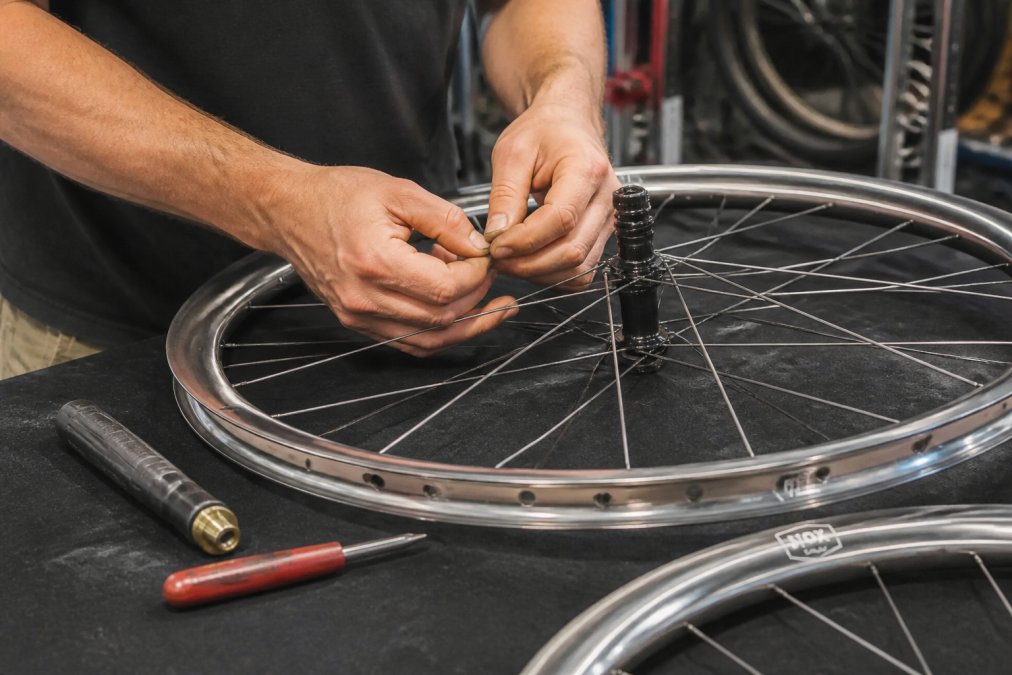
The physics are well understood. The challenge is applying them correctly.
How Rider Weight Loads Spoke Tension
Spoke tension is the core structural variable in any wheel. When a rider sits on a bike, the hub is pulled downward relative to the rim. Spokes on the lower portion lose tension. If a spoke's resting tension is too low, it will go slack under load, causing fatigue and failure.
For heavier riders, this effect is amplified. More mass means greater deflection at the contact patch and a larger tension differential between loaded and unloaded spokes. A wheel built with 24 spokes at moderate tension might handle 75 kg without issue (peer-reviewed research). At 100 kg, those same spokes cycle through a wider tension range with every revolution, accelerating fatigue.
The solution combines higher initial tension, appropriate spoke count, and rim construction stiff enough to distribute load across more spokes simultaneously.
Lateral Stiffness, Rim Profile, and Structural Integrity
Lateral stiffness determines how much a wheel deflects sideways under pedalling load and cornering forces. For heavier riders, lateral flex causes brake rub and power transfer loss.
Rim profile plays a direct role. Deeper rims are generally stiffer laterally, but rim depth alone doesn't tell the whole story. The carbon layup, wall thickness, and internal structure determine actual rigidity. A 45 mm rim with thin, cost-optimised layup can be less laterally stiff than a well-engineered 35 mm rim.
Filament wound carbon manufacturing, as used in the STOXbyHand 45 FWT and 50 FWT rim range, produces consistent fibre orientation that translates directly to fatigue resistance over thousands of kilometres.

Carbon Wheel Weight Limits: What the Numbers Actually Mean
Carbon wheel weight limits published by manufacturers are often less meaningful than the testing methodology behind them. A stated limit of 120 kg means little without knowing whether that accounts for dynamic loading and road vibration.
Carbon wheel weight limits should be understood as a starting point, not a binary pass/fail. The real question is: what is the safety margin above that limit, and how does the wheel behave as it approaches it?
Carbon Layup and Fatigue Resistance
Carbon layup refers to how individual carbon fibre plies are oriented and stacked during rim manufacturing. A rim engineered for heavier riders uses additional plies at high-stress zones: the spoke bed, the brake track, and the bead wall.
Fatigue resistance matters more than peak strength. A rim that survives one extreme impact but degrades under repeated moderate loads is a poor choice for heavier riders covering significant kilometres. Filament wound technology produces a rim with exceptionally consistent fibre alignment, meaning fewer weak points and more predictable behaviour under load.
Hooked vs Hookless Rims for Heavier Loads
Hooked rims feature a physical bead hook that retains the tyre mechanically. Hookless rims rely on tyre bead geometry and air pressure alone.
For heavier riders, hooked rims offer a meaningful safety advantage. The physical hook provides secondary retention if tyre pressure drops suddenly, particularly relevant at the higher pressures heavier riders often run. The STOXbyHand 45 FWT Wide and 50 FWT Wide wheelsets use a 25 mm internal hooked rim width, supporting a wide tyre range while retaining mechanical security.

Spoke Count for Heavy Riders: Finding the Right Number
The right spoke count depends on rider mass, terrain, riding style, and rim stiffness. Most production wheelsets ship with 24 spokes. For riders above 90 kg, 28 spokes rear is a sensible minimum (peer-reviewed research). Above 100 kg, or carrying additional load, 32 spokes rear and 28 front is more appropriate.
| Rider Weight | Road (Rear) | Gravel (Rear) | Front |
|---|---|---|---|
| Under 85 kg | 24-24 spokes | 24-24 spokes | 24 spokes |
| 85-100 kg | 24-28 spokes | 24-28 spokes | 24 spokes |
| Over 100 kg | 28 spokes | 28 spokes | 24-28 spokes |
| E-bike / cargo | 28+ spokes | 28+ spokes | 28+ spokes |
Higher spoke counts distribute load across more contact points and reduce the tension differential per spoke under load.
Lacing Patterns and Spoke Gauge
Lacing pattern describes how spokes cross between hub and rim. For heavy riders, 3-cross lacing is the standard recommendation for rear wheels. The crossed pattern transfers torque more effectively, distributes tension more evenly, and is more resistant to spoke fatigue than radial or 2-cross builds.
Spoke gauge refers to spoke diameter. Double-butted spokes, which are thicker at the ends and thinner in the middle, offer a practical compromise: thick ends handle high-stress zones at hub and nipple, while the thinner middle section adds compliance. For heavier riders, double-butted spokes in a 2.0/1.8/2.0 or 2.0/1.6/2.0 profile suit most road and gravel applications.
Brass Nipples, Spoke Tension, and Long-Term Reliability
Brass nipples are heavier than aluminium but significantly more resistant to corrosion and thread seizure. For wheels in wet conditions or with long service intervals, brass nipples are the correct choice for heavier riders.
Spoke tension must be set correctly and evenly across all spokes. Uneven tension is more damaging than slightly lower overall tension. Precision tensioning, verified with a calibrated tensiometer, separates hand-built wheels from machine-built ones.
Advanced Spoke Materials: Berd, TiFi Polymer, and Carbon
Standard steel spokes are the baseline. For heavier riders with specific performance goals, advanced spoke materials offer genuine advantages with trade-offs worth understanding.
Berd spokes are made from ultra-high-molecular-weight polyethylene fibre. They are exceptionally light with high tensile strength. Compliance characteristics differ significantly from steel, changing how the wheel feels over rough surfaces. Berd spokes require specific tension protocols and aren't compatible with all hub flange designs.
TiFi polymer spokes, as used in the STOXbyHand TiFi Polymer Spoked Gravel 45 wheelset, weigh just 2.2 g each. The key insight isn't just weight reduction; it's the combination of compliance and speed. TiFi polymer spokes absorb road noise and vibration while maintaining structural integrity under load.

Carbon fibre spokes offer high stiffness, low weight, and aerodynamic cross-sections, most effective in aero wheel builds where rotational mass and drag are primary concerns.
Road vs Gravel: Matching the Build to the Terrain
Terrain changes everything. A wheel optimised for smooth tarmac underperforms on gravel, and a gravel-optimised build carries unnecessary weight on road.
For road riding, the priority is lateral stiffness, low rotational mass, and aerodynamic rim profile. A 45-50 mm rim depth suits most road conditions. The STOXbyHand 45 FWT Wide Carbon Spoked GWR at AU$2,600 and the 50 FWT Wide RG at AU$2,490 are engineered for this use case, with filament wound rims and 25 mm internal width supporting tyres from 28 mm upward.
For gravel, the calculus shifts toward durability, tyre volume, and impact resistance. A 30-35 mm rim depth is typical, and internal width should support at least a 40 mm tyre comfortably.
Tubeless-Ready Compatibility and Tyre Pressure for Heavy Riders
Tubeless-ready compatibility is now standard on quality carbon rims. Heavier riders have specific reasons to prioritise it: tubeless setups allow lower tyre pressures without pinch flat risk, directly relevant to ride quality and traction for riders above 90 kg.
Heavier riders need more air pressure to support their weight, but the optimal pressure is lower than many assume (the CDC). A 40 mm tyre at 3.0-3.5 bar suits many riders in the 90-110 kg range on gravel. Road tyres in the 28-32 mm range typically require 5.5-7.0 bar for heavier riders, depending on surface and riding style.
Tubeless also eliminates the tube as a failure mode, which matters on long gravel events where a pinch flat far from support is a significant inconvenience.
Hub Engagement, Thru-Axle, and Disc Brake Compatibility
Hub engagement refers to how quickly the drivetrain engages when a rider begins pedalling from a coasting position. For heavier riders, fast hub engagement reduces the brief shock load when power is applied suddenly. The STOXbyHand MTB XC/AM 29er asymmetrical wheelset uses a 54-ratchet hub, providing rapid engagement suited to trail riding and loaded applications.
Thru-axle standards (12x100 mm front, 12x142 mm or 12x148 mm rear) offer significantly better wheel retention and lateral stiffness compared to quick-release skewers. For heavier riders on disc brake bikes, thru-axle is the correct choice. The increased axle diameter reduces flex under braking, improving brake modulation and reducing rotor rub.
The Custom Wheel Build Process: From Spec to Finished Wheelset
The custom wheel build process begins with a specification conversation, not a parts list. The builder needs to understand the rider before selecting components.
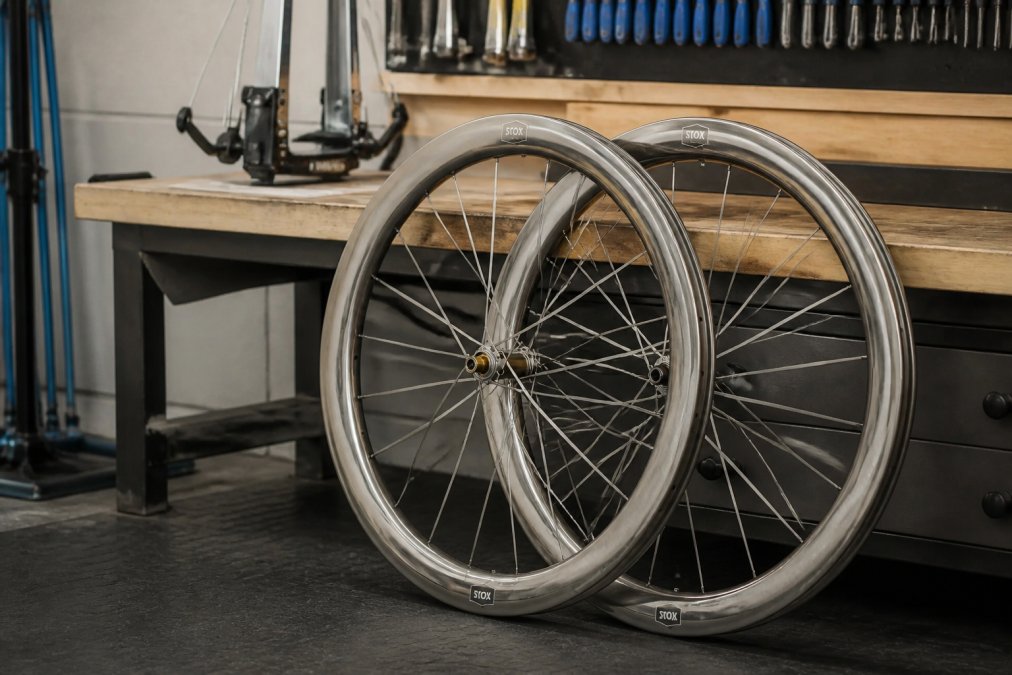
A production wheelset is designed for a statistical average rider. A hand-built wheel is designed for a specific rider's weight, terrain, riding style, and performance goals.
What Information You Need to Provide
Before a build begins, the builder needs:
- Rider weight (with kit, shoes, and any carried load)
- Bike type and intended use (road racing, endurance road, gravel, MTB, e-bike)
- Axle standard (quick-release or thru-axle, front and rear dimensions)
- Freehub standard (Shimano HG, SRAM XD, Campagnolo, or other)
- Brake type (rim brake or disc; if disc, rotor attachment standard)
- Tyre size preference and whether tubeless is intended
- Performance priorities (aero, weight, durability, compliance)
Accurate information leads to better build outcomes. Estimating weight or omitting intended use creates compromises that could have been avoided.
Precision Tensioning and Quality Checks
Precision tensioning determines whether a hand-built wheel outperforms a machine-built one. The process involves:
- Initial lacing and rough tensioning to seat spokes
- Progressive tension increase in stages, checking dish and lateral true throughout
- Stress-relieving the spokes by applying lateral pressure to seat spoke elbows fully
- Final tension measurement with a calibrated tensiometer at every spoke
- Final true check for lateral and radial runout within 0.3 mm tolerance
- Rim tape application and tubeless valve installation if specified
A quality hand-built wheel should hold tension and true for thousands of kilometres with only minor periodic adjustment.
Maintenance Schedules and Warranty for Hand Built Carbon Wheels
Maintenance is where most riders underinvest. Heavier riders pay a higher price for that neglect. The forces acting on a wheel at 100 kg are meaningfully greater than at 70 kg, requiring shorter inspection intervals.
A practical maintenance schedule for heavier riders:
| Interval | Check |
|---|---|
| Every 500 km | Spoke tension check, visual rim inspection |
| Every 1,500 km | Full re-true, hub bearing check |
| Every 5,000 km | Hub service (repack or replace bearings) |
| After any impact | Full spoke tension and rim integrity check |
| Annually | Comprehensive inspection including rim wear indicators |
Hub bearings carry more radial load in heavier rider wheels and are more susceptible to contamination. Sealed cartridge bearings are easier to replace but harder to service. Cup-and-cone hubs can be adjusted and repacked, extending service life significantly if maintained correctly.
Rim crack propagation is a specific risk for carbon wheels under repeated high load. Any visible crack, delamination, or flat spot should be treated as a reason to stop riding that wheel immediately. Carbon rims can fail suddenly without warning if a structural defect is present.
A heavier rider asking "will this hold up?" deserves a specific, engineered answer, not a reassurance. The right hand built carbon wheels for heavy riders combine appropriate spoke count, correct lacing pattern, a rim layup designed for sustained load, and precision tensioning that ensures every spoke carries its share of the work. STOXbyHand builds each wheelset to these principles, with spoke options from standard double-butted steel through to TiFi polymer, and rim profiles suited to road, gravel, and mountain bike applications. If you're ready to spec a build that matches your actual weight and riding style, explore the STOXbyHand range and get a wheelset built for the rider you are, not the average the market assumes.
Frequently Asked Questions
Is there a weight limit for carbon wheels?
Most production carbon wheels list a combined system weight limit, rider, bike, and kit, typically between 100 kg and 120 kg. Hand built carbon wheels for heavy riders can be specced beyond those limits by increasing spoke count, selecting a stiffer carbon layup, and using precision tensioning. The 45 FWT Wide Carbon Spoked GWR and TiFi Polymer Spoked Gravel 45 from STOXbyHand are built to order, so load capacity is addressed at the spec stage rather than after the fact.
How does spoke count affect wheel strength for heavier cyclists?
Each spoke carries a share of the load, so spoke count for heavy riders directly affects how that load distributes around the rim. A 32-spoke build spreads force across more contact points than a 24-spoke aero build, reducing peak tension at any single spoke. Higher spoke count also improves fatigue resistance over time, meaning the wheel holds its tension and stays true through more kilometres, critical for riders who put consistent high loads through their wheels on every ride.
What are the downsides of carbon fibre wheels?
Carbon rims are more sensitive to impact damage than alloy at equivalent weight, and a hard strike on a pothole can crack a rim that an alloy equivalent would dent and survive. Heat build-up from prolonged rim braking on descents was a historic concern, though disc brake compatibility has largely resolved this for new builds. Cost is the other factor: a quality hand built carbon wheelset starts around $1,890 and rises with spoke and hub specification. The performance and weight gains are real, but the investment is significant.
Do I need to send my bike in to order custom wheels, or can I spec them remotely?
You do not need to send your bike in. The custom wheel build process starts with your rider weight, total system weight including kit and bags, axle standard (thru-axle or quick release), brake type (disc or rim), freehub driver (XD or Shimano), and intended use, road, gravel, or mountain. STOXbyHand uses those inputs to select rim depth, spoke count, lacing pattern, and spoke material. Accurate information at this stage is what determines how well the finished wheelset performs under your specific load.
This article was written using GrandRanker