

Table of Contents
- Understanding Carbon Fiber Spokes vs Steel Alternatives
- Key Performance Factors When Choosing Carbon Spokes
- Carbon Spoke Durability for Enduro and Aggressive Terrain
- Matching Spoke Specifications to Your Riding Style and Weight
- How to Maintain Carbon Fiber Wheelsets
- Spoke Tension, Truing and Hand-Built Quality Standards
- Making Your Final Selection
- Frequently Asked Questions
Last Updated: September 22, 2026
Understanding Carbon Fiber Spokes vs Steel Alternatives
Learning how to choose carbon fiber spokes for mountain bikes starts with understanding that carbon fibre spokes achieve lateral stiffness through material properties that steel cannot match at equivalent weights, enabling more efficient power transfer and responsiveness.
A carbon spoke wheel transmits power directly into forward momentum, making this distinction critical for aggressive terrain where efficiency matters.
Carbon spokes don't bend, they either stay true or break, so spoke count, lacing pattern, and rider weight are critical to durability.
The difference between a carbon spoke wheel that lasts and one that fails comes down to engineering decisions made before the first spoke goes into the rim.
Key Performance Factors When Choosing Carbon Spokes
Stiffness-to-Weight Ratio and Rotational Inertia
A carbon spoke delivers lateral stiffness comparable to a much thicker steel spoke at a fraction of the mass, reducing the energy required to accelerate and decelerate.
Below 1,200 grams, wheels become so light that rotational inertia works against you on rolling terrain. The Carbon Spoked 5031 at 1,281 grams hits the sweet spot, delivering acceleration benefits and rolling efficiency.
Spoke Count and Lacing Patterns
Spoke count determines lateral stiffness: a 20-spoke rear wheel flexes under hard acceleration, while a 24-spoke rear wheel stays rigid.
A 21/24 spoke count (21 front, 24 rear) provides stiffness for aggressive riding without the weight penalty of a full 32-spoke wheel, with extra rear spokes handling asymmetric pedalling loads.
Riders over 85 kilograms benefit from 21/24 setup; lighter riders can use 20/20 and save weight.
Tensile Strength and Impact Resistance
High-modulus carbon has exceptional tensile strength but is brittle, a single impact in the wrong place can cause failure.
Carbon spokes either survive impacts or snap. Impact resistance depends on engineering that prevents impacts from reaching the spoke: proper tension, correct spoke count, and appropriate rim depth.
Carbon Spoke Durability for Enduro and Aggressive Terrain
Carbon spokes excel in enduro racing only when engineered correctly, durability depends on spoke count, build precision, and rider weight.
How Carbon Spokes Fail vs. Steel
Steel spokes fail through fatigue from repeated bending; carbon spokes fail through impact or overload, not gradual weakening.
Rocky descents create repeated impacts and sustained lateral loads. Steel spokes handle impacts well; carbon spokes handle sustained loads better but are vulnerable to impact concentration if spoke tension is uneven.
Durability Patterns Over 2+ Years of Trail Riding
Properly Built Wheels (Hand-Built, 0.1 mm Trueness): A carbon wheelset built to professional standards typically survives 3 to 5 years of aggressive riding before spoke failure, which is usually isolated and impact-related. After repair and re-tensioning, it functions reliably for another 1 to 2 years.
Factory-Built Wheels (Tolerance ±0.3 mm): Factory carbon wheelsets typically show spoke failures within 18 to 36 months of aggressive riding, often multiple spokes indicating systemic tension problems. Secondary failures follow within weeks to months.
Steel Spoke Wheels (For Comparison): A properly built steel wheelset survives 5 to 10 years but requires regular re-tensioning and develops lateral run-out over time.
Terrain-Specific Durability Demands
Different terrain types stress carbon spokes in different ways, and durability varies accordingly.
Rocky, High-Impact Terrain: A 20-spoke rear wheel develops failures faster than a 24-spoke wheel because each spoke absorbs more impact energy. Specify 24-spoke rear wheels for rocky terrain; the durability gain outweighs the minor weight penalty.
Rooty, Technical Singletrack: A 21/24 configuration is ideal; the rear wheel's extra stiffness handles asymmetric pedalling loads while the front maintains responsiveness.
Smooth, High-Speed Terrain: A 20/20 or 21/20 configuration is sufficient; durability is excellent because impact stress is minimal.
Mixed Terrain (Enduro Racing, All-Mountain): Build quality is critical.
Build Quality as the Primary Durability Factor
Build quality, specifically spoke tension uniformity and trueness precision, is the primary durability factor. A wheel trued to 0.1 millimetre distributes load evenly; hand-built tension uniformity within 2 to 3 percent ensures consistent load distribution as the wheel ages. Factory wheels often have 10 to 15 percent tension variation, causing cascading failures.
Maintenance Impact on Long-Term Durability
Regular inspection and re-tensioning every 12 to 18 months of aggressive riding maintains structural integrity and extends durability by 1 to 2 years.
Matching Spoke Specifications to Your Riding Style and Weight
Rider Weight and Power Output Considerations
Your weight and power output determine lateral and radial loads. A 70-kilogram rider producing 1,500 watts creates more stress than a 90-kilogram rider producing 800 watts. The Carbon Spoked 5031 comes in 20/20 (under 85 kg) and 21/24 (up to 115 kg) configurations.
Terrain-Specific Selection
Rough terrain favours higher spoke counts and heavier wheelsets for even impact absorption. Singletrack favours lighter wheels for acceleration and deceleration. Mixed terrain typically uses 21/24 setup.
How to Maintain Carbon Fiber Wheelsets
Carbon wheelsets require different maintenance protocols than steel, and understanding the specifics separates owners who can perform basic repairs from those who must return to a professional builder every time a spoke fails.
Routine Maintenance and Inspection
Inspect visually for hairline cracks or discolouration. Check lateral run-out regularly; if it exceeds 0.5 millimetre, re-tension before cascading failures occur.
Spoke Replacement: The Practical Reality
A bent carbon spoke must be replaced, it cannot be straightened. Replacement depends on your hub interface type.
Taper-lock interfaces allow isolated repairs without disrupting wheel tension.
Spoke Compatibility and Measurement: Carbon spokes require exact length measurement from hub flange to nipple seat. A 2-millimetre error will cause installation failure or spoke failure under load.
After installing a new spoke, bring it up to tension gradually while checking trueness. Professional re-tensioning is recommended for multiple spoke replacements.
When to Seek Professional Help
If more than one spoke has failed, or if lateral run-out has increased beyond 1 millimetre, the wheel's structural integrity is compromised and re-tensioning the entire wheelset is necessary. A professional wheel builder can re-tension the entire wheelset to uniform standards, restoring the wheel's durability.
Storage and Environmental Protection
Keep your carbon wheelset away from extreme temperature swings. Store wheels in a climate-controlled space.
Avoid prolonged exposure to saltwater or corrosive environments. Rinse your wheels with fresh water after riding in wet or coastal conditions, and dry them thoroughly before storage.
Spoke Tension, Truing and Hand-Built Quality Standards
Hand-built quality separates wheelsets that last from those that fail prematurely. A hand-built wheel is built to a trueness standard, typically 0.1 millimetre or better, and that precision determines durability.
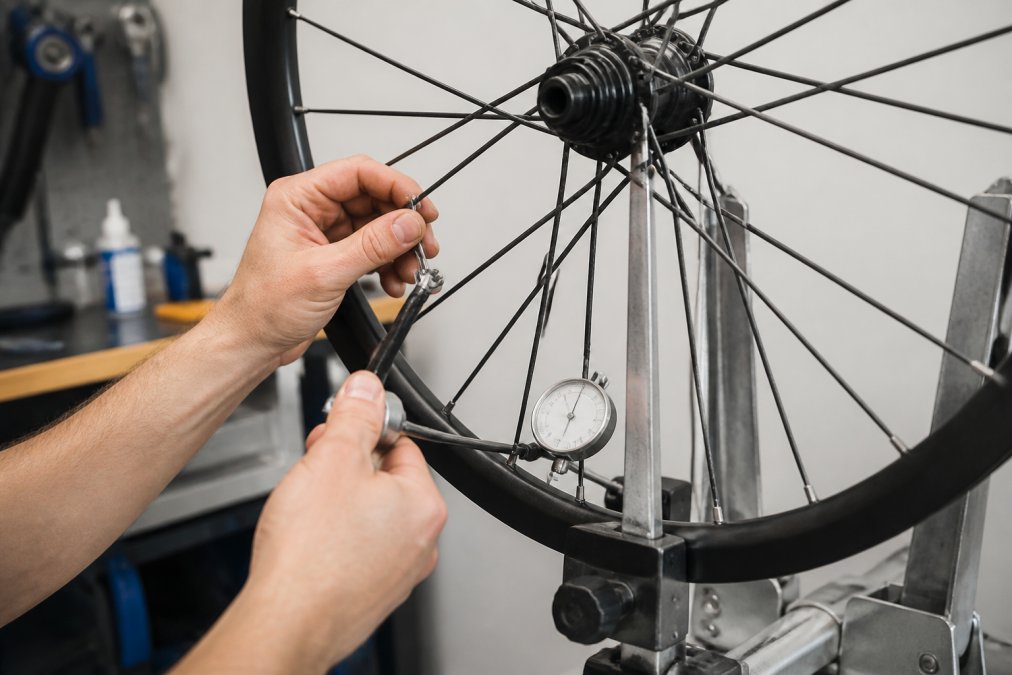
Spoke tension uniformity is where hand-building proves its value. Every spoke in a properly built wheel carries nearly identical tension. This distributes load evenly and prevents stress concentration. Hand-built wheels from STOXbyHand maintain tension uniformity within 2 to 3 percent.
Truing to 0.1 millimetre radially and laterally requires skill and time. It cannot be rushed. Precision trueness ensures that spoke tension remains consistent as the wheel ages.
The hand-built advantage extends to spoke replacement protocols.
Making Your Final Selection
Understanding how to choose carbon fiber spokes for mountain bikes requires matching three variables: spoke count, wheel weight, and build quality. Get any one of these wrong and the wheelset either underperforms or fails.
| Configuration | Rider Weight | Spoke Count | Best For | Weight |
|---|---|---|---|---|
| Carbon Spoked 5031 (20/20) | Up to 95 kg | 20 front / 20 rear | Lighter riders, climbing-focused | 1,280 g |
| Carbon Spoked 5031 (21/24) | Up to 115 kg | 21 front / 24 rear | Heavier riders, aggressive terrain | 1,350 g |
| Carbon Spoked Wave 5031 | Up to 120 kg | 24 front / 24 rear | High-speed racing, cross-wind stability | 1,420 g |
Frequently Asked Questions
Are carbon fiber spokes worth the extra cost compared to steel?
Carbon spokes reduce rotating mass and rotational inertia significantly, meaning your legs do less work accelerating the wheel. This translates to faster acceleration and sustained speed with less effort. For competitive riders and those tackling long climbs, the weight savings and stiffness improvements justify the investment. Hand-built wheelsets like the Carbon Spoked 5031 ($2,400) combine this performance with precision construction to 0.1mm trueness, ensuring consistent spoke tension and durability that mass-produced alternatives struggle to match.

What rider weight and power output should I consider when choosing carbon spokes?
Your body weight plus bike determines the spoke count and rim depth you need. Riders under 85 kg can use lighter 20-spoke configurations, while heavier riders or those outputting significant power require 21- or 24-spoke counts for lateral stiffness during sprinting and out-of-saddle climbing. The Carbon Spoked 5031 with 21/24 spoke count supports riders up to 115 kg with bike, while the 20/20 configuration suits those up to 95 kg. Matching your weight to the correct spoke count prevents premature fatigue and maintains wheelset responsiveness.
How do I maintain carbon fiber wheelsets to ensure long-term durability?
Carbon wheelsets require minimal maintenance compared to traditional builds. Inspect for visible cracks or damage after rough rides, particularly in enduro conditions. Store wheels in a cool, dry place. Regular professional truing keeps your wheelset performing optimally.
Can carbon fiber spokes handle aggressive mountain biking and enduro racing?
Yes, modern carbon spokes are engineered for impact resistance and fatigue life comparable to premium steel. The key is matching spoke count to terrain severity and rider weight. Enduro riders benefit from higher spoke counts (24+) and stiffer rim profiles that absorb impact without transferring stress to individual spokes. Hand-built wheelsets with uniform spoke tension and precise truing distribute load evenly, preventing premature spoke breakage in aggressive terrain.