

Table of Contents
- What You Need to Know Before Choosing Custom Bike Wheels
- Hand Built vs Factory Wheelsets: What Actually Changes on the Road
- The Benefits of Custom Carbon Wheelsets for Road, Gravel and MTB
- Choosing Rim Depth for Road Cycling and Gravel Racing
- Spokes, Hubs and Lacing: The Build Decisions That Decide Durability
- Matching Custom Bike Wheels to Your Riding Discipline and Wheel Size
- Conclusion
- Frequently Asked Questions
Last Updated: September 14, 2026
What You Need to Know Before Choosing Custom Bike Wheels
Choosing custom bike wheels comes down to three variables you can control: your body, your terrain, and your budget. Everything else, rim depth, spoke count, hub brand, follows from those three.
This guide from STOXbyHand draws on more than 12 years of hand-building carbon wheelsets for road, gravel and mountain bike riders. We'll show you how to prioritise each decision so you spend money where it actually changes how the bike feels, not where a spec sheet looks impressive.
Custom bike wheels are wheelsets built to a specification matched to an individual rider, rather than a mass-produced set designed to suit an average. That distinction matters most when you sit at either end of the weight or power spectrum, or when your terrain is unusual.
Rider Weight, Power Output and Terrain
Rider weight and power output determine how many spokes you need, how stiff the rim should be, and how much vertical compliance you can afford to lose.
Heavier riders and high-torque riders need more spokes and a stiffer rear rim. Lighter riders can run fewer spokes and a shallower, more forgiving profile. Gravel and MTB riders trade some aerodynamic gain for impact resistance and tire clearance.
- Under 70 kg, road: 20-24 spokes front, 24 rear
- 70-90 kg, road or gravel: 24 spokes front, 28 rear
- Over 90 kg, or e-bike torque: 28 spokes front, 32 rear
- MTB, any weight: 28-32 spokes, wider internal rim width
Setting Your Budget and Performance Priorities
Decide what you're actually buying before you look at prices. Weight, aerodynamics, durability and serviceability rarely all improve together, and a build that chases all four usually delivers none of them well.
Work through this order:
- Set your maximum budget first, not last
- Choose rim material (carbon or alloy) within that budget
- Choose rim depth based on your typical terrain and speed
- Choose spoke type and count for your weight and power
- Choose hubs for engagement and long-term bearing service
Hand Built vs Factory Wheelsets: What Actually Changes on the Road
Hand built vs factory wheelsets is not a marketing distinction. It describes who controls spoke tension, and spoke tension is what keeps a wheel true.
Factory wheelsets are assembled by machine to a target tension, then shipped. Hand-built wheelsets are tensioned, stress-relieved and re-trued by a person who can compensate for the specific rim and hub in front of them. The Wheelbuilding guidance from Park Tool explains how uneven tension shortens spoke life long before a wheel visibly fails.
Spoke Tension, Truing and Long-Term Serviceability
Even spoke tension is the single best predictor of how long a wheel stays true. A wheel with one over-tensioned spoke will pull that section out of line as the rim fatigues.
What most reviews miss is that serviceability is a design choice, not a bonus. A wheel built with standard J-bend spokes and a common freehub body can be repaired anywhere. A wheel built with proprietary parts may need to go back to the builder for something as simple as a bearing replacement.
- Standard spokes and nipples: repairable at most workshops
- Proprietary spokes: usually require the original builder
- Serviceable bearings: replaced in minutes with basic tools
- Sealed cartridge bearings: replaced as a unit, no repacking
The Benefits of Custom Carbon Wheelsets for Road, Gravel and MTB
The benefits of custom carbon wheelsets come down to three things: rotational weight, lateral stiffness where you need it, and the ability to specify exactly the ride quality your discipline demands.
Carbon fibre lets a builder tune stiffness directionally. A rim can be stiff laterally for power transfer while staying compliant vertically for comfort. Aluminium alloy rims are more affordable and more forgiving of impact damage, but they can't be tuned the same way and they're heavier for the same depth.
Carbon Fibre vs Aluminium Alloy Rims
Carbon fibre rims are lighter at a given depth, can be shaped for aerodynamics, and can be tuned for lateral stiffness and vertical compliance independently. Aluminium alloy rims cost less, resist impact damage better, and are easier to source and replace.
| Factor | Carbon Fibre | Aluminium Alloy |
|---|---|---|
| Weight at 45mm depth | Lighter | Heavier |
| Aerodynamic shaping | Highly tunable | Limited |
| Impact resistance | Lower | Higher |
| Repairability after damage | Usually replace | Usually replace |
| Cost | Higher | Lower |
| Best for | Racing, aero, weight goals | Training, rough terrain, budget |
There's an honest limitation here: carbon rims don't tolerate a hard impact as well as alloy. If you ride rocky terrain and crash often, alloy may be the smarter long-term decision.
Choosing Rim Depth for Road Cycling and Gravel Racing
Choosing rim depth for road cycling and gravel racing is a trade between aerodynamic drag and crosswind handling. Deeper rims are faster in a straight line and harder to control in gusty conditions. The mechanism is straightforward: a deeper rim reduces the pressure difference between the front and rear of the wheel, which lowers drag, but it also increases the side area that crosswinds can push against.
The practical ranges:
- 30-35mm: climbing, wind-exposed routes, lighter riders
- 40-50mm: the all-round road and gravel sweet spot
- 55-65mm: flat, fast racing where crosswinds are manageable
- 65mm+: time trial and triathlon specific
Why Depth Helps, and When It Stops Helping
Aero gain scales with speed. At lower speeds the drag reduction is small in absolute terms, so a shallow, lighter rim often feels faster because it accelerates more easily. At higher sustained speeds the aero benefit grows and a deeper rim wins on flat terrain.
The trade-off is weight and crosswind sensitivity. A deeper rim is heavier, which costs you on climbs and in repeated accelerations, and it presents more side area to gusty wind. The result is that depth is a terrain and rider-weight decision as much as a speed decision.
- Lighter riders feel crosswind force more, so they often do better on shallower rims even on flat routes.
- Heavier riders can manage deeper rims in the same conditions because the bike is more stable under them.
- Hilly or wind-exposed routes favour shallower rims regardless of rider weight.
- Flat, sheltered routes favour deeper rims because the aero gain is realised without the crosswind penalty.
Crosswind Stability and the 105% Rule
The 105% rule states that a rim should be at least 105% as wide as the tyre it's paired with for the aerodynamic benefit to hold. If the tyre is wider than the rim, airflow separates and the aero gain largely disappears.
This is why internal rim width and external rim width both matter. A 25mm internal width rim with a 34mm tyre needs an external width that still exceeds the tyre's measured width once it's inflated and seated. Tyres grow when inflated, so the measured width at your riding pressure is the number that counts, not the nominal size on the sidewall.
Matching Depth to Discipline
- Road climbing and wind-exposed routes: 30-35mm. Prioritise low weight and predictable handling over aero.
- Road all-round and fast group rides: 40-50mm. The best compromise for most riders on mixed terrain.
- Gravel racing: 35-45mm. Enough depth for aero benefit on smooth sections without making the wheel twitchy on loose surfaces.
- Flat time trial and triathlon: 55-65mm or more, where crosswinds are manageable and sustained speed is high.
For gravel specifically, depth matters less than width and durability. A wider rim that supports a wider tyre at lower pressure will often be faster overall on rough terrain than a deeper, narrower rim, because rolling resistance and control dominate over aero at gravel speeds.
If you ride a mix of terrain, the safest choice is a mid-depth rim in the 40-50mm range paired with a tyre whose measured width stays within the 105% rule. That setup gives you most of the aero benefit without the crosswind penalty of a deep rim.
Spokes, Hubs and Lacing: The Build Decisions That Decide Durability
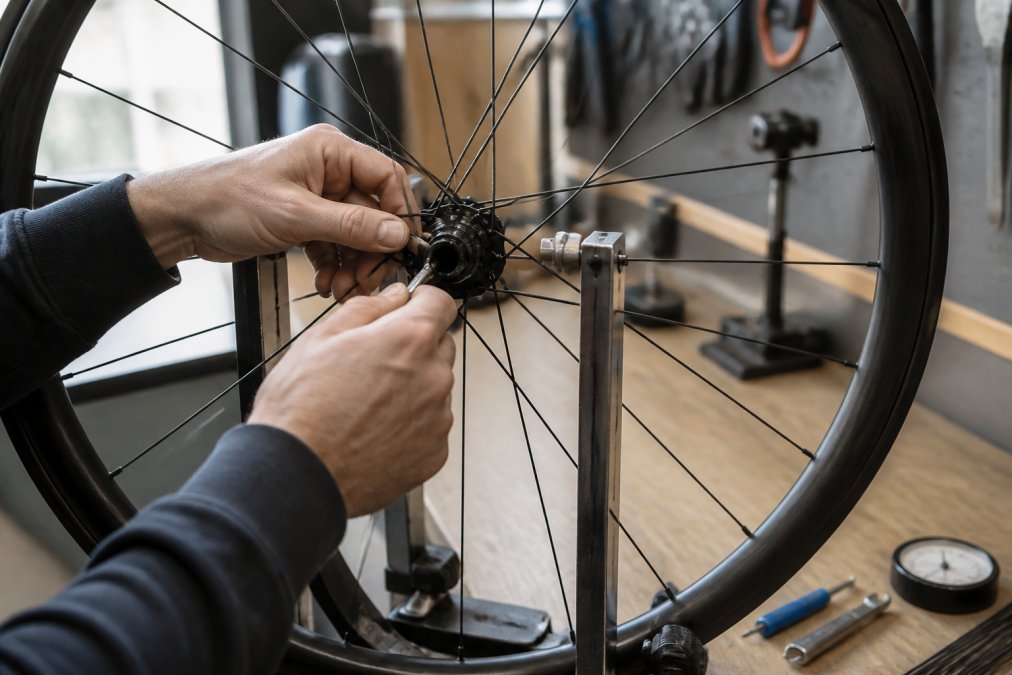
Spoke count, spoke type and hub engagement decide whether a wheelset survives years of hard riding or needs rebuilding after one season.
Spoke Count, Spoke Type and Lacing Patterns
Spoke count sets your baseline durability. Spoke type sets weight and ride feel. Lacing pattern sets how the load is distributed.
- Straight gauge: heavier, cheapest, most durable under abuse
- Butted: lighter, compliant, good for road and gravel
- Bladed: aerodynamic, needs a slotted hub flange, common on race builds
- Straight-pull: cleaner spoke line, no J-bend fatigue point
- J-bend: easier to source and replace anywhere
- 2-cross: standard rear lacing, good balance of stiffness and comfort
- 3-cross: heavier riders and loaded touring
- Radial: front wheels and non-drive sides only
Polymer spokes are a newer option. At STOXbyHand we build with carbon fibre, Berd and TiFi polymer spokes, and polymer spokes are the most noticeable change in ride quality of the three. They're lighter and they damp high-frequency vibration in a way steel and carbon don't.

Hub Engagement, Axle Spacing and Freehub Compatibility
Hub engagement is how quickly the drive mechanism picks up when you start pedalling. Higher engagement points mean less dead travel before power reaches the wheel.
Axle spacing and freehub compatibility are the two specs that most often rule out a wheelset. Check both before anything else.
- Thru-axle: 12x100 front, 12x142 rear is the modern road and gravel standard
- Quick-release: still common on older frames and some rim brake bikes
- Boost: 15x110 front, 12x148 rear for MTB
- Freehub body: HG, XDR or Micro Spline, must match your cassette
- Disc brake vs rim brake: not interchangeable, confirm your frame
Matching Custom Bike Wheels to Your Riding Discipline and Wheel Size
Wheel size standards decide tyre choice, frame clearance and how the bike handles. Getting this wrong is the most expensive mistake in the process.
Wheel Size Standards: 700c, 29er and 650b
700c and 29er share the same bead seat diameter of 622mm. The difference is tyre width and frame design, not rim diameter. 650b uses a 584mm bead seat diameter, which allows a wider tyre in a frame with limited clearance.
| Standard | Bead Seat Diameter | Typical Use |
|---|---|---|
| 700c | 622mm | Road, gravel, cyclocross |
| 29er | 622mm | MTB, gravel |
| 650b | 584mm | MTB, gravel, smaller frames |
For gravel riders, 650b is worth considering if your frame can't clear a wide enough 700c tyre. For road, 700c is the only practical choice.
Here's where custom builds earn their keep. A gravel racer doing long events on rough terrain needs a different wheel from a road racer chasing a personal best on smooth tarmac, even if both riders weigh the same. Our technical guidance from the European Tyre and Rim Technical Organisation sets the bead seat standards that every rim and tyre must meet, which is why sizing is not negotiable.
If you're weighing up options, our Berd Spoked Asymmetric 46 Gravel Wheelset at $2,950 uses an asymmetric rim profile to even out spoke tension between the drive and disc sides. On a symmetric rear disc wheel that tension difference can reach 40%, which is exactly the kind of imbalance that pulls a wheel out of true over time (Spoke Tension Measurement and Adjustment).

For riders chasing outright speed, the Carbon Spoked Wave 5031 at $2,600 is our fastest build, with a 24 carbon spoke count tuned for lateral stiffness so power transfer isn't lost to flex. If weight is the priority, the TiFi Polymer Spoked Gravel 45 at $2,990 uses spokes weighing just 2.2g each, among the lightest available.
Conclusion
The hard part isn't picking components. It's accepting that you can't optimise weight, aerodynamics, durability and cost at the same time, and choosing which one you'll sacrifice.
STOXbyHand builds hand-tensioned carbon wheelsets for road, gravel and MTB riders, with over 12 years of experience and spoke options including carbon fibre, Berd and TiFi polymer. Every build is configured to your weight, power and terrain rather than pulled off a shelf, and every wheel is tensioned and trued by hand before it ships.
Tell us your weight, your discipline and your terrain, and we'll spec the build. Get started with STOXbyHand and ride a wheelset matched to you rather than to an average.
Frequently Asked Questions
What are the benefits of hand-built custom wheels over factory sets?
Hand-built wheelsets are tensioned and trued by a person, not a machine, so spoke tension is even across the wheel and stays that way longer. That matters on rough gravel and under heavier riders, where factory wheels often lose tension early. You also get to specify rim depth, spoke count, hub engagement and axle spacing for your exact bike. The trade-off is cost and build time, but a well-built custom bike wheelset typically needs less truing over its life.
How do I choose the right spoke count for my weight and riding discipline?
Road riders under 75kg can run 20 front and 24 rear spokes comfortably. Above 85kg, or on gravel and MTB, step up to 24 front and 28 rear. Heavier riders, e-bike conversions and loaded bikepacking builds should look at 28 front and 32 rear. Spoke type matters too: a strong bladed or polymer spoke at lower count can outperform a cheap round spoke at higher count, because the wheel holds tension better.
Why choose polymer or carbon spokes for a custom wheelset?
Polymer spokes such as TiFi weigh around 2.2g each and damp road buzz better than steel, which reduces fatigue on long rides without losing stiffness. Carbon spokes cut rotational weight and improve power transfer because they resist stretching under load. Both options let a builder hit a target weight and ride feel that steel spokes cannot match. You will feel the difference most on rough surfaces and in sprint efforts, where less spoke stretch means less wasted energy.
How does rim depth affect handling and aerodynamics?
Deeper rims reduce drag, so a 45-50mm rim is faster on flat roads and in crosswinds it can feel twitchy if you are a lighter rider. Shallower rims around 30-35mm are more stable and comfortable but give away some aerodynamic gain. Gravel riders usually settle between 35mm and 45mm. The 105% rule is a useful guide: the tyre should be no wider than 105% of the rim's external width for the aerodynamics to work.
What is the difference between carbon fibre and alloy rims for custom builds?
Carbon fibre rims are lighter, can be shaped into deeper aerodynamic profiles and absorb vibration better, which is why most custom performance builds use them. Aluminium alloy rims cost less, handle impact damage more gracefully and are easier to repair, but they are heavier and limited in profile. For competitive road and gravel racing, carbon is the usual choice. For a training or commuter wheelset, alloy still makes sense.
Are 700c and 29-inch wheels interchangeable?
Yes, 700c and 29-inch share the same 622mm bead seat diameter, so the rim is the same size. The difference is tyre width and frame clearance. A 29er runs wider MTB tyres and needs a frame built for that volume. A 700c wheel with a 28mm road tyre will not fit a 29er frame with tight clearance, and vice versa. Check tyre clearance and axle spacing before swapping.
How does the custom wheel ordering process work?
Most builders start with a short consultation covering your weight, riding style, terrain, frame and axle spacing. From there they recommend rim depth, spoke type and count, and hub specification. You do not need to send your bike in; accurate measurements from your current wheels are usually enough. A good builder will confirm hub standards, brake type and tyre clearance before starting, then hand-build and tension the wheels before shipping.