

Table of Contents
- Start With Your Frame: Axle Standards and Dropouts
- Road Bike Hub Spacing: Measuring Over-Locknut Dimension
- Road Bike Freehub Body Compatibility and Cassette Standards
- Bicycle Hub Bearing Types: Cartridge vs Cup-and-Cone
- Engagement Points, Pawls and Ratchet Drives
- Disc-Brake vs Rim-Brake Hub Selection
- Road Bike Hub Maintenance and Long-Term Ownership Cost
- A Step-by-Step Compatibility Checklist for Your Road Bike
- Frequently Asked Questions
Last Updated: October 16, 2026
Start With Your Frame: Axle Standards and Dropouts
The frame decides which road bike hubs you can buy. A hub is the centre of the wheel: shell, axle, bearings and freehub body. Get the axle type wrong and nothing else matters.
Every road frame locks you into one axle system:
- Quick release (QR): a 9mm front and 10mm rear skewer clamps the hub into an open dropout.
- Thru-axle: a 12mm bolt threads through the hub and both dropouts. Stiffer, and now standard on most new road bikes.
Thru-axles hold the wheel more rigidly under hard cornering and out-of-the-saddle efforts. QR is lighter and simpler, and older frames still use it.
Quick Release vs Thru-Axle: What Your Frame Accepts
An open slot at the bottom of the dropout is QR; a closed hole with a threaded bolt is thru-axle.
You cannot convert one to the other without adapters, and adapters only exist for some hubs. Buy the correct axle type from the start.
Reading Your Frame Specs Before You Buy
Your frame's spec sheet lists the axle standard, hub spacing and maximum tyre size. Check three things:
- Axle type and diameter
- Hub spacing
- Brake mount type
Most new road frames run 12mm thru-axles front and rear; older rim-brake frames run QR. Confirm yours rather than assuming.
Road Bike Hub Spacing: Measuring Over-Locknut Dimension
Road bike hub spacing is the distance between the outer faces of the hub locknuts, the over-locknut dimension (OLD). The road standard is 100mm front and 142mm rear for thru-axle, or 130mm rear for QR. Match it exactly: a hub 2mm too wide won't sit straight, and forcing it flexes the frame.
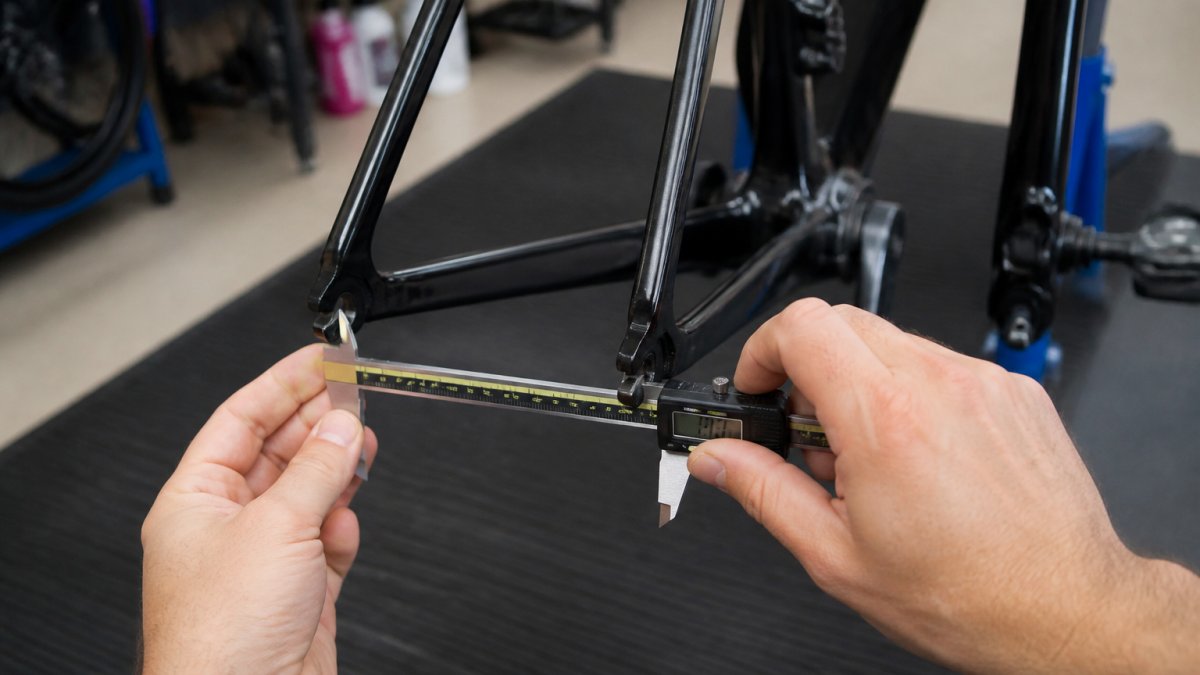
How to Measure OLD With Calipers
Remove the wheel. Measure the gap between the inner faces of the dropouts with digital calipers.
- 100mm front: standard road thru-axle and QR
- 130mm rear: QR road
- 142mm rear: thru-axle road
- 135mm rear: older QR and some gravel frames
Write the number down. Gravel and mountain frames use wider spacing, so don't assume road numbers apply.
Road Bike Freehub Body Compatibility and Cassette Standards
Road bike freehub body compatibility comes down to matching the freehub to your cassette, not your frame. The freehub is the ratcheting sleeve the cassette slides onto. If it doesn't match your groupset, the cassette won't fit.
Three standards cover most road bikes:
- Shimano HG: the long-standing road standard, 11-speed and below
- Shimano Micro Spline: 12-speed mountain, not road
- SRAM XDR: 12-speed road and gravel, including SRAM's wireless groupsets
Shimano HG, Micro Spline and SRAM XDR Explained
Shimano HG is the safe default for most road riders, taking 8 to 11-speed cassettes. SRAM XDR takes SRAM 12-speed cassettes and needs a different freehub body than HG. Micro Spline is Shimano's 12-speed mountain standard and rarely appears on road bikes. Check your cassette brand and speed count before ordering; the wrong freehub body means a new part or a swap.
Bicycle Hub Bearing Types: Cartridge vs Cup-and-Cone
Bicycle hub bearing types split into two designs that affect how long your hubs last and what they cost to own. Sealed cartridge bearings are self-contained units pressed into the hub. Cup-and-cone bearings run loose balls between races cut into the hub itself. Cartridge bearings are the modern default: they resist water and grit, and you replace the whole unit when worn. Cup-and-cone bearings roll smoothly when fresh but need regular greasing and adjustment.
Serviceability: Tools, Parts and Time
Cartridge bearings are replaced, not adjusted: press the old bearing out and a new one in with a bearing press or a drift and mallet. Bearings are standard sizes, so replacements are widely available and the job takes an hour or two with the right tools.
Cup-and-cone bearings are adjusted, not replaced, until the races pit. You need cone spanners in the correct sizes, a clean work area and patience. The balls are cheap, but the races are part of the hub, so once they pit the hub is scrap.
Long-Term Ownership Cost
The honest comparison is not "cartridge is better", but:
- Cartridge: higher upfront hub cost in most cases, predictable replacement cost, standard parts, no adjustment drift. Best for riders who want low attention and are happy to pay a shop or buy a press.
- Cup-and-cone: lower upfront cost, cheap consumables, but requires regular adjustment and has a finite race life. Best for dry-weather riders who enjoy maintenance and accept the hub is disposable.
For year-round wet riding, sealed cartridges need less attention; dry-weather tinkerers can service cup-and-cone at home cheaply.
Ceramic Bearings: Worth It?
Some premium hubs use ceramic bearings for lower friction, but the real-world gain is small next to tyre choice and drivetrain condition, and they can be less tolerant of contamination. Treat them as a marginal refinement, not a reason to buy.
What to Check Before You Buy
- Bearing size and availability. Confirm the bearing code is a standard size you can source locally.
- Replacement tools. Check whether the hub needs a proprietary tool or a standard press.
- Freehub serviceability. The freehub mechanism often wears before the main bearings, so confirm it can be serviced or replaced.
- Spare parts support. A hub with no spare parts path is a disposable hub, whatever the bearing type.
Most quality road bike hubs now use sealed cartridge bearings, the safer long-term choice for most riders. The deciding factor is whether you can get parts and tools when they wear out.
Engagement Points, Pawls and Ratchet Drives
Engagement points decide how quickly your hub catches when you start pedalling. More points mean less crank rotation before drive kicks in. Two mechanisms do the work:
- Pawls: spring-loaded teeth that click into a toothed ring
- Ratchet drives: two toothed rings that mesh under spring pressure
A 36-tooth ratchet gives 36 engagement points, quick pickup for sprinting and technical climbing, where lower counts feel vague. Ratchet drives handle torque better and need less maintenance than pawl systems, but cost more. For most road riders, a 36-tooth ratchet is the sweet spot.
Disc-Brake vs Rim-Brake Hub Selection
Disc-brake and rim-brake hubs are not interchangeable, so pick the one your frame needs. Where the braking force goes changes the axle, flanges, spoke count and rotor interface.
Carbon Spoked 5031 (1281 grams) →
Rim-brake hubs have a plain flange: the pads grip the rim, so the hub carries no braking load, letting builders use narrower flange spacing, lighter shells and fewer spokes. If your frame has calliper or cantilever mounts and a bare rim braking surface, you need rim-brake hubs, and the range is shrinking every season.
Disc-brake hubs have a rotor mount and a stronger axle to take braking torque. Most new road frames now run disc brakes, so this is where the choice has moved.
Rotor Mount Standards: Centre Lock vs Six-Bolt
If you are buying disc hubs, the rotor mount is a second compatibility check after the axle. Two standards cover almost every road bike:
- Centre Lock: the rotor drops onto a splined carrier and is held by a single lockring. Faster to fit, less prone to misalignment, and the default on most road groupsets.
- Six-bolt: the rotor bolts to the hub flange with six T25 bolts. Common on mountain and gravel hubs, and on some road wheels.
A Centre Lock hub cannot take a six-bolt rotor without an adapter, which adds stack height and a small weight penalty. Match the mount to your rotors or budget for new ones, and check the lockring type: some hubs need an external-tooth lockring, others internal, and the wrong tool will not fit.
How Brake Type Narrows Your Hub Options
Work through this before you shop:
- Confirm the frame mount. Flat mount and post mount are frame-side standards; the hub only needs to match the rotor mount, not the calliper mount.
- Confirm the rotor mount. Centre Lock or six-bolt, and the lockring style if Centre Lock.
- Confirm the axle. Disc road frames almost always run 12mm thru-axle, but check front and rear separately.
- Confirm spoke count and lacing. Disc braking loads one side of the wheel, so disc hubs typically need more spokes and a stiffer lacing pattern than rim-brake equivalents.
- Confirm rotor size clearance. Larger rotors need frame and fork clearance, and some hubs only support up to a certain rotor diameter.
A rim-brake hub will not accept a rotor, and a disc hub will not fit a rim-brake frame's dropout spacing in most cases. No adapter turns one into the other.
What This Means for Wheel Building
Disc hubs need more spokes and stiffer lacing to cope with one-sided braking force: a common pattern is 24 front and 24 or 28 rear for disc road, against 20 front and 24 rear for a comparable rim-brake build. Rim-brake wheels can run fewer spokes for less weight, which is why weight-focused rim-brake builds still exist.
On an older rim-brake frame, buy rim-brake hubs and accept the narrower choice; on disc, treat the rotor mount as a hard requirement, not a preference.
Road Bike Hub Maintenance and Long-Term Ownership Cost
Road bike hub maintenance is simple if you keep water out. Check for play by rocking the wheel side to side. Spin it and listen for grinding.
A basic routine:
- Wipe the hub shell after wet rides
- Check bearing play every few months
- Regrease cup-and-cone bearings annually
- Replace cartridge bearings when they feel rough
Sealed cartridges cost less over time because you swap them, not adjust them; cup-and-cone hubs are cheaper to service but demand more time.
The bigger cost is the freehub body. A worn ratchet or pawl set can fail mid-ride, and replacements aren't cheap. Buy a hub with a serviceable mechanism and you'll get years more from the wheel.
This is where hand-built wheels pay off. At STOXbyHand, we build every wheel by hand to 0.1mm trueness, with uniform spoke tension. Our hubs use a 36-tooth star ratchet and heat-treated alloy axles for stiffness at low weight.
A Step-by-Step Compatibility Checklist for Your Road Bike
Work through this list in order before you buy. Each step rules out hubs that won't fit.
- Find your frame spec sheet. Note the axle type and hub spacing.
- Measure OLD with calipers. Confirm 100mm front, 130mm or 142mm rear.
- Check the brake type. Disc or rim, and the rotor mount standard if disc.
- Identify your cassette. Brand, speed count and freehub standard.
- Confirm spoke count and lacing. Disc hubs need more spokes.
- Check rider weight limits. Heavier riders need stiffer builds.
- Confirm warranty and support. Know what's covered before you pay.
Shimano's official compatibility charts list which freehub bodies take which cassettes. Cross-check your groupset against them before ordering.
For heavier riders, spoke count matters as much as the hub. Our Carbon Spoked 5031 comes in a 20/20 build for riders under 85kg, and a 21/24 build with 16 drive-side rear spokes for riders up to 115kg with bike. The extra rear spokes add the lateral stiffness you need under load.
| Check | What to Confirm | Why It Matters |
|---|---|---|
| Frame spec | Axle type and spacing | Wrong axle means no fit |
| OLD measurement | 100mm front, 130/142mm rear | Prevents frame flex |
| Brake type | Disc or rim, rotor mount | Braking load differs |
| Cassette | Brand, speed, freehub | Cassette must slide on |
| Spoke count | Matched to rider weight | Stiffness under load |
| Warranty | Cover and support terms | Long-term cost |
Choosing hubs is a compatibility puzzle, not a spec sheet contest. Get the axle, spacing, freehub and brake type right, and the rest is refinement. Get one wrong and the wheel won't work, however much you spent.
That's the part we take seriously at STOXbyHand. We've spent over 12 years building hand-built carbon fibre wheelsets for road, gravel and mountain riders, with spoke options including carbon fibre, Berd and TiFi polymer. Every build is customised to your weight, riding style and terrain, then hand-built to 0.1mm trueness with uniform spoke tension.
Tell us your frame, your weight and how you ride. We'll build the wheelset that matches. Get started with STOXbyHand and ride wheels built for your bike, not someone else's.
Frequently Asked Questions
Can you explain the meaning of hub spacing on a bike?
Hub spacing, or over-locknut dimension (OLD), is the distance between the inner faces of your frame's dropouts. Road bike hubs typically use 100mm front and 130mm or 142mm rear spacing. Measure yours with calipers before buying. A hub that doesn't match your frame simply won't fit, so this is the first spec to confirm.
Are ceramic bearings worth it in road bike hubs?
Ceramic bearings reduce friction and resist corrosion better than steel, which suits riders chasing marginal gains or logging big kilometres in wet conditions. The trade-off is cost. Well-sealed steel cartridge bearings deliver most of the performance at a lower price. If you ride in the rain often or race, ceramic is a reasonable upgrade; otherwise, spend the money on better seals.
How many points of engagement should a road bike hub have?
For road riding, 36 to 54 points of engagement covers most needs. Higher engagement counts reduce the dead spot before power reaches the wheel, which matters when accelerating out of corners or sprinting. The Carbon Spoked 5031 uses a 36-tooth star ratchet for quick uptake. Below 24 points feels vague on technical climbs or fast group rides.
What is the difference between a freehub and a freewheel?
A freehub has the ratchet mechanism built into the hub body, and the cassette slides onto it. A freewheel combines the gears and mechanism in one unit that threads onto the hub. Almost all modern road bike hubs use freehubs because they handle more gears, run truer, and are easier to service. Freewheels appear on older or budget bikes.