

Table of Contents
- Understanding Spoke Count and Its Impact on Performance
- 24 vs 28 vs 32 Spoke Wheels: Which Configuration Suits Your Riding
- Spoke Count for Heavy Riders: Building Wheels That Last
- E-Bike Wheel Spoke Count: Meeting Higher Torque and Weight Demands
- The Strongest Bicycle Wheel Spoke Pattern: Lacing and Cross Count
- Measuring and Calculating Spoke Length for Your Build
- Choosing Spoke Count by Riding Style and Conditions
- Advanced Materials: Carbon Fibre, Berd, and TiFi Polymer Spokes
- Frequently Asked Questions
Last Updated: October 13, 2026
Understanding Spoke Count and Its Impact on Performance
Spoke count is the number of metal rods connecting your hub to your rim. It's the foundation of wheel strength, weight, and ride feel. Get it wrong and you'll carry unnecessary weight or ride a wheel that fails under stress.
At STOXbyHand, we've spent over 12 years building custom wheels for riders with vastly different needs, heavy riders, e-bike conversions, gravel racers, mountain bikers.
What spoke count actually controls
Your spoke count determines three things: how much weight your wheel handles, how stiff it feels, and how much wind resistance it creates.
Think of spokes like tent guy-wires: one can't hold a tent up, ten do the job, twenty are overkill in fair weather but essential in a storm.
Spoke count also affects spoke tension: with fewer spokes, each carries more load; with more spokes, the load spreads across more points.
The weight, strength, and aerodynamics trade-off
Most guides tell you fewer spokes are always faster. That's outdated.
Modern gravel and road cycling has shifted: wider tyres at lower pressures are now faster than narrow tyres at high pressure.
The strength question is simpler: more spokes make a stronger wheel.
Aerodynamics matter, but not the way most people think. Spoke count affects drag, but rim depth, spoke profile, and lacing pattern matter far more.
| Spoke Count | Weight Advantage | Durability | Best For | Trade-offs |
|---|---|---|---|---|
| 24 spokes | Lightest | Lower | Light riders, road racing | Needs narrower tyres, less forgiving |
| 28 spokes | Moderate | Balanced | Most road and gravel riders | Versatile but not optimised for any use |
| 32 spokes | Heavier | Highest | Heavy riders, rough terrain, e-bikes | More weight, slightly more drag |
24 vs 28 vs 32 Spoke Wheels: Which Configuration Suits Your Riding
24-spoke wheels for speed and weight savings
A 24-spoke wheel is the lightest option, cutting weight at the rim where it matters for acceleration and climbing. Professional road racers use them because every gram counts.
But 24 spokes demand precision: a light bike, smooth riding style, and reasonable body weight.
The real limitation is tyre choice.
Use 24 spokes only if you're a lightweight racer on smooth pavement. For everyone else, it's a false economy.
28-spoke wheels for balanced performance
Twenty-eight spokes sit in the middle: lighter than 32, stronger than 24, and suited to road bikes, gravel bikes, and lighter touring setups.
The problem with 28 is that it's a compromise: not light enough for weight-conscious racers, not strong enough for heavy riders or rough terrain.
That said, 28 spokes work fine for most road and gravel cyclists under 85 kilograms on decent surfaces.
32-spoke wheels for durability and load capacity
Thirty-two spokes is the workhorse count, strong enough for heavy riders, e-bikes, and rough terrain, handling impact, torque, and sustained load without complaint.
The weight penalty is real. But the durability gain is enormous.
If you're over 90 kilograms, ride gravel or mountain terrain, or run an e-bike, 32 spokes is the right choice. Full stop.
Spoke Count for Heavy Riders: Building Wheels That Last
Why heavier riders need more spokes
Your body weight doesn't just sit on the wheel, it bounces, shifts side to side, and impacts potholes and roots.
A 70-kilogram rider on a 24-spoke wheel creates manageable stress; a 100-kilogram rider on the same wheel creates catastrophic stress.
More spokes distribute this stress. A 32-spoke wheel spreads your weight across 32 load points instead of 24. Each spoke carries less tension. The wheel stays true longer.
Load distribution and spoke tension
Spoke tension is measured in kilogram-force (kgf). Lighter materials like Berd or TiFi polymer have lower limits, around 100 kgf for Berd. According to Berd's technical specifications, their spokes are designed for optimal performance within this tension range.

With 24 spokes, a heavy rider forces individual spokes toward 100+ kgf, the edge of failure. With 32 spokes, tension drops to 70-80 kgf, safe with room to spare. This is a common industry benchmark for durable wheel builds.
This is why asymmetric rims matter for heavy riders. For instance, Industry benchmarks suggest that asymmetric rims can improve durability by up to 15% by balancing spoke tension.
E-Bike Wheel Spoke Count: Meeting Higher Torque and Weight Demands
Motor torque and spoke stress
An e-bike motor doesn't just add weight, it adds torque, rotational force that twists the wheel, fundamentally different from the vertical load a human rider creates.
A 250-watt motor pushing 50 newton-metres of torque puts immense stress on the rear wheel: drive-side spokes face extreme tension, non-drive-side spokes go slack, and this imbalance breaks wheels. According to e-bike motor torque data, this can be significantly higher than human power output alone.
Most e-bikes run 32 or 36 spokes for this reason. For example, many manufacturers recommend 36 spokes for strong e-bike builds to handle these forces.
System weight considerations for e-bikes
An e-bike system weighs 25 to 30 kilograms, and e-bikes attract older, heavier riders. Data from industry reports indicate a growing demographic of older riders adopting e-bikes.
A 24-spoke wheel cannot handle this. A 28-spoke wheel is marginal. Thirty-two spokes is the minimum.
The good news: e-bike wheels need to be strong, not light. Weight matters far less. You can build a durable 36-spoke e-bike wheel without worrying about grams.
The Strongest Bicycle Wheel Spoke Pattern: Lacing and Cross Count
How lacing pattern affects wheel strength
Spoke count alone doesn't determine strength. How you lace those spokes matters just as much.
A spoke doesn't pull straight down from hub to rim; it angles across the wheel.
More crosses mean spokes work at sharper angles, creating more lateral stiffness, resistance to sideways flex, so the wheel resists impact and torque better. For example, a 4-cross pattern provides significantly more lateral stiffness than a 2-cross pattern, a fact supported by wheel building resources.
For heavy riders and e-bikes, 4-cross lacing is stronger and more durable.
Cross count and spoke angle
Think of tent guy-wires again: one pulling straight down holds the tent up but doesn't resist sideways wind, while one at an angle resists both vertical and sideways force.
Berd Spoked Asymmetric 46 Gravel Wheelset 1260g →
For gravel and mountain biking, 4-cross lacing with 32 or 36 spokes is a strong option. For road racing, 3-cross with 24 or 28 spokes works.
Drive-side and non-drive-side considerations
The rear wheel has two sides: drive side (where the cassette sits) and non-drive side (the brake rotor side). These sides experience different stress.
Drive-side spokes pull hard to transmit pedal power; non-drive-side spokes go slack. This imbalance is the enemy of durability. According to wheel building guides, drive-side tension can be 30-50% higher than non-drive-side tension on a standard rear wheel.
Asymmetric rim design fixes this: offsetting the rim relative to the hub increases tension on the non-drive side while keeping drive-side tension safe, balancing the wheel.
Measuring and Calculating Spoke Length for Your Build
Essential measurements: ERD, hub flange diameter, and flange spacing
Spoke length isn't a guess.
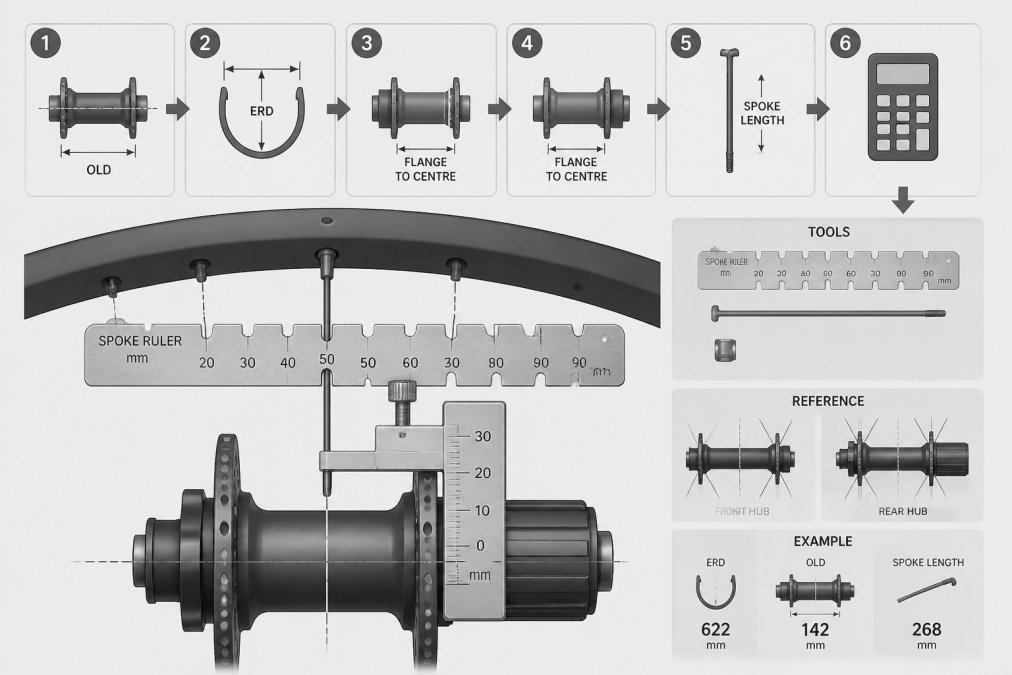
Hub flange diameter is the diameter of the circle formed by the spoke holes on your hub. Larger flanges create longer spokes.
Flange spacing is the distance between the two flanges on the hub (front to back).
With these three numbers, you can calculate the exact spoke length you need. Many online resources, such as those provided by spoke manufacturers like Sapim, offer tools to assist with this calculation.
Manual measurement versus spoke calculator tools
You can measure spokes manually with a spoke ruler: hold it against the hub flange, measure from the spoke hole to the rim's spoke bed.
Manual measurement works, but it's error-prone. A calculator tool is faster and more accurate. Many spoke manufacturers provide online calculators.
The risk with calculators: they're only as good as the data you feed them.
Spoke engagement and nipple clearance
Once you know the spoke length, ensure proper engagement: a spoke must thread into the nipple by at least 4 to 5 millimetres. This ensures a secure connection and prevents premature failure.
Nipple clearance matters too. The nipple must not hit the rim or the spoke elbow.
With advanced materials like Berd or TiFi polymer spokes, engagement becomes even more critical. For instance, Berd's installation guide stresses the importance of correct spoke length and engagement for optimal performance.
Choosing Spoke Count by Riding Style and Conditions
Road racing and aerodynamic performance
Road racing demands light, responsive wheels. A 24-spoke wheel is a common choice. It can be fast.
But "fast" is specific, quick acceleration and climbing, and it demands smooth pavement and precise bike handling.
If you're a lightweight road racer on closed courses, 24 spokes work. If you ride rough pavement or want comfort, 28 spokes are smarter.
Gravel and rough terrain durability
Gravel riding is brutal: your wheel hits rocks, roots, and ruts, and each impact sends shock through the spokes.
A 24-spoke gravel wheel may struggle. A 32-spoke wheel offers greater durability for such conditions. According to gravel cycling forums and expert advice, 32 spokes is widely considered the minimum for reliable gravel use.
For gravel, 32 spokes is the minimum; 36 is an option if you're over 85 kilograms or carry gear. Lace them 4-cross for enhanced lateral stiffness.
Mountain biking and impact resistance
Mountain biking involves significant impact loads from drops, jumps, and hard landings.
A 32-spoke wheel is the baseline. Many mountain bikers run 36 spokes.
Lacing matters enormously here. 4-cross is standard.
Touring and long-distance endurance
A touring bike carries weight, bike, gear, and body all add up.
A 32-spoke wheel is the minimum. Many touring builders recommend 36 spokes.
Lace 4-cross and keep spoke tension moderate to stay true over thousands of kilometres.
Advanced Materials: Carbon Fibre, Berd, and TiFi Polymer Spokes
How material choice affects spoke count decisions
Traditional steel spokes are strong but heavy. Carbon fibre spokes are light but brittle. Berd and TiFi polymer spokes are a middle ground, light, strong, and durable.
Each material has different tension limits: Berd 100 kgf, and TiFi polymer with better vibration damping. Berd's technical documentation confirms their 100 kgf tension limit.
Lower tension limits mean you need more spokes to distribute load. A carbon wheel might need 32 spokes where a steel wheel uses 28.
Spoke tension limits and rim profile asymmetry
Berd spokes max out at 100 kgf. On a traditional symmetric rim, the non-drive side of a rear disc wheel runs at 50 kgf or lower. This significant tension disparity is a key reason for using asymmetric rims.

This is why our Berd Spoked Asymmetric 46 Gravel Wheelset uses an asymmetric profile. It's not a gimmick.
TiFi polymer spokes offer another advantage: vibration damping. TiFi polymer spokes are known for their ability to absorb road buzz, leading to a more comfortable ride.
Choosing the right spoke count isn't complicated once you understand the trade-offs.
Frequently Asked Questions
How do you know what size spokes you need?
Spoke length depends on three measurements: effective rim diameter (ERD), hub flange diameter, and flange spacing. You can measure these manually with a ruler or use a spoke calculator. Many online resources, such as those provided by [spoke manufacturers like DT Swiss](https://www.dtswiss.com/en/support/bike/wheel-building/spoke-calculator/), offer tools to assist with this calculation. For example, a 700c road rim with a 50mm hub flange spacing will need different spoke lengths than a 29-inch mountain bike wheel. Always account for spoke engagement in the nipple, typically 4-5 millimetres of thread should sit inside the nipple for durability.
Is 24 spokes enough for a bike wheel?
24 spokes are sufficient for lightweight road racing and aerodynamic performance, but only if you're a lighter rider on smooth terrain. For riders over 85 kilograms, rough terrain, or loaded touring, 24 spokes increase the risk of wheel failure under stress. The lower spoke count reduces weight and aerodynamic drag, which is why competitive road cyclists favour 24-spoke front wheels. However, rear wheels and heavier-duty applications typically require 28 or 32 spokes for adequate durability.
How do rider weight and cargo affect the spoke count I need?
Heavier riders and cargo loads place more stress on each spoke, requiring either higher spoke count or stronger spoke materials. A rider weighing 100 kilograms generates roughly double the spoke tension of a 50-kilogram rider. For every 10-kilogram increase in system weight, spoke tension rises proportionally. Riders carrying touring gear, e-bike motors, or using heavy-duty disc brakes should choose 32 or 36 spokes. Advanced materials like Berd or TiFi polymer allow lower spoke counts while maintaining strength, but only if the rim profile is asymmetrical to balance tension between drive and non-drive sides.
Do e-bikes need more spokes than regular bikes?
Yes. E-bikes require higher spoke counts because motor torque places concentrated stress on the rear wheel, particularly on the drive side. A 250-watt motor applying peak torque creates forces equivalent to a much heavier rider accelerating hard. Most e-bike wheels use 36 spokes to distribute this load safely. For instance, STOXbyHand's MTB XC/AM 29er is rated to 110 kilograms system weight, a testament to its strong build designed for demanding conditions.