

Table of Contents
- Road versus Gravel Wheel Purpose and Intended Terrain
- Rim Width and Tyre Support: Gravel Wheel Rim Width Explained
- 700c versus 650b Gravel Wheels: Diameter and Performance Trade-Offs
- Durability and Impact Resistance on Rough Surfaces
- Carbon Gravel Wheels versus Alloy: Material Performance Comparison
- Road and Gravel Wheel Compatibility: Can You Swap Them?
- Aerodynamics, Weight, and Rolling Efficiency
- Wheelset Comparison and Selection Guide
- Frequently Asked Questions
Last Updated: October 12, 2026
Road versus Gravel Wheel Purpose and Intended Terrain
When comparing road vs gravel bike wheels, you're looking at designs engineered for fundamentally different environments. A road bike wheel prioritises speed and efficiency on smooth pavement, while a gravel bike wheel is built to absorb impact and maintain traction on rough, unpredictable surfaces. The distinction isn't cosmetic; it shapes every aspect of the wheelset's design, from rim width to spoke count to material choice.
Road wheels typically feature narrower rims (internal width 17-21 mm) paired with thinner tyres (23-28 mm). This setup reduces rolling resistance on asphalt and allows riders to maintain higher speeds with less effort. The wheel's geometry is optimised for the predictable demands of tarmac: consistent surface contact, minimal shock absorption, and aerodynamic efficiency.
Gravel wheels, by contrast, use wider rims (26-32 mm internal) to support larger tyres (40-50 mm or wider). This wider platform distributes impact forces across a larger contact patch, crucial when you're riding over rocks, roots, and rutted terrain. The increased volume also allows lower tyre pressures, typically 35-50 PSI versus 80-130 PSI for road setups, which further improves grip and comfort on rough ground.
Rim Width and Tyre Support: Gravel Wheel Rim Width Explained
Rim width is a critical specification when comparing road vs gravel bike wheels. It directly determines what tyre sizes you can safely mount and how well the tyre performs under load.

Internal rim width (measured inside the rim) dictates tyre support and sidewall stability. A narrower internal width (17-19 mm for road wheels) creates a tighter fit around the tyre bead, which works well for thin, high-pressure road tyres.
External rim width (the outer measurement) affects aerodynamics and tyre profile. Road rims typically measure 23-25 mm externally, while gravel rims range from 32-44 mm.
According to tyre manufacturer guidelines on rim compatibility, mounting a 45 mm gravel tyre on a road rim (internal width 19 mm) creates an unstable, pinched profile that increases puncture risk and reduces cornering confidence.
Many gravel wheelsets also feature asymmetric rim profiles, where the non-drive side is offset slightly inward. STOXbyHand's Core Gravel 35 Wheelset uses a 2.8 mm offset to achieve more even spoke tension and increase lateral stiffness.
700c versus 650b Gravel Wheels: Diameter and Performance Trade-Offs
Wheel diameter fundamentally changes how a gravel bike handles. The two standards in gravel riding are 700c and 650b, and each offers distinct advantages.
700c gravel wheels maintain the same diameter as road wheels, which means easier rolling on smooth sections and better momentum maintenance at speed. The larger diameter also rolls over obstacles more easily; a rock that might catch a 650b wheel slides underneath a 700c wheel.
650b gravel wheels are smaller and lighter, which reduces rotational mass and improves acceleration. They also allow slacker seat tube angles and lower bottom brackets, which can improve handling on technical terrain.
The choice depends on your route profile. If you're riding mixed terrain with significant road sections, 700c is faster overall. If you're racing on predominantly rough surfaces with tight singletrack sections, 650b's agility and lower weight create an advantage.
STOXbyHand offers the Core Gravel 35 Wheelset in both diameters, allowing you to test both standards and find what suits your riding style.
Durability and Impact Resistance on Rough Surfaces
Road wheels are built for consistent, predictable forces. Gravel wheels must survive repeated impacts from rocks, roots, and rough ground without cracking or losing true. This demands different material choices and construction techniques.
Rim material plays a crucial role. Road wheels typically use standard carbon fibre layups optimised for weight and aerodynamics. Gravel wheels require stronger carbon schedules with additional resin and fibre orientation to absorb lateral impacts. STOXbyHand's gravel wheelsets use Toray T700 carbon, a proven material that balances light weight with impact resistance.
Spoke count and design also affect durability. Road wheels often use 16-18 spokes per wheel to minimise weight. Gravel wheels typically use 24-28 spokes, which distributes impact forces across more load paths and reduces the stress on each individual spoke.
The real durability difference emerges after 100+ hours on rough surfaces. A road wheel subjected to gravel riding often develops spoke breakage, rim cracks, or lateral flex that requires frequent truing. A proper gravel wheelset maintains trueness and spoke tension through the same abuse because it was engineered for those forces from the start.
Carbon Gravel Wheels versus Alloy: Material Performance Comparison
Carbon and alloy represent fundamentally different engineering approaches for gravel wheels, each with genuine trade-offs.
Carbon wheelsets are lighter, stiffer, and more aerodynamic. They excel at high speeds and accelerate faster due to lower rotational mass. STOXbyHand's TiFi Polymer Spoked Gravel 45 at 1,190 grams demonstrates how carbon construction enables ultralight builds without sacrificing durability.

The downside: carbon wheels are more expensive and require careful handling. A hard impact can crack the rim, and repairs are often impossible; you replace the wheel rather than fix it. Carbon also demands specific brake pad compounds (organic or sintered metal, not rim brakes on carbon unless specifically rated).
Alloy wheelsets are heavier but more forgiving. They tolerate impacts better, rarely crack, and can often be straightened or repaired if damaged. Alloy wheels are also cheaper, making them accessible for riders who want to experiment with gravel without a large investment.
Berd Spoked Asymmetric 46 Gravel Wheelset 1260g →
For competitive gravel racing, carbon is the standard. The weight savings and stiffness advantage matter when you're racing 50+ miles on rough terrain.
Road and Gravel Wheel Compatibility: Can You Swap Them?
The short answer: no, not safely. Road and gravel wheelsets are incompatible in ways that go beyond just aesthetics.
Tyre clearance is the first barrier. Road frames typically have 25-28 mm of clearance between the tyre and frame. A 45 mm gravel tyre won't fit, and forcing a 35 mm gravel tyre into a road frame often rubs on the seat stays or chainstays.
Rim width incompatibility is the second issue. A road tyre (25 mm) mounted on a gravel rim (30 mm internal) creates an unstable, overly wide profile. The tyre sits too high on the rim, creating poor cornering support and unpredictable handling.
Brake compatibility matters too. Many modern gravel wheels use disc brakes exclusively. Road frames with rim brakes can't use those wheels. Even disc-brake road frames may have different axle standards (12 mm thru-axle versus 15 mm) than gravel frames, making swapping physically impossible.
A conversion checklist would include: frame clearance for larger tyres, brake type compatibility, axle standard matching, and rim width suitability for your tyre choice. For most riders, buying purpose-built wheelsets is simpler and safer than attempting a hybrid setup.
Aerodynamics, Weight, and Rolling Efficiency
Road wheels prioritise aerodynamics and rolling speed in ways gravel wheels don't need to.
Road wheels typically feature deeper rims (40-65 mm) with bladed or flattened spokes to reduce drag. This design creates a more aerodynamic profile that matters at speeds above 40 km/h. Gravel wheels use shallower rims (35-50 mm) because aerodynamics matter less when you're navigating rough terrain at variable speeds.
Weight distribution differs too. Road wheels are optimised for light weight everywhere: thin rims, thin spokes, minimal hub material. Gravel wheels accept slightly more weight to gain durability and impact resistance. A typical road wheelset weighs 1,200-1,400 grams. A comparable gravel wheelset weighs 1,400-1,600 grams.
Rolling resistance on smooth pavement favours road wheels. Narrow tyres at high pressure (100+ PSI) roll faster than wider tyres at lower pressure (40-50 PSI).
STOXbyHand's Carbon Spoked Wave 5031 demonstrates road wheel optimisation: 1,420 grams, 24 carbon spokes, and a wave-shaped rim profile that releases crosswind pressure. This wheelset excels at high-speed pavement riding but would feel harsh and unpredictable on gravel.

Wheelset Comparison and Selection Guide
The table below compares key specifications across road and gravel wheel categories to help you choose the right wheelset for your riding.
| Specification | Road Wheels | Gravel Wheels | Winner |
|---|---|---|---|
| Internal Rim Width | 17-21 mm | 26-32 mm | Gravel (wider support) |
| Tyre Clearance | 25-28 mm | 50+ mm | Gravel (versatile) |
| Spoke Count | 16-20 | 24-28 | Gravel (durability) |
| Typical Weight | 1,200-1,400 g | 1,400-1,600 g | Road (lighter) |
| Aerodynamic Rim Depth | 40-65 mm | 35-50 mm | Road (faster) |
| Impact Absorption | Poor | Excellent | Gravel |
| Pavement Rolling Resistance | Low | Moderate | Road |
| Rough Terrain Performance | Poor | Excellent | Gravel |
| Price Range | £1,500-3,500 | £1,400-3,500 | Similar |
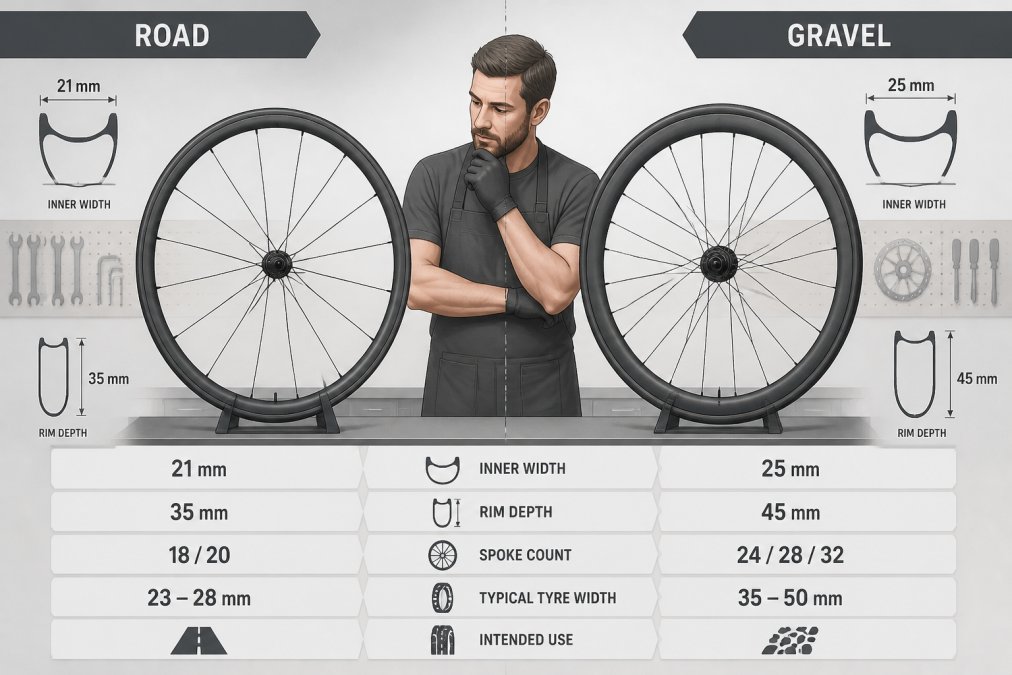
The choice depends entirely on your primary riding environment. If you ride mixed terrain, gravel wheels offer better all-around performance. If you're racing gravel events on rough terrain, gravel wheels are non-negotiable.
At STOXbyHand, we build hand-crafted wheelsets for both disciplines. Our TiFi Polymer Spoked Gravel 45 and Berd Spoked Asymmetric 46 Gravel Wheelset use advanced spoke materials, TiFi polymer at 2.2 grams per spoke and Berd polymer with 15 times the strength-to-weight ratio of steel, to achieve ultralight, durable gravel builds.
Research from gravel racing technical guides shows that riders competing on rough surfaces benefit most from purpose-built gravel wheels with 24+ spoke counts and internal rim widths above 28 mm.
For riders transitioning from road to gravel, the wheelset choice is your biggest performance lever. A road wheel on gravel will feel harsh, unpredictable, and prone to mechanical failure. A gravel wheel on pavement feels sluggish but is safe and durable.
Road and gravel bike wheels solve different problems for different terrain. Choosing the right wheelset means matching your wheel to where you actually ride.
Frequently Asked Questions
What is the difference between road bike wheels and gravel bike wheels?
Road bike wheels feature narrow rims (typically 17-21 mm internal width) designed for 25-32 mm tyres at high pressures (90-130 psi), prioritising aerodynamics and speed on smooth pavement. Gravel bike wheels have wider rims (26-32 mm internal width) that support 35-50 mm tyres at lower pressures (40-65 psi), offering better traction, comfort, and impact resistance on rough surfaces. Gravel wheels are also built with stronger spoke counts and reinforced rims to handle unpredictable terrain.
Can you use road wheels on a gravel bike?
Technically possible but not recommended. Road wheels lack the rim width to properly support wider gravel tyres, reducing stability and increasing puncture risk. The narrow rim profile also prevents you from running the lower pressures that make gravel riding comfortable and safe. Gravel bikes are designed for wider tyres and require rims that provide adequate tyre support across the full width.
Should I choose a 700c or 650b gravel wheelset?
700c gravel wheels offer faster rolling speed and work well on mixed terrain with longer stretches of pavement. They suit riders prioritising efficiency on varied routes. 650b wheels have a smaller diameter, lower centre of gravity, and better manoeuvrability in technical terrain, ideal for aggressive gravel racing and rocky, rooty conditions. Your choice depends on your typical riding: favour 700c for endurance mixed routes, 650b for technical off-road performance.
Are carbon gravel wheels worth it compared to alloy?
Carbon gravel wheels offer significant advantages: reduced weight (typically 200-400 g lighter), superior vibration damping for comfort, and better aerodynamics. However, they cost considerably more. Alloy wheels are durable, easier to repair, and adequate for most gravel riding. Carbon makes sense if you race, ride 50+ mile events regularly, or prioritise lightweight performance. For casual gravel riding, quality alloy wheels deliver reliable durability at lower cost.
What rim width is best for gravel tyres?
Gravel rims should have 26-32 mm internal width to properly support 35-50 mm tyres. Narrower rims (under 25 mm) under-support wider tyres, reducing grip and increasing pinch-flat risk. Wider internal rims (32 mm+) allow tyres to sit lower and wider, improving traction and comfort. Match your rim width to your typical tyre size: 26 mm internal for 35-42 mm tyres, 30-32 mm internal for 45-50 mm tyres.