

Table of Contents
- What Wheel Stiffness Actually Does
- Wheel Stiffness and Power Transfer
- Lateral Stiffness in Bicycle Wheels
- How Spoke Design Affects Stiffness
- Gravel Wheel Stiffness and Terrain Demands
- Wheel Stiffness and Ride Comfort
- Measuring Stiffness: What Matters for Your Riding
- Choosing the Right Stiffness for Your Build
- Frequently Asked Questions
Last Updated: October 15, 2026
What Wheel Stiffness Actually Does
Understanding why stiffness matters in cycling wheels is fundamental to efficient power transfer: a stiff wheel keeps energy moving forward, a flexy one wastes it. It matters most during hard efforts, sprinting, climbing out of the saddle, accelerating on gravel, where a flexy wheel feels sluggish and a stiff one feels sharp and direct. Stiffness comes in two forms: lateral (side-to-side) and torsional (twisting); lateral is what most cyclists feel first.
Wheel Stiffness and Power Transfer
Lateral stiffness affects how much of your effort reaches the road, but the mechanism is more specific than 'flexy wheels waste watts'.
Where the energy actually goes
Pedal force runs through the chain, cassette, freehub, hub shell, spokes, rim and tyre contact patch, and every element deflects slightly. A wheel that deflects sideways stores energy in the bent rim and stretched spokes and releases most of it as the load eases; the loss is the fraction that does not return to forward motion, plus extra tyre scrub and drivetrain misalignment.
In practice the recoverable portion is small: any well-built wheel transfers the overwhelming majority of a rider's power, and differences between two competent wheels are typically single-digit watts at race pace, not tens.
What the numbers actually look like
No universally accepted figure exists for 'watts lost to wheel flex', so treat any brand quoting one with caution. What is established is the relative scale:
- Drivetrain friction is the largest controllable loss in the system. A dirty or poorly lubricated chain can absorb several watts more than a clean, well-lubricated one at typical race power.
- Tyre rolling resistance varies by several watts between models and pressures, often more than the difference between two wheels of different stiffness.
- Wheel lateral deflection under hard efforts is typically 1-3 mm at the rim for a well-built wheel, with energy loss small relative to the items above.
If you are chasing speed, the chain, tyres and position usually return more than a stiffer wheel, and cost far less.
Why sprinters and climbers still want stiff wheels
This is why stiffness matters in cycling wheels, the case is about response and control, not watt savings:
- Sprinters apply large, rapidly changing side loads. A laterally stiff wheel keeps the rim tracking straight so the contact patch stays where the rider expects, a gain in confidence and line-holding, not measurable watts.
- Climbers out of the saddle at low cadence load the wheel torsionally as well as laterally; a torsionally stiff wheel feels more direct, which riders describe as 'sharper'.
- Heavier riders generate larger absolute side loads, so a given wheel deflects more under them, which is why spoke count and build recommendations scale with rider weight.
How spoke count and build change the result
Lateral stiffness rises with spoke count, spoke stiffness, bracing angle (how far the hub flange sits from the rim centreline) and the rim's resistance to bending.
Hand-building matters because tension consistency turns stiff components into a stiff wheel: uneven tension creates soft spots that deflect first regardless of spoke count, while even tension makes the wheel behave as one structure.
A practical way to judge power transfer
To test the effect yourself, use a repeatable route and a power meter:
- Pick a flat or gently rolling segment you can ride at a consistent effort.
- Ride it several times on your current wheel at a fixed target power (for example, 250 W) and record speed.
- Swap only the wheel, keeping tyres, pressure and position identical.
- Repeat and compare average speed at the same power.
Differences under about 0.5 km/h at the same power fall within normal day-to-day variation; only differences that repeat across several runs are worth taking seriously.
Lateral Stiffness in Bicycle Wheels
Lateral stiffness is the wheel's resistance to side-to-side bending.
A laterally stiff wheel resists that force: the rim stays true, spokes stay evenly tensioned, and power flows straight to the ground.
Gravel riders need exceptional lateral stiffness.
Spoke design is the primary factor in lateral stiffness.
Rim profile matters too: a wider internal width gives better lateral support, a narrower rim allows more flex.
How Spoke Design Affects Stiffness
Spoke tension is equally important: uneven tension creates weak spots, over-tensioning can damage spokes or rim, and under-tensioning reduces stiffness and durability. Hand-built wheels allow precise control; machine-built wheels often miss it.
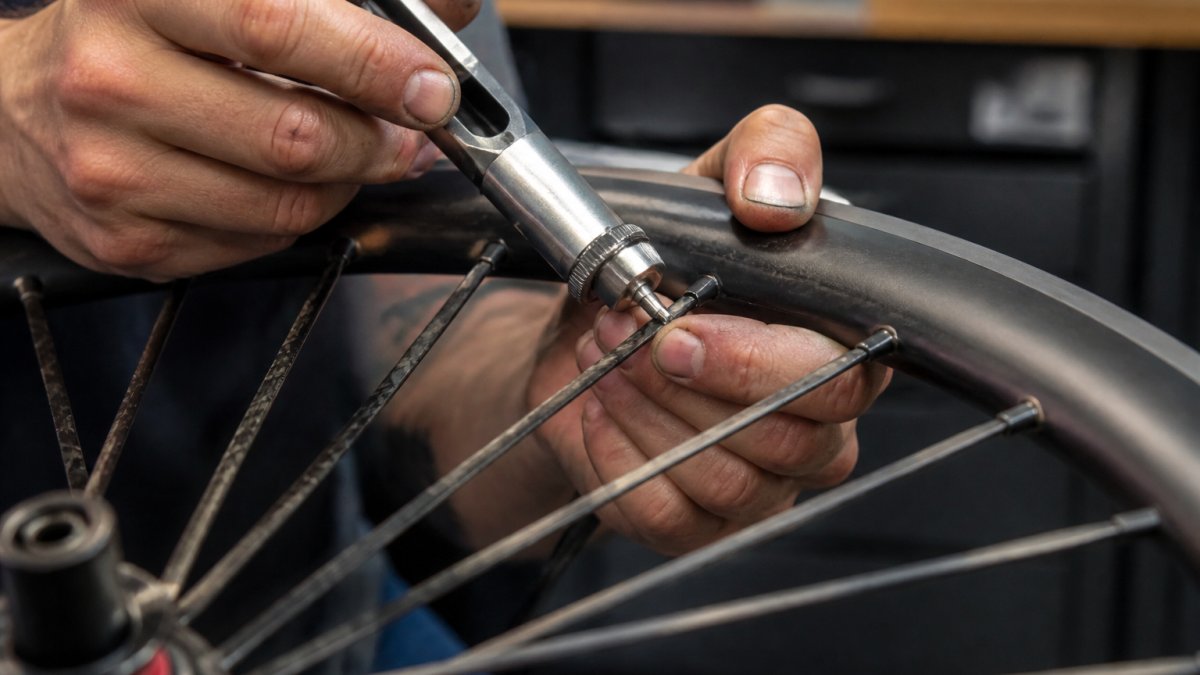
Carbon spokes and power delivery
Carbon spokes are significantly stiffer than steel at the same weight and transfer power more efficiently because they flex less under load, the gold standard for road and gravel racing.
The downside is brittleness, carbon spokes can crack if hit hard, and cost. But for riders who value maximum power transfer, they deliver real gains.
Our Carbon Spoked 5031 uses high-modulus carbon with a taper-lock interface between spoke and nipple, preventing the spoke from rotating and maintaining consistent tension over time.

Berd and TiFi polymer alternatives
Berd spokes are made from Dyneema, an ultra-high molecular weight polyethylene.
Their real advantage is durability in harsh conditions: they resist corrosion and fatigue and are impervious to the elements, making them exceptional for long-term reliability on rough gravel.
TiFi spokes combine titanium and aramid fiber.
The trade-off is cost, but for riders seeking maximum comfort without sacrificing stiffness, TiFi delivers.
Gravel Wheel Stiffness and Terrain Demands
This is where conventional wisdom breaks down.
Spoke choice becomes critical. Carbon spokes are stiff but brittle. Berd spokes are stiff and durable. TiFi spokes are stiff and compliant, they absorb vibration.

Rim depth also matters. Deeper rims (50mm+) provide more lateral support and stiffness but catch crosswinds more; for gravel racing, 45-50mm strikes the right balance.
Wheel Stiffness and Ride Comfort
Stiffness and comfort seem contradictory, but the relationship is more nuanced. A properly designed stiff wheel can be comfortable, depending on spoke material, rim construction and tyre setup.
Tire pressure is the primary comfort variable. Lower pressure provides compliance; higher pressure increases stiffness. A stiff wheel paired with low tire pressure can actually feel more comfortable than a flexy wheel with high pressure, the tire absorbs vibration.
Measuring Stiffness: What Matters for Your Riding
Stiffness is not a single number, and spec-sheet figures rarely translate directly into how a wheel feels under you. Understanding what is actually measured, and what is not, is the fastest way to avoid paying for stiffness you will never use.
Lateral stiffness: the measurement that matters most
Lateral stiffness is the wheel's resistance to side-to-side deflection at the rim. In a typical bench test the wheel is clamped at the axle, a known force is applied at the rim (often 10-20 kgf, or roughly 98-196 N), and a dial gauge or laser measures rim movement, expressed in newtons per millimetre (N/mm), the force needed to deflect the rim one millimetre.
A stiffer wheel returns a higher N/mm figure: 3 mm deflection under a 100 N side load is roughly 33 N/mm, 1.5 mm is roughly 67 N/mm. That doubling is meaningful on the bench but does not double your speed.
Torsional stiffness: the quieter measurement
Torsional stiffness is the wheel's resistance to twisting between hub and rim under drive torque. It is measured by locking the rim, applying a known torque at the hub (often 20-50 Nm) and reading angular deflection in degrees, expressed in newton-metres per degree (Nm/°).
Torsional stiffness matters most under hard, low-cadence efforts, a standing start, a steep pinch, a sprint from near-zero speed. Under steady high-cadence pedalling, the effect is far smaller than most marketing implies.
Why lab figures do not predict your speed
A bench test clamps the axle rigidly and applies force at one point; a real rider does neither. On the road the tyre, rim bed, spoke pattern, hub shell, frame rear triangle and shifting body weight all interact, so a very stiff bench wheel can feel vague if the tyre is over-inflated, and a modest one sharp if tyre and pressure suit the terrain.
- Bench stiffness is comparative, not predictive. Use it to compare two wheels under identical test conditions, not to estimate a speed gain.
- Tyre pressure changes the felt result more than a few N/mm. Dropping 10 psi (about 0.7 bar) on a 28 mm tyre alters ride feel more than most wheel swaps.
- Torsional and lateral stiffness are not interchangeable. A wheel can be laterally stiff and torsionally soft, or the reverse. Ask which figure a brand is quoting before comparing.
What you can measure yourself, cheaply
You do not need a lab to sanity-check a wheel. A few low-cost checks tell you more than a spec sheet:
- Spoke tension consistency. A tensiometer (entry-level units start around $80-$150 AUD) lets you compare tension across spokes; even tension within roughly ±10% is a reasonable target for a hand-built wheel.
- Trueness. A truing stand or an upside-down bike with a zip-tie pointer shows lateral runout; a well-built wheel typically holds within about 0.2-0.5 mm.
- Bearing condition and hub adjustment. Spin the axle by hand, gritty or notchy bearings, or play in the hub, mimic the feel of a flexy wheel and cost far less to fix.
A diagnostic sequence for locating power loss
If a wheel feels slow, the wheel is not always the cause. Work through this order before buying anything:
- Tyres and pressure. Check for a slow puncture, worn casing, or pressure wrong for your weight and surface.
- Drivetrain friction. A dirty chain, worn cassette or mis-adjusted derailleur can absorb more watts than a modestly flexy wheel. Clean and lubricate the chain, then re-test.
- Bearings and hub adjustment. Rough bearings or a binding freehub body drag noticeably.
- Spoke tension and trueness. Uneven tension or a wheel out of true feels vague under load.
- Fit and technique. Saddle height, cleat position and pedalling style can create the sensation of lost power that no wheel will fix.
- Wheel stiffness. Only after the above should stiffness be the suspect, and even then, compare against a known-good wheel before committing.
This sequence is the part most guides skip, and the part that saves the most money.
Choosing the Right Stiffness for Your Build
Stiffness requirements vary by riding style and terrain. Road racers need maximum lateral stiffness.
Rider weight matters significantly. Heavier riders (90kg+) need stiffer wheels to prevent excessive flex.
For gravel racing, our Berd Spoked Asymmetric 46 Gravel Wheelset (starting at $2,950) balances stiffness with durability.
For maximum comfort without sacrificing stiffness, the TiFi Polymer Spoked Gravel 45 ($2,990) reduces vibration by around 29% compared to carbon spokes.

Budget also plays a role. Hand-built wheels cost more than machine-built alternatives.
Choosing the right wheel stiffness is about matching your wheel to your riding style, terrain, and weight. Our Carbon Spoked Wave 5031 and custom configurations with Berd and TiFi polymer spokes deliver the stiffness and precision that competitive cyclists demand. Get started with a custom wheelset and experience how proper stiffness transforms your ride.
Frequently Asked Questions
What does stiffness mean in a cycling wheel?
Wheel stiffness refers to how much a wheel resists lateral (side-to-side) and torsional (twisting) movement when you apply force through the pedals or during cornering. A stiffer wheel deforms less under load, meaning more of your power goes directly into forward motion rather than being absorbed by flex. This is measured in terms of lateral stiffness, which directly impacts how responsive the wheel feels when you accelerate or sprint.
How does wheel stiffness affect power transfer?
Stiffer wheels transfer more watts into forward momentum because less energy is lost to lateral flex. When you sprint or climb out of the saddle, a flexible wheel absorbs some of that power by bending side to side. A stiff wheel, achieved through carbon spokes, higher spoke counts on the drive side, or asymmetric rim profiles, keeps that energy focused on acceleration.
Does wheel stiffness matter for gravel riding?
Yes, but differently than on road. Gravel wheel stiffness must balance power transfer with comfort and durability. Overly stiff wheels can transmit harsh vibrations from rough terrain, reducing control and increasing fatigue. Materials like Berd and TiFi polymer spokes damp vibrations more effectively than steel or carbon alone, allowing you to maintain stiffness for power while absorbing road chatter. An asymmetric rim profile, like those used in gravel-specific builds, also helps balance spoke tensions between the drive and non-drive sides, improving durability under the stress of rough terrain.
What makes a carbon wheelset stiff?
Carbon stiffness comes from rim construction, spoke count, and spoke material. A high-modulus carbon rim with internal EPS moulding resists flex better than air-bag moulded alternatives. Carbon spokes themselves add lateral stiffness and acceleration response compared to steel. Spoke count matters too: 24 spokes on the rear, especially with asymmetric bracing (more spokes on the drive side), creates greater resistance to lateral movement. Hand-built wheels tensioned uniformly to tight tolerances, like those built to 0.1mm trueness, maintain that stiffness longer because spoke tension remains consistent under load.