

Table of Contents
- Carbon Rim vs Alloy Rim: The Quick Comparison
- Weight, Stiffness and Ride Quality
- Carbon Wheelset Durability: How Carbon Rims Fail and Last
- Alloy vs Carbon MTB Wheels: Which Handles Aggressive Terrain?
- The Benefits of Hand-Built Carbon Wheels
- Cost, Repairability and Long-Term Value
- Frequently Asked Questions
Last Updated: September 21, 2026
Carbon Rim vs Alloy Rim: The Quick Comparison
The carbon rim vs alloy rim decision comes down to one trade-off: carbon saves weight and adds stiffness, alloy absorbs abuse and costs less to replace. For most competitive road and gravel riders, carbon wins; for commuters and aggressive trail riders on a budget, alloy still makes sense. At STOXbyHand, we've hand-built carbon wheels for over 12 years, and the honest answer depends on how and where you ride.
Carbon rim refers to a wheel rim manufactured from carbon fibre composite, where layers of carbon cloth are bonded in a resin matrix to create a strong, light structure. Alloy rim refers to a rim extruded from aluminium, typically 6061 or 6069 series, which is heavier but more ductile.
Here's the short version before the detail:
| Factor | Carbon Rim | Alloy Rim |
|---|---|---|
| Weight | Lighter | Heavier |
| Stiffness | Higher stiffness-to-weight ratio | Lower, but more forgiving |
| Durability | Impact-resistant but can crack | Bends rather than cracks |
| Repairability | Limited, often replaced | Often bent back or replaced cheaply |
| Cost | Higher upfront | Lower upfront |
| Best For | Racing, climbing, aero gains | Training, commuting, budget builds |
The 5 factors below decide it: weight and stiffness, durability, terrain, build quality, and long-term cost.
Weight, Stiffness and Ride Quality
Weight and stiffness are where carbon rims earn their price. A carbon rim can be built lighter while staying stiffer than alloy, which sharpens acceleration and cornering support.
Rotational mass at the rim costs more energy to spin up than weight at the hub, so trimming rim weight improves acceleration noticeably. Carbon also lets builders tune radial stiffness and lateral compliance separately, something an aluminium extrusion can't match. The catch: a very stiff carbon rim can feel harsh if the layup isn't tuned for compliance, and alloy's extra flex suits some riders on rough surfaces.
Carbon Wheelset Durability: How Carbon Rims Fail and Last
Carbon wheelset durability is often misunderstood. Carbon rims rarely fail from riding fatigue; they fail from concentrated impact, such as a hard square-edge hit or a crash. Alloy rims bend in the same scenario.
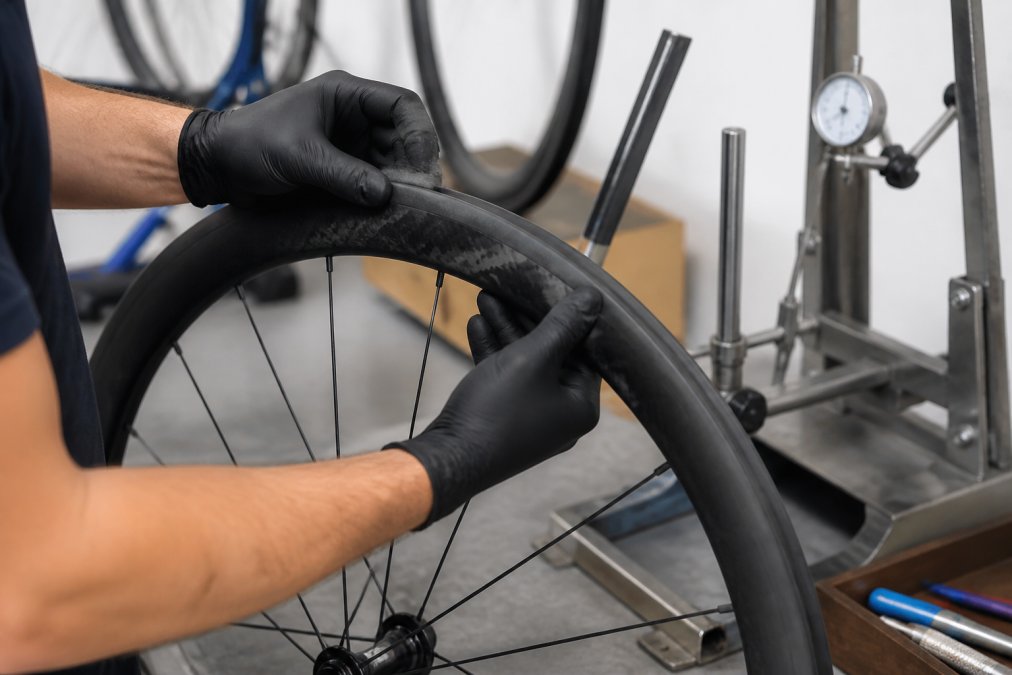
An alloy rim that takes a hit usually dents or bends, and a shop can often true it back. A carbon rim either survives the impact or cracks, and a crack means replacement. Carbon does hold stiffness for years because composite doesn't fatigue like aluminium, while alloy rims gradually lose tension and go out of true. But repairability is the weak point: few shops repair cracked carbon, while alloy bends are routine fixes. If rock strikes are common where you ride, factor that in.
Alloy vs Carbon MTB Wheels: Which Handles Aggressive Terrain?
For aggressive mountain biking, alloy vs carbon MTB wheels is closer than road riders assume. The deciding factor is not weight, it's how each material manages impact energy across the terrain you actually ride.
An alloy rim is ductile: hit a square-edge rock and it dents, folds, or bends, but usually stays rideable and can often be trued back. A carbon rim is brittle in the same scenario: it either absorbs the hit or cracks, and a crack means replacement. That single difference drives most of the MTB decision.
Where carbon wins on trail:
Carbon Spoked 5031 (1281 grams) →
- Lateral stiffness under cornering. A stiffer rear wheel tracks more predictably when you're loading the tyre hard through a berm or off-camber root section. Alloy flexes more, which can feel vague at speed.
- Rotational mass on climbs and accelerations. Trimming rim weight helps most when you're repeatedly accelerating out of tight switchbacks or technical climbs.
- Fatigue life. Carbon composite doesn't fatigue like aluminium, so a well-built carbon rim holds stiffness and trueness over seasons of hard use.
Where alloy wins on trail:
- Rock strikes. On rocky descents, alloy's ability to bend rather than crack is a genuine advantage. A dented alloy rim often gets you home; a cracked carbon rim usually doesn't.
- Cheap repairs. A bent alloy rim can often be straightened, and replacement rims are inexpensive. Cracked carbon is rarely repaired and almost always replaced.
- Cost of abuse. If you're learning, racing enduro on a budget, or riding terrain that punishes wheels, alloy's lower replacement cost changes the maths.
Rim profile and tyre pressure interact with all of this. A wider internal rim bed lets you run lower tyre pressure without burping, and lower pressure lets the tyre absorb more impact before it reaches the rim.
A practical way to decide:
- Cross-country racing and fast trail riding where you're chasing weight and stiffness: carbon is the sensible pick.
- Aggressive trail, enduro, and rocky descents where rock strikes are routine and cheap repairs matter: alloy is often the smarter long-term choice.
- Mixed use where you want one wheelset to do everything: a well-built carbon rim with crash replacement cover is a reasonable compromise, provided you accept that a bad hit means replacement rather than repair.
The Benefits of Hand-Built Carbon Wheels
The benefits of hand-built carbon wheels come down to build quality. A factory wheel is assembled to a tolerance; a hand-built wheel is assembled to a standard.
Cost, Repairability and Long-Term Value
Cost is where alloy keeps a firm grip. A quality alloy wheelset costs a fraction of a carbon one, and a bent alloy rim is cheap to replace. But the real question is cost per season of use, which depends on repairability and fatigue life.
| Wheelset | Weight | Price | Best For |
|---|---|---|---|
| Carbon Spoked 5031 | 1281g | Enquire | All-round road, climbing |
| SL 5031 | 1428g | $1,990 | Aero road, climbing |
| MTB XC / AM 29er | Not listed | $1,890 | XC and all-mountain |
| 45 FWT Wide GWR | 1160g | $2,600 | Wide-tyre gravel and road |
| Wave CS 4565 | 1420g | $2,200 | Racing, crosswind stability |
A simple way to decide:
- If you race or ride serious distances and can accept that a bad impact means replacement, carbon's stiffness-to-weight ratio, fatigue life, and resale value justify the price.
- If you commute, train in all weathers, and want cheap repairs, alloy is the better value, lower upfront cost, cheap replacement rims, and easier recycling at end of life.
- If you're on the fence, weigh the cost of one cracked carbon rim against the cost of a season of alloy truing, and factor in whether your wheelset carries crash replacement cover.
Frequently Asked Questions
Do carbon rims make a difference?
Yes, mainly in weight, stiffness and aerodynamics. A carbon rim can be built with a deeper aerodynamic profile at a lower weight than alloy, and the stiffness-to-weight ratio is higher, so acceleration and cornering support improve. The trade-off is cost and impact behaviour: carbon can crack where alloy would bend. Whether you feel the difference depends on your riding, your terrain and your current wheelset.
Which is better for durability: alloy or carbon rims?
They fail differently rather than one simply outlasting the other. Alloy rims bend and dent, which you can often true out or ride home on. Carbon rims resist bending but can crack under a hard impact, and a cracked rim is a replacement. Carbon wheelset durability depends on the layup, resin and build quality, so a well-made carbon rim can last many seasons while a cheap one may not.
How long can I expect carbon rims to last compared to alloy?
There is no fixed lifespan for either. Alloy rims wear at the brake track and fatigue over time, while carbon rims are more likely to be taken out by a single hard impact than by gradual wear. Fatigue life in carbon depends on the layup schedule and resin matrix, and a hand-built wheel with uniform spoke tension spreads load more evenly, which supports a longer service life.
Are carbon rims worth the extra cost for mountain biking?
For aggressive terrain, the case is strongest when the rim is designed for it. The MTB XC / AM 29er wheelset from STOXbyHand uses a 2.8mm asymmetric offset to balance spoke tension, which increases rigidity and durability, and it is priced at $1,890 with a 2-year manufacturing warranty and 50% crash replacement. If you mostly ride smooth trails, alloy remains the cheaper and more forgiving option.
Do carbon rims provide a noticeable weight advantage?
They can, and rotational mass matters more than total weight because it affects acceleration. A carbon wheelset such as the Carbon Spoked 5031 comes in at 1281 grams, with a 20/20 spoke count at roughly 1280 grams and a 21/24 count at roughly 1350 grams. Lighter rims spin up faster, though a wheel that is too light can lose inertia on flat terrain, which is why build choice matters as much as the material.