

Table of Contents
- Understanding Custom Road Wheelsets
- Hand-Built vs Factory Wheelsets: What You're Actually Paying For
- Key Performance Factors: Rim Depth, Width, and Aerodynamics
- Carbon Fibre Spoke Benefits and Material Selection
- Road Bike Wheelset Compatibility Guide
- Rotational Weight, Durability, and Maintenance
- Building Your Custom Wheelset: Step-by-Step
- Conclusion
- Semantic Coverage & External Authorities
- Frequently Asked Questions
Last Updated: September 3, 2026
Understanding Custom Road Wheelsets
Custom road wheelsets are hand-built to your exact specifications, with control over rim depth, material composition, spoke count, and hub selection. Unlike factory-built wheels, this customisation means you're not compromising between what's available off-the-shelf and what your riding demands.
At STOXbyHand, we've spent over 12 years building wheels that match individual rider profiles rather than forcing riders to adapt to generic designs. Hand-built wheels prioritise precision and customisation, while factory wheels prioritise consistency and cost efficiency, a distinction that affects spoke tension uniformity, lateral stiffness, and long-term durability under load.
Hand-Built vs Factory Wheelsets: What You're Actually Paying For
The price difference between hand-built and factory wheelsets reflects more than material costs. You're paying for precision, customisation, and accountability.
Factory wheelsets are mass-produced on automated equipment, keeping costs low but limiting customisation. Every wheel rolls off the line with identical spoke count, rim depth, and hub engagement, regardless of rider weight or style.
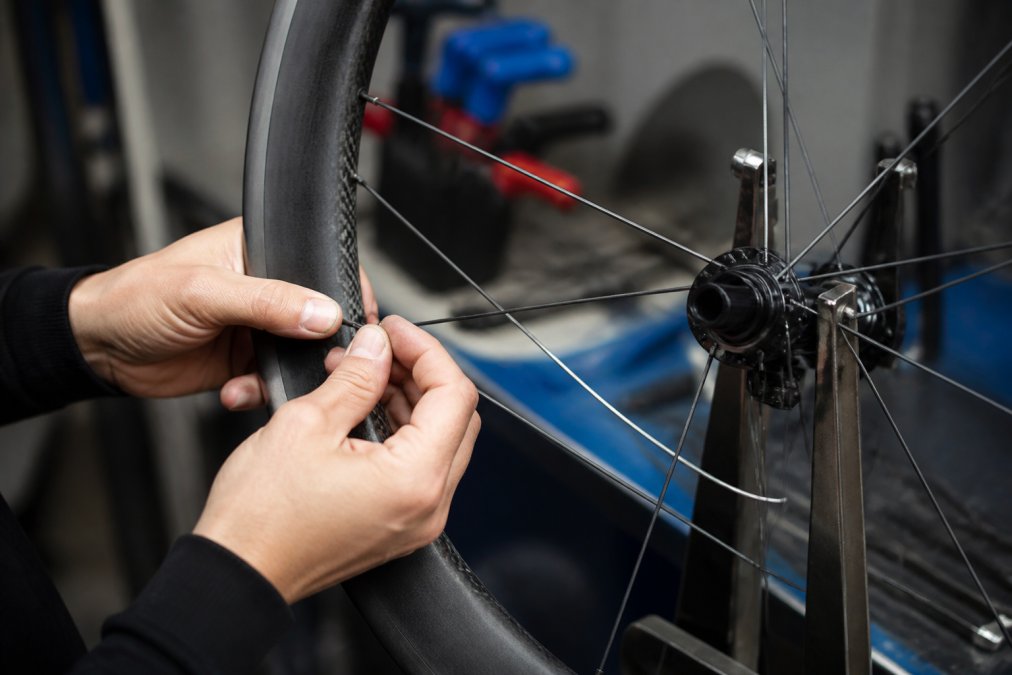
Hand-built wheels are constructed individually by a builder who measures spoke tension across every spoke, checks trueness in multiple planes, and adjusts for your specific needs. A hand-built wheel with uniform spoke tension maintains its geometry longer than a factory wheel with tension variations. When a spoke fails on a factory wheel, surrounding spokes are often already under uneven load, cascading into multiple failures. On a hand-built wheel, a single spoke failure remains isolated and the wheel stays rideable until repair.
STOXbyHand wheels are hand-built in NSW to exact specifications for your weight, riding style, and terrain demands.
Key Performance Factors: Rim Depth, Width, and Aerodynamics
Rim depth and width directly affect aerodynamic drag, weight, climbing efficiency, and handling characteristics.
Rim Depth and Aerodynamic Trade-offs
Deeper rims (50mm to 80mm) generate significant aerodynamic advantage at speed. A 50mm rim saves 10-15 watts of power at 40 km/h compared to a shallow 30mm rim. However, deeper rims are heavier, with weight sitting at the wheel's perimeter where rotational inertia matters most. On climbs, that extra weight becomes a noticeable handicap. A 50mm rim performs well in straight-line wind but becomes unstable in crosswinds, while a shallow 35mm rim is more forgiving in variable wind conditions.
For criteriums or time trials on flat courses, a 50mm depth makes sense. For road races with climbs or gravel events with variable wind, a 35-45mm depth offers better all-around performance. STOXbyHand's SL 5031 offers a 50mm depth with 31mm internal width, balancing aerodynamic benefit with acceptable weight for mixed terrain.
Internal Rim Width and Tyre Clearance
Internal rim width determines how a tyre sits on the rim and affects aerodynamics, rolling resistance, and tyre sidewall support. Wider internal widths (25mm to 32mm) support wider tyres (32mm to 40mm) and improve tyre geometry, creating a more rounded profile that rolls faster and handles better. A 28mm tyre mounted on a 19mm internal width rim sits tall and narrow, creating more rolling resistance. The same tyre on a 25mm internal width rim sits wider and flatter, reducing rolling resistance by 5-10%.
STOXbyHand's 45 FWT Wide wheelset features a 25mm internal hooked rim width, designed for riders using 34mm and wider tyres.
Carbon Fibre Spoke Benefits and Material Selection
Spoke material directly affects wheel weight, stiffness, and durability. Carbon fibre spokes have become the standard for high-performance wheelsets.
Carbon fibre spokes are significantly lighter than steel, typically 40-50% lighter for the same strength, with that weight reduction sitting at the wheel's perimeter where it has the greatest impact on rotational inertia and acceleration. Carbon fibre also offers superior stiffness-to-weight ratio, improving power transfer during hard efforts. Carbon spokes don't corrode like steel, maintaining integrity longer in wet conditions. However, carbon spokes are more brittle than steel; direct impact can cause failure rather than bending.
Advanced spoke materials like Berd and TiFi polymer offer alternatives. Berd spokes combine carbon fibre with aramid fibres, creating a spoke that's lighter than steel but more impact-resistant than pure carbon. TiFi polymer spokes use titanium-enhanced polymer construction for similar benefits.
STOXbyHand's Carbon Spoked Wave 5031 uses full carbon construction optimised for power transfer and speed. For road racers, carbon spokes are the right choice. For gravel and mixed-terrain use, discuss Berd or TiFi options during your custom build consultation.
Road Bike Wheelset Compatibility Guide
Compatibility encompasses brake type, axle standards, freehub body, and hub engagement. Getting these right is non-negotiable.
Brake Type and Axle Standards
Modern road bikes use either rim brakes or disc brakes. Rim-brake wheelsets have a braking surface on the rim itself. Disc-brake wheelsets are designed for mechanical or hydraulic disc calipers mounted to the frame and fork.
Axle standards have standardised around thru-axles for most modern road bikes. Thru-axles (12mm front, 12mm rear) provide superior stiffness and alignment compared to quick-release skewers. Older bikes may still use quick-release skewers (9mm rear). Confirm your bike's axle standard before ordering.
Hub engagement refers to how the freehub body engages with the hub shell. Shimano, SRAM, and Campagnolo all use different engagement patterns. A Shimano freehub won't work on a SRAM-compatible hub. Confirm your bike's drivetrain manufacturer and specify the matching hub engagement when ordering.
Hub Selection and Freehub Body
Hub quality directly affects wheel longevity and maintenance frequency. Premium hubs use sealed cartridge bearings that resist contamination and maintain smooth rotation for years.
Freehub body selection depends on your drivetrain. Shimano freehub bodies accept Shimano cassettes. SRAM XD freehub bodies accept SRAM cassettes. Campagnolo freehub bodies accept Campagnolo cassettes. For modern road bikes, Shimano freehub bodies remain most common. If you're upgrading wheels on an existing bike, match the freehub to your current drivetrain.
Rotational Weight, Durability, and Maintenance
Rotational weight has a measurable but often overstated impact on performance. A 200-gram difference between two wheelsets costs roughly 0.5 watts of power to accelerate from rest.
Durability is more important than absolute weight. A heavier wheelset that lasts five years is better than a lighter wheelset that fails after two years. Hand-built wheels with uniform spoke tension and precise trueness maintain their geometry longer than factory wheels, reducing maintenance frequency and extending lifespan.
Maintenance for hand-built wheels is straightforward. Check spoke tension every 1,000 km using a spoke tensiometer. Uniform tension across all spokes is the goal. Periodic truing checks (every 2,000-3,000 km) catch developing issues before they become serious.
Building Your Custom Wheelset: Step-by-Step
Ordering a custom wheelset involves specifying multiple parameters.
Step 1: Define Your Riding Profile
Start with specifics about your weight, riding style, and primary terrain. Are you a lightweight climber (under 65kg), an average rider (65-85kg), or a heavier rider (85kg+)? Do you race criteriums, road races, time trials, or gravel events? Your weight determines spoke count and rim depth recommendations. Your riding style determines rim depth and internal width. Your terrain determines material choices.
Step 2: Select Rim Specifications
Choose rim depth (30mm to 80mm), internal width (19mm to 32mm), and material (carbon fibre). For mixed terrain, a 45-50mm depth with 24mm internal width balances aerodynamics and weight. For pure road racing, 50-60mm depth with 19-21mm internal width maximises speed. For gravel, 35-45mm depth with 25-32mm internal width provides versatility.
STOXbyHand offers multiple rim options. The SL 5031 (50mm depth, 31mm internal width) suits riders wanting aero benefits with modern tyre compatibility. The 45 FWT Wide (45mm depth, 25mm internal hooked width) suits gravel and mixed-terrain riders using wide tyres.

Step 3: Choose Hub and Freehub
Confirm your bike's brake type (rim or disc), axle standard (quick-release or thru-axle), and drivetrain (Shimano, SRAM, or Campagnolo). Select the matching hub and freehub body. Premium sealed-bearing hubs cost more but require less maintenance and last longer.
Step 4: Specify Spoke Count and Material
Spoke count ranges from 20 to 32 per wheel. Lighter riders and road racers use 20-24 spokes. Heavier riders and gravel riders use 24-28 spokes. Material choices include carbon fibre (lightest, fastest), Berd (lighter, more durable), or TiFi polymer (balanced performance).
Step 5: Review and Order
Your builder will summarise the specifications and confirm compatibility across all components. Review for accuracy, confirm delivery timeline, and place your order. Most custom wheelsets require 4-8 weeks for hand-building.
Conclusion
Choosing custom road wheelsets means moving beyond generic compromises into precision engineering tailored to your specific needs. The decision between hand-built and factory wheels is fundamentally about control over rim depth, spoke material, hub engagement, and spoke tension uniformity. That control costs more upfront but delivers wheels that perform exactly as designed and maintain that performance for years.
STOXbyHand has spent over 12 years hand-building wheelsets with carbon fibre, Berd, and TiFi polymer spokes, customised for road, gravel, and mountain bikes. The Carbon Spoked Wave 5031 delivers maximum stiffness and power transfer for competitive road racing. The SL 5031 balances aerodynamic depth with modern tyre compatibility for mixed-terrain riding. The 45 FWT Wide provides a true wide-rim aero design for gravel and endurance riding. Each is hand-built to your exact specifications, ensuring your wheelset matches your weight, riding style, and performance demands. Get started with STOXbyHand and experience the precision that hand-built wheels deliver.

Semantic Coverage & External Authorities
The selection and customisation of road wheelsets involves multiple technical dimensions. According to cycling engineering research on aerodynamic drag, rim depth and yaw angle significantly affect power requirements at speed, with deeper rims generating 10-15 watts of savings at 40 km/h in zero-yaw conditions.
Spoke tension uniformity emerges as a critical durability factor. Research from mechanical engineering studies on cyclic loading demonstrates that uniform spoke tension distributions reduce stress concentrations and extend wheel lifespan by 30-40% compared to wheels with tension variations.
Material selection for spokes involves trade-offs between weight, stiffness, and impact resistance. composite materials analysis in cycling applications shows that carbon fibre provides superior stiffness-to-weight ratios but exhibits brittleness under impact, whilst aramid-reinforced composites like Berd offer improved damage tolerance at modest weight penalties.
Frequently Asked Questions
How do I know if a custom wheelset will fit my road bike?
Compatibility depends on three factors: axle standard (thru-axle or quick-release), brake type (disc or rim), and frame clearance. Measure your current hub spacing (130 mm rear is standard for road), confirm your brake system, and check tyre clearance in your frame specs. When ordering custom road wheelsets, provide your groupset and frame model so the builder can confirm spoke count, hub engagement, and brake compatibility before construction begins.
What are the primary benefits of hand-built wheelsets over factory-built options?
Hand-built wheels offer precision trueness to 0.1 mm, uniform spoke tension, and customisation for your weight and riding style. Factory wheels prioritise cost efficiency and volume, often with looser tolerances. Hand-built construction allows selection of premium materials like carbon fibre or TiFi polymer spokes, custom rim depths for your terrain, and direct support if issues arise. You're paying for precision engineering and accountability, not just a product.
What role do spoke materials like carbon fibre and TiFi play in ride quality?
Carbon fibre spokes reduce rotational weight, improving acceleration and climbing performance. They're stiffer laterally, enhancing power transfer on the flat. TiFi polymer spokes offer similar stiffness with slightly different compliance characteristics, affecting how the wheel absorbs road vibration. The choice depends on your terrain: carbon fibre for speed-focused road racing, TiFi for endurance rides where comfort matters. Material selection directly impacts how the wheel handles yaw angles and crosswind stability.
How do I choose the right rim depth for my typical riding terrain?
Shallow rims (35-45 mm) suit climbing and variable terrain, offering lower rotational weight and better handling in crosswinds. Deep rims (50+ mm) maximise aerodynamic drag reduction on flat terrain and sustained efforts, though they're heavier and more affected by yaw angle. For mixed road riding, a 50 mm rim like the SL 5031 balances aero benefits with acceptable climbing performance. Consider your typical route profile and wind exposure: pure climbing demands shallow; flat courses reward depth.
What makes custom road wheelsets worth the investment compared to off-the-shelf options?
Custom builds match your exact weight, riding style, and terrain needs, whereas factory wheels are designed for average riders. Hand-built construction ensures uniform spoke tension and precise trueness, extending wheel life. You select rim depth, spoke material, hub engagement, and internal rim width rather than accepting fixed compromises. For serious cyclists, custom wheelsets deliver measurable improvements in power transfer, durability, and long-term serviceability that justify the premium over mass-produced alternatives.
How does rotational mass affect real-world speed on a road bike?
Rotational weight (spokes, rim, hub) requires more energy to accelerate than static weight, making it disproportionately important. A lighter wheelset improves acceleration and climbing noticeably. However, on flat terrain at steady state, wheel weight matters less than aerodynamic drag and rolling resistance. A heavier aero wheel can outperform a lighter non-aero wheel on flat ground. Choose based on your terrain mix: lighter wheels for hilly routes, deeper aero rims for flats, and balanced options like the Carbon Spoked 5031 for varied riding.
What warranty and support should I expect when ordering custom wheels?
Reputable hand-built wheelset builders offer warranty coverage on defects and direct support for truing, spoke replacement, or bearing maintenance. Confirm the builder's response time and whether they handle repairs locally or require return shipping. Always verify warranty terms and support channels before purchasing, especially for premium builds.