

Table of Contents
- What to Look for in a Custom Wheel Builder
- Hand Built vs Factory Wheelsets: Why It Matters
- Red Flags and Vetting Checklist for Remote Builders
- How Much Does Custom Wheel Building Cost
- Choosing Spokes for Custom Wheels
- Warranty, Support, and Post-Build Break-In
- Component Compatibility and Fitment Guide
- Frequently Asked Questions
Last Updated: September 26, 2026
Finding reliable custom wheel builders requires knowing what separates precision craftsmanship from mass production. At STOXbyHand, we've spent over 12 years hand-building carbon fibre wheelsets for competitive cyclists. This guide walks you through how to evaluate a custom wheel builder, what questions to ask, and the red flags to watch for.
What to Look for in a Custom Wheel Builder
A good wheel builder combines precision, material knowledge, and time investment. The difference between a wheel that holds true for years and one that fails after a few rides comes down to these factors.
Years of Experience and Precision Standards
Experience matters because wheel building isn't forgiving.
Ask builders directly: "What's your trueness tolerance?" The best builders work to 0.1mm or tighter. If they don't have a number, that's a red flag.
Look for builders who:
- Can specify their trueness tolerance (aim for 0.1mm or better)
- Can explain their build process in detail
- Offer a warranty on manufacturing defects
Material Knowledge and Spoke Options
A builder who only offers steel spokes is limiting your options. The best builders understand carbon fibre, Berd polymer, and TiFi polymer spokes and can recommend the right one for your riding style.
Custom wheel builders worth hiring will ask about your riding style, weight, terrain, and priorities (speed, comfort, durability), then recommend spokes based on your answers, not inventory.
Questions to ask about materials:
- What spoke options do you offer?
- Which spoke would you recommend for my riding style?
- Why would you choose that spoke over the alternatives?
- What's the weight difference between options?
Hand Built vs Factory Wheelsets: Why It Matters
The difference between a hand-built wheel and a factory wheelset isn't just craftsmanship, it's precision, customisation, and durability.
Truing Precision and Spoke Tension
Hand-built advantages:
- Trueness tolerance of 0.1mm or better
- Uniform spoke tension across all spokes
- Adjustment for individual rider weight and riding style
- Immediate fixes if something isn't right
Customisation and Component Selection
Factory wheelsets are designed for average riders; hand-built wheelsets are designed for you.
You can specify rim depth, spoke count, spoke material, hub type, brake compatibility, asymmetric profiles, colours, and logos. A builder will dial in exactly what you need.
This matters for heavier riders, aggressive terrain, or specific aerodynamic goals. A factory wheelset is a compromise; a hand-built wheelset is a solution.
Red Flags and Vetting Checklist for Remote Builders
Most custom builders work remotely, so you need to know what to look for before placing an order.
Warning Signs to Avoid
Stop immediately if a builder:
- Won't specify their trueness tolerance
- Doesn't ask questions about your riding style, weight, or terrain
- Offers only one spoke option
- Has no warranty on manufacturing defects
- Can't provide examples of previous builds
- Doesn't respond to emails within 48 hours
- Offers pricing significantly lower than established builders (usually means corners are being cut)
- Won't explain their build process or materials
A builder who rushes you or won't answer questions doesn't care about precision. A good builder will take time to get it right.
Essential Questions Before You Order
Before you commit, ask these questions in writing (email is best so you have a record):
Build process:
- What's your trueness tolerance?
- How long does a build take?
- Do you stress-relieve spokes after building?
- How do you ensure uniform spoke tension?
Materials and customisation:
- What spoke options do you offer?
- Can you explain the differences between them?
- What rim profiles do you stock?
- Can you build asymmetric wheels for rear disc setups?
- What brake compatibility do you support?
Warranty and support:
- What's your warranty on manufacturing defects?
- What happens if a wheel arrives damaged?
- Do you offer crash replacement?
- How long is your turnaround time?
- How do I contact you if something goes wrong after delivery?
Clear, detailed answers signal a trustworthy builder; deflection or vague answers signal someone to avoid.
| Question | Why It Matters | Red Flag if Answer is |
|---|---|---|
| Trueness tolerance? | Precision determines how long the wheel stays true | "I don't measure it" or vague answer |
| Stress relief process? | Prevents spokes from loosening over time | No mention of stress relief |
| Warranty details? | Protects you if something fails | "No warranty" or very limited coverage |
| Turnaround time? | Tells you if they're rushed or careful | Less than 5 days (usually means corners cut) |
| Spoke tension method? | Ensures uniform build quality | "We use a machine" or vague process |
How Much Does Custom Wheel Building Cost
Understanding what drives custom wheel pricing helps you evaluate whether a builder's pricing is fair.
45 FWT Wide Carbon Spoked GWR (1160 →
What Affects Pricing
Rim choice is the biggest variable. Carbon fibre rims cost more than alloy; deeper rims cost more; asymmetric rims cost more due to engineering.
Spoke material affects price significantly. Steel is cheapest; carbon fibre costs more; Berd and TiFi polymers are premium due to manufacturing cost and build skill required.
Hub choice matters too. A basic alloy hub costs less than a high-end hub with ceramic bearings or a high-engagement ratchet system.
Labour time is the final factor. Builders working to 0.1mm tolerance take longer than those at 0.5mm tolerance, and that extra time costs money.
Hand-built wheelsets typically cost $2,400-$3,000.
The price difference reflects precision, customisation, and durability.
Choosing Spokes for Custom Wheels
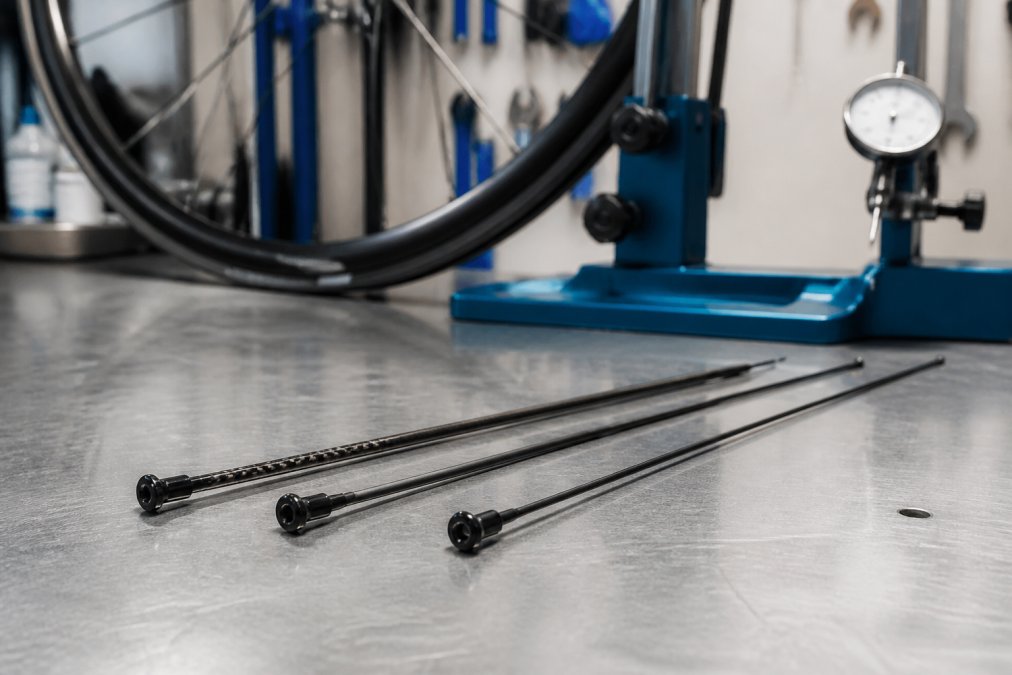
Spoke choice is one of the most important decisions in a custom build. Different materials offer different trade-offs between weight, stiffness, vibration damping, and durability.
Carbon Fibre, Berd, and TiFi Polymer Compared
Carbon fibre spokes are the lightest option. They're stiff, which means they transfer power efficiently. They're best for riders who prioritise speed on smooth surfaces. The downside is that they don't damp vibrations as well as other materials, so the ride can feel harsh on rough roads.
Berd spokes use ultra-high-molecular-weight polyethylene (the same material used in ballistic body armour). They're lighter than steel spokes and significantly more durable. They damp vibrations better than carbon fibre, which means a smoother ride. They're impervious to corrosion, so they last longer in wet conditions. Berd spokes are best for gravel riders and cyclists who ride in variable conditions.
TiFi polymer spokes combine titanium and aramid fibres. They're the lightest spoke option available (2.2 grams each). They offer the most elasticity of any spoke material, which means maximum vibration damping. They reduce vibrations by around 15% compared to steel and 29% compared to carbon fibre spokes. TiFi spokes are best for riders who want the smoothest ride possible and are willing to pay premium pricing for it.
| Spoke Material | Weight | Vibration Damping | Durability | Best For | Relative Cost |
|---|---|---|---|---|---|
| Carbon Fibre | Standard | ||||
| Berd Polymer | Higher | ||||
| TiFi Polymer | Premium |
Spoke Count and Lacing Patterns
Spoke count affects stiffness and weight. A 32-spoke wheel is stiffer than a 28-spoke wheel. A 36-spoke wheel is stiffer than a 32-spoke wheel. More spokes mean more weight but more stiffness and durability.
For road bikes, 28 or 32 spokes is standard. For gravel bikes and heavier riders, 32 or 36 spokes is better. For mountain bikes, 32 or 36 spokes is typical.
Lacing pattern also affects stiffness. A radial lacing (spokes go straight from hub to rim) is lighter and more aerodynamic but less stiff. A 2-cross or 3-cross lacing (spokes cross two or three other spokes) is stiffer and more durable. Most custom builders use 2-cross for road bikes and 3-cross for gravel and mountain bikes.
Ask your builder which spoke count and lacing pattern they recommend for your weight, riding style, and terrain.
Warranty, Support, and Post-Build Break-In
A good warranty protects you if something goes wrong. A good builder also supports you after delivery.
Ask about the break-in period.
Component Compatibility and Fitment Guide
Brake type: Disc or rim brake? Your builder needs to know. Disc brake wheels require specific hub specifications.
Frequently Asked Questions
What qualifications should a professional custom wheel builder have?
Look for builders who demonstrate knowledge of spoke tension, lacing patterns, and truing to 0.1mm precision or better. Ask for examples of their work. Experienced builders understand hub engagement, rim profiles, and how different materials like carbon fibre, Berd, and TiFi polymer affect ride quality and durability. Verify they've worked with your specific riding discipline, whether road, gravel, or mountain.
How does hand-built wheel quality compare to factory-built wheels?
Hand-built wheels offer precision that factory production often cannot match. A skilled builder can achieve uniform spoke tension across the entire wheel and true it to 0.1mm runout both laterally and radially. This precision extends wheel life and improves ride quality. Custom builders also select components specifically for your weight, riding style, and terrain, whereas factory wheels are mass-produced for generic use. The trade-off is longer turnaround times and higher cost.
What should I ask a wheel builder before commissioning a set?
Ask about their experience with your specific rim and hub combination, their truing tolerance, and whether they stress-relieve spokes to prevent fatigue. Request their warranty terms, crash replacement policy, and typical turnaround time. Clarify component compatibility: ask if the wheel is compatible with your thru-axle or quick-release setup. For remote builders, confirm their communication process, how they handle issues, and whether they offer rebuild or truing services after delivery.
How much does custom wheel building cost, and what affects the price?
Custom wheel building costs vary based on rim depth, spoke material, and hub choice. Hand-built carbon wheelsets typically range from $2,400-$3,000+. Factors affecting price include rim construction method (filament wound rims cost more than standard), spoke material (carbon fibre, Berd polymer, and TiFi polymer each command different prices), hub flanging for increased lateral stiffness, and labour intensity. Asymmetric rim profiles and specialist spoke options like Berd, which requires lower maximum tension and better spoke balance, add to the cost but improve durability and comfort. Premium pricing reflects precision engineering, material quality, and the builder's experience.