

Table of Contents
- Why Handbuilt Bike Wheels Are Stronger
- Machine Built vs Hand Built Wheels: The Real Difference
- Spoke Tension and Wheel Durability: The Core of Wheel Strength
- Hand Built Carbon Wheels for Heavy Riders
- Wheel Failure Analysis: What Actually Breaks and Why
- The Impact of Modern E-Bike Torque on Wheel Strength
- Frequently Asked Questions
Last Updated: September 30, 2026
Why Handbuilt Bike Wheels Are Stronger
A handbuilt wheel is stronger because a human builder controls spoke tension individually, balances it across the whole wheel, and stress-relieves the finished build. Machines lace and tension fast, but cannot judge tension balance the way a builder can, and that difference decides whether a wheelset survives years of rough terrain or goes out of true within months.
At STOXbyHand, we have spent over 12 years building carbon wheelsets by hand for road, gravel and mountain bike riders. The pattern is consistent: the wheels that last are the ones where every spoke was tensioned and checked by a person, not a preset torque value.
Strength in a bicycle wheel is not about stiffness alone. It is about how evenly load is shared. A wheel with one loose spoke forces its neighbours to carry more load, and that is where cracks and fatigue begin.
Below, we break down what separates a handbuilt wheel from a machine-built one, why spoke tension matters more than rim depth, and how modern e-bike torque has changed what a strong wheel needs to withstand.
Machine Built vs Hand Built Wheels: The Real Difference
The core difference is not the parts, it is the process. Machine-built wheels are laced and tensioned by automated equipment that pulls every spoke to roughly the same target value, then stops. Hand-built wheels are tensioned, checked, corrected and re-checked in cycles until tension is balanced across the whole wheel.
Machines work fast and cheaply, but they cannot feel a spoke that is at the right tension yet seated badly in the nipple, or a rim that pulls unevenly at one eyelet.
A common mistake is assuming identical tension numbers mean an identical wheel. Tension uniformity across the drive side, non-drive side, and around the full circumference is what actually determines durability.
What Machine Tensioning Actually Misses
A machine tensioner applies a preset torque to each nipple in sequence. It has no feedback loop for how that spoke interacts with its neighbours. Three specific problems follow:
Spoke wind-up. When a machine turns a nipple, the spoke blade twists along its length rather than transferring all rotation into linear tension. The gauge reads correct, but the spoke stores torsional energy; once ridden, that twist unwinds and tension drops, often 10-15% on the first ride. Hand builders prevent this by holding the spoke blade while turning the nipple, or by over-turning slightly and backing off to release the twist.
Nipple seating angle. A machine cannot detect whether a nipple sits square in the rim bed. If the spoke hole is drilled at a slight angle, common on deeper carbon rims, the nipple loads the rim wall unevenly, and that concentrated stress becomes a crack initiation site. Hand builders check seating by feel and by watching how the nipple interfaces with the rim during tensioning.
Tension balance across the wheel. A machine tensions each spoke to a target value independently, without measuring whether the drive-side average matches the non-drive side, or whether one quadrant runs 15% tighter than another. A wheel can have every spoke at "correct" tension and still be mechanically unbalanced. Hand builders use a tensometer to map tension around the full circumference and across both sides, then correct until the spread is within ±5% on a quality build.
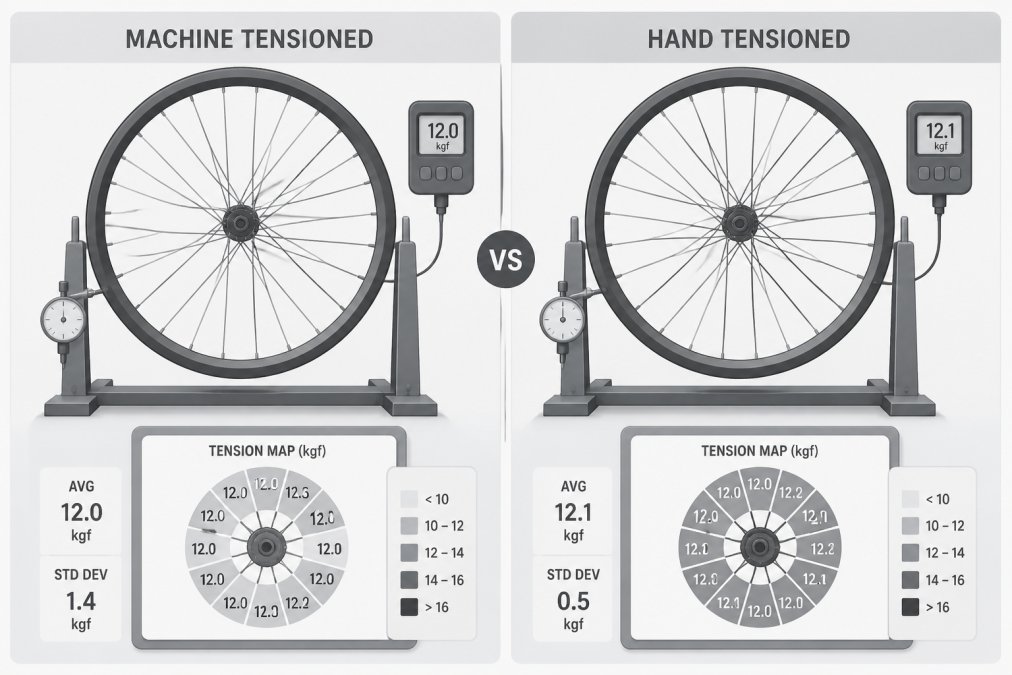
Why Tension Balance Beats Raw Tension
A wheel with one loose spoke forces its neighbours to carry more load, a load path problem, not a metaphor. When a spoke goes slack under load, the rim deflects further at that point, increasing stress on adjacent spokes. Those spokes fatigue faster, lose tension, and the imbalance spreads. That is why a wheel reading "correct" on a machine can still fail prematurely: the machine measured tension, but not balance.
Sheldon Brown's wheelbuilding reference remains one of the clearest explanations of why tension balance, not raw tension, governs how long a wheel stays true. Hand builders use a truing stand and a tensometer to measure both lateral and radial runout, then adjust until the wheel is mechanically consistent before it ever reaches a rider.
Spoke Tension and Wheel Durability: The Core of Wheel Strength
Spoke tension is the single biggest factor in wheel durability because a wheel only stays strong while every spoke carries its share of the load. When tension is uneven, the loosest spokes go slack under load and the tightest take double the stress, the imbalance that causes premature spoke fatigue and rim cracking.
Berd Spoked Asymmetric 46 Gravel →
Stress-Relieving and Fatigue Life
Stress-relieving is the process of loading and unloading the finished wheel so spoke elbows seat properly against the hub flange and residual stresses are released. Skip it, and the wheel loses tension on its first few rides as the spokes settle.
Hand builders stress-relieve by hand, then re-tension. This is why handbuilt wheels hold their tension far longer than machine-built equivalents, and why Park Tool's wheel building guide treats stress-relieving as a mandatory step rather than an optional one.
Hand Built Carbon Wheels for Heavy Riders
For heavier riders, the limiting factor is usually system weight, not rim material. A wheel rated to a maximum system weight will fail predictably above it, no matter how well it is built. The fix is a build specified around the rider's actual weight and terrain, not a stock wheelset.
How Rider Weight Changes the Load Case
A bicycle wheel carries load through tension, not compression. The hub hangs from the spokes above it, and the spokes below go slack under load. As rider weight increases, the slack zone widens: more spokes lose tension on every rotation, so fewer carry the load at any moment. Without enough tension headroom, the slack zone grows until spokes are fully detensioned, and that is when fatigue accelerates.
The Four Variables That Must Change Together
Spoke count. More spokes share the load across more elements, reducing stress on each. A 24-spoke and a 32-spoke wheel can both be strong, but the 32-spoke build tolerates a wider tension spread before any single spoke becomes critically loaded.
Why Stock Wheelsets Fail Heavy Riders
Our TiFi Polymer Spoked Gravel Max build uses a 54mm front and 50mm rear filament-wound carbon rim with TiFi polymer spokes, rated to a 105kg maximum system weight. For riders who need more headroom, the MTB XC / AM 29er uses asymmetric rims with a 2.8mm offset that lifts average spoke tension and balances the non-drive and rotor sides, with a 2-year manufacturing warranty and 50% off retail crash replacement.
| Build | Rim | Spokes | Max System Weight | Price |
|---|---|---|---|---|
| TiFi Polymer Spoked Gravel 45 | 45mm, 32mm internal | TiFi polymer | 105kg | $2,990.00 |
| Berd Spoked Asymmetric 46 | 46mm, 30mm internal | Berd polymer | 110kg | $2,950.00 |
| TiFi Polymer Spoked Gravel Max | 54/50mm | TiFi polymer | 105kg | $3,290.00 |
| MTB XC / AM 29er 30/36 | Asymmetric, 2.8mm offset | Pillar Wing | Not listed | $1,890.00 |
Wheel Failure Analysis: What Actually Breaks and Why
Wheels rarely fail at the rim first. They fail at the spoke elbow, nipple seat or hub flange, almost always from tension imbalance rather than impact. A spoke that runs slack under load flexes at the elbow on every rotation, and that repeated flexing eventually fatigues the metal.

The Impact of Modern E-Bike Torque on Wheel Strength
E-bike torque changes the load case entirely. A mid-drive motor delivers torque through the drivetrain, so the rear wheel sees repeated high-torque pulses on every pedal stroke, not the smoother input of a human leg alone. That cyclic loading accelerates spoke fatigue on any wheel not built with tension balance in mind.
Frequently Asked Questions
What is the difference between machine-built and hand-built bike wheels?
Machine-built wheels are assembled by automated equipment that laces and tensions spokes to a preset average. Hand-built wheels are assembled by a wheelbuilder who adjusts each spoke individually, balances tension across the wheel, and stress-relieves the spokes. This manual process corrects the uneven tension and residual stress that machines leave behind, which is why handbuilt bike wheels resist going out of true and last longer under hard use.
Do handbuilt wheels stay true longer than factory wheels?
Yes, because the wheelbuilder balances spoke tension and stress-relieves the spokes during the build. Machine-built wheels often have uneven tension from spoke to spoke, so the most heavily loaded spokes fatigue faster and the rim gets pulled out of line. When tension is uniform and residual stresses are removed, the wheel holds its shape through potholes, gravel and heavy torque. That durability is the main reason riders choose handbuilt bike wheels for racing and aggressive terrain.
Why does spoke tension consistency matter for wheel strength?
A wheel is only as strong as its most heavily loaded spoke. If tension varies widely, some spokes carry far more load than others and reach their fatigue limit sooner. Consistent tension spreads the load evenly across all spokes, so no single spoke is overworked. This is why wheelbuilders use a tensometer to measure every spoke and adjust until the tension balance is tight, which directly extends spoke fatigue life and protects rim integrity.
Are handbuilt carbon wheels better for heavy riders?
They can be, because a wheelbuilder can choose a spoke count, spoke gauge and lacing pattern that suits the rider's weight and terrain. Heavier riders benefit from higher spoke count, balanced tension and a rim that is stiff enough to resist lateral flex under load. A custom build also lets the builder set tension uniformity so the wheel handles the extra radial and axial loads without premature spoke fatigue. Off-the-shelf wheels rarely offer that level of tuning.