

Last Updated: October 30, 2026
Quick Summary
Asymmetrical rims move the spoke holes off-centre so spoke tension is more even between the drive and non-drive sides of a rear wheel, giving better balance and stiffness for hard riding. Their drawbacks are higher cost, harder building, and limited benefit on front wheels.
- Asymmetrical rims shift the spoke bed to balance spoke tension on a rear wheel with a wide cassette.
- The MTB XC / AM 29er 30/36 Asymetical wheel uses a 2.8mm offset.
- Asymmetric wheels are usually more expensive and harder to lace than symmetric ones.
- Front wheels need less offset, so the benefit there is smaller.
- Confirm hub spacing, spoke count and rim offset match before ordering.
Table of Contents
- What an Asymmetric Mountain Bike Rim Is
- Asymmetric vs Symmetric MTB Rims: How the Design Differs
- Pros of Asymmetrical Rims: Spoke Balance, Stiffness and Durability
- Cons of Asymmetrical Rims: Cost, Build Complexity and Limits
- Mountain Bike Wheel Dish and Rim Offset: What Matters on the Trail
- Choosing the Best Rim Width for Mountain Biking
- Deciding Whether an Asymmetric Build Suits Your Riding
- Frequently Asked Questions
What an Asymmetric Mountain Bike Rim Is
An asymmetric mountain bike rim is a wheel rim where the spoke holes sit off-centre, so the rim is not evenly balanced left to right. The rim's centre line is shifted toward one side, which changes how the spokes pull on the hub. Asymmetrical rims are built to even out spoke tension between the drive side and the non-drive side of the rear wheel.
Most riders encounter this design in a rear wheel with a cassette on the drive side. The cassette pushes the hub's centre out toward the right side, so the spokes on the left side run at a steeper angle and carry more load. An offset rim moves the spoke bed to compensate.
Asymmetric vs Symmetric MTB Rims: How the Design Differs
A symmetric rim has its spoke holes centred on the rim, so the spokes on both sides meet the hub at similar angles. The result is simple and common. The downside is that a rear hub with a wide drive side can leave the drive-side spokes tighter than the non-drive side, which is the problem an asymmetric rim is designed to fix.
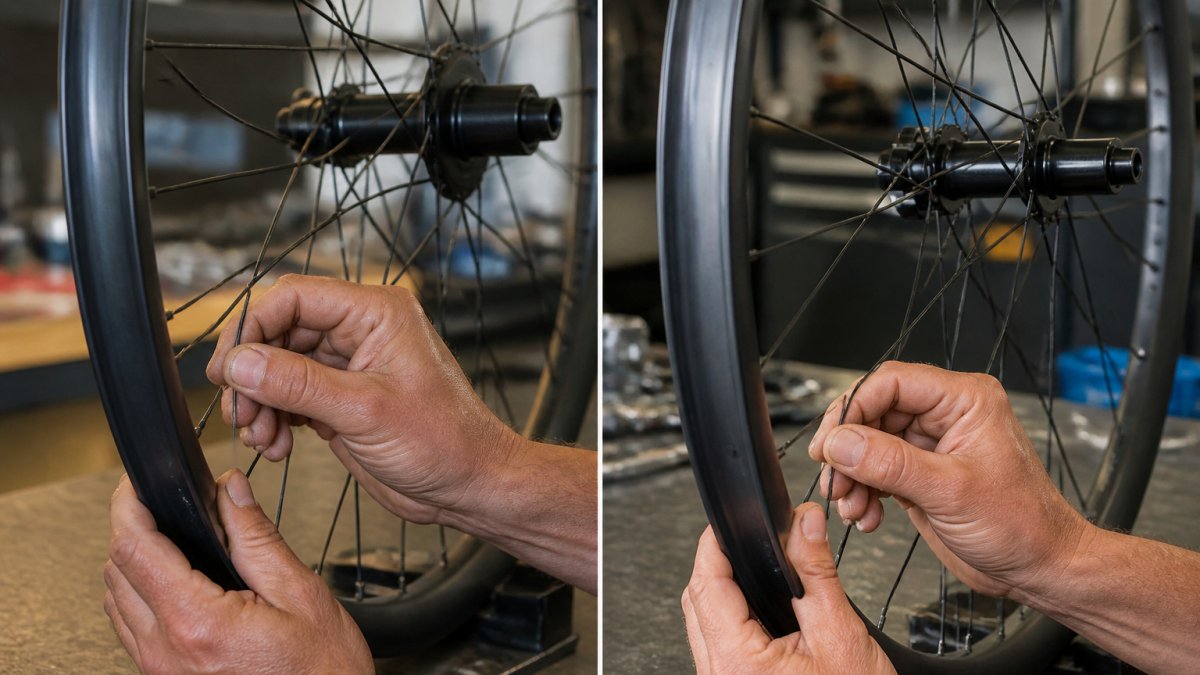
Asymmetric rims move the spoke bed, not the hub. That single change alters the spoke angle and the tension distribution across the wheel. Symmetric rims are easier to source and simpler to build, but they can leave spoke tension uneven on a rear wheel with a wide cassette.
!Rear mountain bike wheel on a workbench with a technician positioning a spoke at the rim
Pros of Asymmetrical Rims: Spoke Balance, Stiffness and Durability
The main advantage is better spoke balance. By shifting the spoke bed, the rim lets the wheel carry a more even load on each side.
The benefits depend on the build quality and the rider. In general, riders can expect:
- More even spoke tension across the wheel
- Better lateral stiffness for aggressive riding
- Potentially longer spoke and rim life when the build is correct
- A stronger rear wheel for trail and enduro use
How Offset Changes Spoke Tension
Offset is the distance the spoke bed is shifted from the rim centre. A larger offset pulls the spoke angles closer together on each side, which can reduce the imbalance between drive and non-drive spokes. See how spoke patterns are chosen for custom wheels to see how offset changes tension in practice. Too much offset, however, can make the wheel harder to true and needs a matching hub.
The MTB XC / AM 29er 30/36 Asymetical wheel uses a 2.8mm offset. Its listing describes the offset as a way to balance spoke tension across the wheel.
A common pattern is that a rear wheel with a wide cassette benefits most from offset because the drive-side flange sits further inboard. Front wheels usually have less dish, so the same offset yields a smaller gain. When comparing rims, check the stated offset against your hub's flange spacing: an offset that is too large for the hub can push the spoke angle past the point where tension balance improves, and it may complicate truing. Optimising these wheel build variables ensures that the chassis remains stable under load, providing a platform that complements the nuanced performance of enduro suspension benefits.
Wheel Strength and Lateral Stiffness
Lateral stiffness is how well a wheel resists side-to-side flex under cornering load. A balanced spoke set helps here, because the wheel is less likely to pull out of true. Wheel strength depends on the rim, spokes, hub and build tension working together.
Whether that difference matters to you depends on how hard you ride and how much weight you carry. A well-built symmetric wheel with careful tensioning can still perform well, so the design is one variable among several.
Cons of Asymmetrical Rims: Cost, Build Complexity and Limits
Asymmetric rims have real trade-offs. The most obvious is cost. Asymmetric wheels are usually more expensive than standard symmetric wheels, and custom builds add labour on top of the parts.
Build complexity is the second issue. Our guide to choosing carbon fibre spokes for mountain bikes covers spoke selection for riders who want to tackle the build themselves. An asymmetric wheel must be laced with the correct offset orientation, and the spoke tension has to be set carefully on each side. A mistake here can leave the wheel out of true or uneven in tension. Riders who want a simple replacement wheel may find a symmetric option easier to source.
Asymmetric rims also have limits. They suit rear wheels with a wide drive side best. Front wheels usually have less need for offset, so the benefit is smaller there. The design does not fix a poorly built wheel, and a cheap asymmetric wheel can perform worse than a well-built symmetric one.
MTB XC / AM 29er 30/36 Asymetical →
Watch out: a rim built for one hub spacing will not balance correctly on another, so always confirm the hub, spoke count and offset match before ordering.
Build and Maintenance Checks That Reveal the Limits
A practical way to judge the trade-offs is to treat the build as a process, not a purchase. Before lacing, confirm the rim's offset direction matches the hub's drive side and that the spoke lengths suit the intended cross pattern. After lacing, check dish with a dish gauge or a truing stand reference, then measure tension on both sides with a calibrated tensiometer. A common pattern is that the non-drive side reads lower; if the gap is large, recheck the offset and hub spacing rather than simply adding tension.
Retensioning after the first few rides is normal as spokes seat. If the wheel goes out of true repeatedly, the cause is often uneven tension or a mismatch between rim offset and hub geometry, not the asymmetric design itself. Keep a record of starting tensions so you can spot drift.
Material and Construction Trade-offs
Aluminium and carbon rims behave differently under the same offset. Aluminium rims are generally more forgiving of minor tension variation and are easier to true; carbon rims can be stiffer and lighter but may demand more careful tension limits and handling. Spoke count also matters: a lower count concentrates load on fewer spokes, so the benefit of balanced tension becomes more important, while a higher count can mask imbalance. Allowable tension is set by the rim maker, so never exceed it to chase balance.
The main trade-offs of asymmetric rims are summarised below.
| Drawback | What it means | Note | | --- | --- | | Cost | Usually more expensive than symmetric wheels | Custom builds add labour on top of parts | | Build complexity | Must be laced with the correct offset orientation | Mistakes leave wheel out of true or uneven in tension | | Sourcing | Simple replacement may be harder | Symmetric options are easier to find | | Limited benefit on front wheels | Front wheels need less offset | Gain is smaller there | | Hub compatibility | Rim must match hub spacing and spoke count | Mismatch causes imbalance and truing problems | | Cheap builds | Poor asymmetric wheel can underperform | Well-built symmetric wheel may be better |
Mountain Bike Wheel Dish and Rim Offset: What Matters on the Trail
Dish is the position of the rim centre relative to the hub flange centre. Rim offset describes how far the spoke bed sits off the rim centre line. The two are related, but they are not the same thing. Dish affects spoke angles on the hub, while rim offset is a property of the rim itself. Our guide to choosing the right spoke count explains how the number of spokes affects wheel strength and balance.
For trail riding, the goal is a wheel where spoke tension is balanced and the rim sits true under load. Riders who ride hard, carry extra weight or run wide cassettes often benefit most from paying attention to dish and offset when choosing a wheel.
Choosing the Best Rim Width for Mountain Biking
Rim width affects tyre shape, traction and the feel of cornering. Wider rims support wider tyres and give a more stable contact patch, while narrower rims suit lighter, faster setups. The right width depends on your tyres and your riding style.
As a starting point, match the rim width to the tyre width recommended by the rim maker. The product listing recommends a tyre range of 2.2 to 3.1 inches for the MTB XC/AM 29er build. Pick a width that fits your riding and your tyre choice, then check the manufacturer's tyre range before you buy.
You can review the MTB XC / AM 29er 30/36 Asymetical wheel on our product page if you have already settled on a width and want a ready-made asymmetrical option.
Deciding Whether an Asymmetric Build Suits Your Riding
Whether an asymmetric build suits you depends on how you ride, how much you spend and how much you want to tune your wheels. Riders who push hard on rough trails, carry extra load or run wide rear cassettes gain the most from balanced spoke tension. Riders who ride gently on smooth trails may not notice much difference.
Consider these questions before you decide:
- Do you ride aggressively or carry extra load?
- Is your rear wheel fitted with a wide cassette?
- Are you comfortable with a more involved custom build?
- Does the extra cost fit your budget?
If you want a wheel built to your riding style, you can compare custom options on our custom wheel guide before committing.
Frequently Asked Questions
Are asymmetric rims worth it?
For most riders who run a rear wheel under heavy load, an asymmetric rim is worth considering because the offset allows spoke tension to be balanced more evenly between the drive side and non-drive side. The trade-off is that asymmetric builds are more expensive and less forgiving if the wheel is later rebuilt with a different hub. If you ride mostly smooth trails at moderate speeds, a symmetric rim may give you the same practical performance for less money.
What is the best rim width for mountain biking?
The best rim width depends on your tyre size and terrain. Wider rims are generally associated with supporting larger tyres at lower pressures and improving traction and cornering stability. Narrower rims are lighter and can be a better fit for fast cross-country riding. Asymmetric rims are available across these widths, so choose the width first and then confirm the offset and spoke pattern match your hub. Tyre manufacturers list a recommended rim width range, which is a useful starting point.
What is the difference between asymmetrical and symmetrical rims?
A symmetrical rim has its spoke holes centred on the rim, so the spokes on each side of the hub meet the rim at the same angle and tension. An asymmetrical rim shifts the spoke bed toward the drive side, which lets the non-drive side spokes run at a steeper, more balanced angle. This reduces the tension difference between the two sides of the wheel. Symmetric rims are simpler to build and service, while asymmetric rims offer better balance and stiffness at the cost of a more specific build.
Can you use an asymmetric rim on the front and rear wheel?
Asymmetric rims are most commonly used on the rear wheel, where the drive side spokes carry the highest load from the cassette and the offset provides the greatest benefit. Front wheels usually do not carry the same drive-side load, so a symmetric rim is often sufficient there. Some riders run asymmetric rims at both ends for consistency, but this is a preference rather than a requirement. Check the hub spacing and dish of each wheel before ordering, since front and rear builds are specified separately.
