

Table of Contents
- Step 1: Why Handbuilt Wheels Outperform Factory Wheelsets
- Step 2: Matching Spoke Count and Tension to Your Riding
- Step 3: Cutting Rotational Weight for Faster Acceleration
- Step 4: Choosing Rim Depth, Width and Tyre Compatibility
- Step 5: Specifying Hand Built Carbon Wheels for Heavy Riders
- Step 6: Road Bike Wheel Upgrades and Before-and-After Gains
- Step 7: Compatibility Checks, Maintenance and Repairability
- Conclusion: Building a Wheelset That Matches Your Riding
- Frequently Asked Questions
Last Updated: October 6, 2026
Step 1: Why Handbuilt Wheels Outperform Factory Wheelsets
Handbuilt wheels improve performance because a builder controls spoke tension, tension balance and trueness far more precisely than a factory line.
This guide from STOXbyHand walks through the seven build decisions that change how a bike rides, and how to specify each for your weight, terrain and style.
Factory wheelsets win on price and convenience but lose on consistency. Machine lacing leaves uneven spoke tension, and uneven tension is where wheels go soft, creak and crack.
Here is what separates the two:
- Tension accuracy: hand tensioning targets a set value per side, not a range
- Tension balance: drive and disc side tensions are matched deliberately
- Trueness: we build to 0.1mm lateral and radial runout
- Stress relief: spokes are bedded in so they do not loosen later
- Repairability: standard spokes and nipples, not proprietary parts
The payoff is a wheel that stays true, holds speed and feels planted.
Step 2: Matching Spoke Count and Tension to Your Riding
Spoke count and tension decide how a wheel carries load.
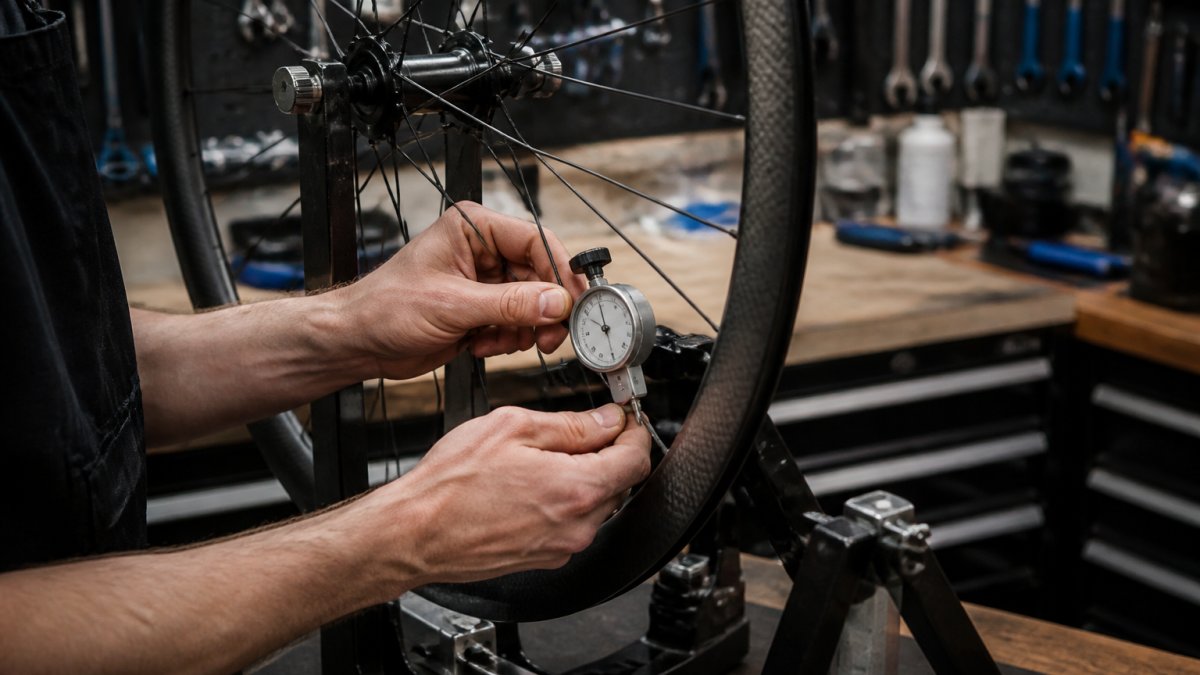
Spoke tension is the force pulling each spoke into the rim, measured in kilogram-force (kgf). Get it wrong and the wheel either feels dead or fails early.
A common mistake is chasing the lowest spoke count for weight.
Riders over 85kg who push hard power need more lateral stiffness, so more rear spokes. Lighter riders can run fewer.
Here is a practical starting framework most builders work from:
| Rider weight | Rear spoke count | Front spoke count | Typical use |
|---|---|---|---|
| Under 65kg | 24 | 20 | Road, climbing |
| 65-85kg | 28 | 24 | Road, all-round |
| 85-100kg | 32 | 28 | Road, gravel, touring |
| Over 100kg | 32-36 | 28-32 | Gravel, touring, e-bike |
These are starting points, not rules.
Lacing Patterns and Tension Balance Explained
Lacing pattern changes how force travels from hub to rim. The three most common are:
- Radial: spokes run straight from hub to rim. Lightest and stiffest laterally, but poor at transmitting drive torque. Front wheels only, or non-drive rear.
- Two-cross: each spoke crosses two others. The standard all-round pattern for rear wheels. Good torque transfer and a comfortable ride.
- Three-cross: each spoke crosses three others. More spoke length means more elasticity and better shock absorption. Common on touring and heavier riders.
Asymmetric rims fix the biggest tension problem in rear wheels. On a symmetric rim, drive and disc side tensions can differ by up to 40% because bracing angles differ; an asymmetric profile evens that out.
This matters most with low-tension spokes. Berd polymer spokes cap at 100kgf, steel at about 120kgf.

Tension targets also depend on the rim. A modern carbon rim with a reinforced spoke bed can take 120-130kgf drive side; a lightweight alloy rim may be rated 100-110kgf.
How to Read a Tension Sheet
A tension sheet is a table of every spoke's measured tension. Check three things:
- Average tension per side, drive side should be higher than non-drive on a rear wheel, but within the rim's rated range.
- Spread, most builders aim for every spoke within plus or minus 5% of the side average. Wider spread means uneven load.
- Balance ratio, on a well-built rear wheel with an asymmetric rim, non-drive tension is usually 60-75% of drive side. On a symmetric rim it can drop to 50-60%.
If a builder cannot supply a tension sheet, ask for the target values and tolerance band. A builder who works to a number will know both.
Step 3: Cutting Rotational Weight for Faster Acceleration
Rotational weight costs you twice: to spin it up and to keep it moving.
This is where spoke material earns its money. Berd spokes use Dyneema, with 15 times the strength-to-weight ratio of steel.

Lighter spokes mean quicker response out of corners and on climbs. They also damp road buzz, so the wheel feels smoother at the same tyre pressure.
But there is a trade-off. Extremely light builds suit smooth surfaces. Rough gravel and hard hits still favour more spokes and higher tension.
Step 4: Choosing Rim Depth, Width and Tyre Compatibility
Rim depth sets the aerodynamic trade. Deeper rims cut drag at speed. Shallower rims feel livelier and handle crosswinds better.
Rim width matters just as much because it changes tyre shape. A wider internal width supports a wider tyre with a rounder profile, improving grip and comfort.
Match these three together:
- Depth: 45-50mm suits road and fast gravel
- Internal width: 24-32mm depending on tyre size
- Tyre size: check the rim's stated minimum before you buy
A 50mm deep, 31mm wide rim optimised for a 30mm tyre is a strong all-round road setup.
Get the match wrong and you lose the aero gain or pinch the tyre. Always check the rim's minimum and maximum tyre sizes first.
Depth: What You Gain and What You Give Up
Depth is a trade between drag and weight, and between speed and control.
| Depth | Best for | Trade-off |
|---|---|---|
| 25-35mm | Climbing, mixed terrain, windy days | Less aero benefit above 35km/h |
| 35-45mm | All-round road, fast gravel | Modest aero gain, still manageable in crosswinds |
| 45-60mm | Flat road, time trial, triathlon | Heavier, more affected by crosswinds |
| 60mm+ | Pure speed on flat courses | Hard to handle in gusty conditions |
The aero benefit of depth grows with speed. Below about 30km/h a shallow rim is often faster and more comfortable because it is lighter and easier to control; above 35km/h deeper rims start to pay back their weight penalty.
Berd Spoked Asymmetric 46 Gravel Wheelset 1260g →
Width: The Number That Changes Everything
Internal rim width matters most for tyre fit: it sets the tyre's actual inflated width and profile.
A useful rule of thumb: the tyre's measured width should be no more than about 105% of the rim's external width, and no less than the rim's stated minimum. Wider makes the tyre bulge and handle poorly; narrower risks it rolling off under load.
Here is a practical compatibility guide:
| Internal rim width | Recommended tyre width |
|---|---|
| 19-21mm | 23-28mm |
| 21-25mm | 25-32mm |
| 25-30mm | 28-45mm |
| 30-35mm | 35-50mm |
These ranges assume tubeless or tubed clincher tyres. Tubular rims follow their own sizing. Always confirm against the rim manufacturer's published chart.
Tubeless, Hooked and Hookless
Most modern handbuilt wheels are tubeless-ready: the rim has a sealed bed and bead lock to hold the tyre without an inner tube.
Hookless rims rely on a straight sidewall and tight tolerances to hold the bead.
Hooked rims have a small lip that mechanically retains the bead. They work with both tubed and tubeless tyres and accept higher pressures. If you are unsure, hooked is the safer choice.
A Note on Tyre Choice
Tyre choice affects performance more than most riders expect. A wider tyre at lower pressure rolls faster on rough surfaces because it deforms less against the road. On smooth tarmac, a narrower tyre at higher pressure still has the edge.
For most riders on mixed surfaces, a 28-32mm tyre on a 25-30mm internal width rim is the sweet spot. It balances rolling resistance, comfort and grip without giving away much aerodynamics.
Step 5: Specifying Hand Built Carbon Wheels for Heavy Riders
Hand built carbon wheels for heavy riders need more spokes, higher tension and a higher system weight rating.
Start with the system weight limit. That is rider plus bike plus gear.
Then choose your spoke count. Heavier riders and strong sprinters should take the higher count.
Finally, confirm the hub and spoke combination suits your power.
At STOXbyHand, we match tension side to side. That is what keeps a heavy rider's wheel true long after a factory set has gone soft.
Step 6: Road Bike Wheel Upgrades and Before-and-After Gains
Road bike wheel upgrades deliver the clearest performance gain per dollar of any component swap. Wheels sit low, spin fast and carry your weight, so changes show up immediately.
To test the gain, measure before and after with the same setup. Keep the same tyres, pressure and route. Then compare.
Track these numbers:
| What to Measure | How to Test | What Good Looks Like |
|---|---|---|
| Acceleration | 0-30km/h sprint, same gear | Faster time, same effort |
| Average speed | Same loop, same power | Higher speed at equal watts |
| Comfort | Same tyre, same pressure | Less vibration, less fatigue |
| Trueness | Check runout after 500km | Still within 0.1mm |
| Tension | Check with a tensiometer | Even, balanced sides |
The comfort gain surprises most riders. TiFi polymer spokes measured with an on-bike 3D accelerometer cut vibration by around 15% versus steel and around 29% versus carbon spokes, a real drop in fatigue over a long ride.
Step 7: Compatibility Checks, Maintenance and Repairability
Compatibility and maintenance decide whether a wheelset lasts years or months. Check these before you order:
Run through this list:
- Axle type and spacing match your frame
- Freehub body suits your groupset
- Brake type matches, disc or rim
- Rotor mount and size are correct
- Tyre width sits inside the rim's range
- System weight limit covers rider plus bike plus gear
- Spare spokes and nipples are available
Repairability is where handbuilt wheels pull ahead again. Standard spokes and nipples mean any good shop can true or rebuild the wheel. Proprietary parts often mean shipping it away.
Maintenance is simple. Check spoke tension and trueness every few months, and after any hard hit. Keep hub bearings clean and replace them when they feel rough.
Conclusion: Building a Wheelset That Matches Your Riding
The gap between a good wheelset and a great one is not the price tag but whether the build matches your weight, terrain and style.
That is exactly what we do at STOXbyHand. We build hand-built carbon wheels with carbon, Berd and TiFi polymer spoke options, customised for road, gravel and mountain riding. Every wheel ships with balanced tension.
Tell us your weight, your terrain and how you ride. We will specify the wheelset that fits, and you will feel the difference on the first climb.
Frequently Asked Questions
How do handbuilt wheels improve cycling performance?
Handbuilt wheels improve performance by giving the builder control over spoke tension, tension balance and trueness. A wheel built with even tension transfers power more efficiently, holds speed better and stays true longer than a machine-built equivalent. The builder can also match spoke count and rim depth to your weight and terrain, so the wheel flexes less under load and rolls with less resistance. The result is faster acceleration, better handling and fewer mid-ride surprises.
Are handbuilt wheels better than factory-built wheelsets?
For most riders chasing performance, yes. Factory wheelsets are built to a price and a tolerance that suits mass production, so tension balance and stress relief are often inconsistent. Handbuilt wheels are tensioned, stress-relieved and trued by hand, which reduces premature spoke fatigue and improves long-term durability. The trade-off is cost and lead time. If you ride hard, carry more weight or race, the extra precision is worth it. If you commute short distances on smooth paths, a stock wheelset may be enough.
What wheel features matter most for heavier riders?
Spoke count, spoke tension and rim stiffness matter most. A heavier rider needs more spokes and higher, more even tension to stop the wheel flexing under load. Asymmetric rims help here because they even out tension between the drive and non-drive sides, which is often where heavy riders see spokes fail first. Look for a build rated to your system weight, with a spoke count of 21/24 or higher on the rear, and a rim that supports the tyre width you actually ride.
How should I maintain handbuilt wheels after upgrading?
Check spoke tension and trueness every 1,000 to 1,500km, or after any big hit. Wipe rims and check brake tracks or disc rotors for wear. If a spoke loses tension, get it corrected before it fatigues neighbouring spokes. Avoid pressure washing hubs, and have bearings inspected annually. A well-maintained handbuilt wheel can be retrued and rebuilt rather than replaced, which is where the long-term value sits compared with a sealed factory wheelset.